The Adventures of Red Sonja

This is a review of The Adventures of Red Sonja Volume 1-3, written by Clair Noto, Roy Thomas, and Bruce Jones with pencils by Frank Thorne and others. These comics were released in the 1970’s from Marvel, and are an offshoot of the Conan universe. This review will focus on the Clair Noto/Roy Thomas material, as I did not care for Mr. Jones’s interpretation of the character.

Does Red Sonja have a character? Yes, she does! She also has a metal bikini, which Mr. Thomas takes credit – or blame – for, depending on your viewpoint. She is a wandering mercenary. She’s depicted as a thief in an issue written by Mr. Jones, but seems mostly to make her living as a sellsword. In one issue, she takes a traveler’s cloak with the promise to return it at the tavern, which a thief wouldn’t do.

Red Sonja is depicted as fearless, competent with a sword, and smarter than your average mercenary. She wins a duel by leaping atop the carcass of a great mammoth. When her heavier foe follows, he sinks into the mammoth like a stone. 

The writers mention in passing that Red Sonja has vowed never to sleep with a man, but don’t go into details. She has two potential love interests. Both are heirs to thrones, and both want to make her their queen. She leaves them without looking back. My impression is that she is a born wanderer.

Red Sonja has a code. She’s not an unstoppable killing machine – which would be boring– but she takes no shit. She doesn’t want to kill you, but if you provoke her she will. Case in point: she becomes a wanderer when a king tries to make her his concubine and ends up with a knife in his throat. In another story, she kills three men who best her in a bar brawl – which she does not start – and steal her money.

Red Sonja is a sword & sorcery comic that alternates between one-shots and multi-part storylines. These issues contain loads of fantasy elements, many of which veer into surrealism. In one story, Sonja is tossed into an enormous clam, and fights her way out armed only with a handful of diamonds. Nothing bizarre about that, right?

In another, she fights a man wearing a mask made of poppies, which lull his victims to sleep. Poppy Man serves a trio of vampires who have transformed his father into an enormous carnivorous plant. We also have insect queens, rocs hatching from tiny eggs crafted by centaurs, and unicorns with regenerating horns. 

The multi-part storylines can be dense plot-wise, with lots of characters coming and going. Plot twists are thrust upon the reader without warning, but that’s part of the fun of reading these comics. Recommended, especially for lovers of fantasy and sword & sorcery comics.
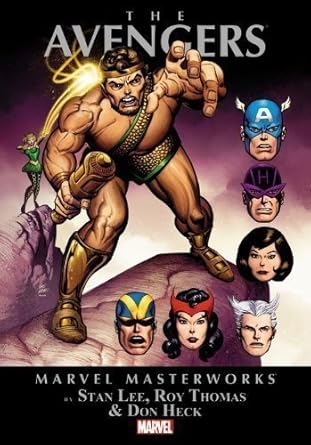
Marvel Masterworks: The Avengers Volume Four

This is a review of Marvel Masterworks: The Avengers Volume Four. See what I thought of the first three volumes here, here, and here. A quick review of the first forty issues of the Avengers –started slow, but got better once the creators started making the team members fight each other more than the villains. Jack Kirby (comic creator) is gone, Stan Lee (writer) is leaving, and Roy Thomas’ (writer) time is upon us.

This volume, the roster expands as Hank Pym – aka Ant Man, aka Goliath, aka Yellowjacket, aka Ultron’s Daddy – and The Wasp rejoin the team. The Greek God Hercules, who at one point we see playing ukulele at a tiki bar, also joins after a mild misunderstanding – Herc tries to kill them all – gets ironed out. Hawkeye wants his girlfriend The Black Widow to join the team, also, and she’d be an interesting addition, but it doesn’t happen because reasons.

The tension between Hawkeye and Captain America is gone, replaced by tension between Goliath and Hawkeye. Goliath is written as a loose cannon. Besides that, he’s sort of a dick. He is also the team’s strong-man, which is weird considering he’s a scientist. What kind of scientist, do you ask? If forced to answer, I would call Pym a physicist, just because the power to grow and shrink seems to be quantum physics. What he has, of course, is a doctorate in handwavium.

The team fights the Sons of the Serpent, a two-issue storyline that today would be an 18 part event. The Living Laser storyline features one of the first realistic depictions of a stalker in comic books I’ve ever seen. There are Ultroids in Bavarian villages and yet another battle with the Sub Mariner, who manages to uncover the Cosmic Cube.

I have a confession to make. Sometimes reading 60’s era Marvel comics (besides Jack Kirby and Steve Ditko) is a real slog, but I look forward to these volumes. After a rough first volume, this series is a must-read. Recommended!

Marvel Masterworks: The Sub-Mariner Volume Two

This is a review of Marvel Masterworks: The Sub-Mariner Volume Two. You can read my review of the first volume, here. Warlord Krang, Namor’s archnemesis from the previous book, only makes a brief appearance. He’s replaced by Daredevil villain The Plunderer, aka Kazar’s Evil Brother, aka The Bad Seed, who wants to conquer the earth by arming his men with VIBRA-GUNS. Namor has a rock dropped on his head and then is buried in an avalanche, while Atlantis is destroyed for the second or third – or maybe the fourth – time. I lost count.

Prince Namor is as gullible and hot-tempered as ever. He has no control over his emotions, declaring war on the surface world in one panel and saving humans from certain death in the next. The meta-story revolves around his never-ending frustration with the surface world. He’s banned from Atlantis because of a stupid misunderstanding, and then leaves his people to fend for themselves after Atlantis is destroyed – when his subjects need him most. This is Namor’s fatal flaw, much like Magneto’s fatal flaw – his narcissism and anger ensure that it will always be about him. Namor must avenge this and wreak vengeance on that, blah blah blah. It’s a very childlike outlook.

The stories are less disjointed, but still way too reliant on coincidence, misunderstandings, and bad luck. The scene where Atlantis is destroyed is worth mentioning. The underwater city is carpet-bombed by a U.S. submarine; earlier, The Plunderer destroys a domed city full of humans. The visuals are striking, and makes me wonder if the creators were influenced by the footage and imagery of the Vietnam War. I don’t know if this is true, btw.

This volume should appeal to Sub-Mariner fans and lovers of obscure characters. Namor is interesting in that he’s a gray character – he’s fought alongside the Fantastic Four as well as Dr. Doom. Another possible draw is Bill Everett – the creator of The Sub-Mariner – doing the pencils and/or inkwork in a few of these issues. All in all, an interesting read about a flawed – but interesting – antihero.

.