Marvel Masterworks: Daredevil Volume Eighteen

This is a review of Marvel Masterworks Daredevil Volume Eighteen, written by Denny O’Neil and drawn by various artists. Read my reviews of Volumes One, Two, and Three here, here, and here. Why, you may ask, did I switch from Volume Three to Volume Eighteen? Well, the third volume of Daredevil was so bad I didn’t want to read the fourth.  It happens, especially with 1960’s Marvel comics. For every classic issue of Spider-Man or The Fantastic Four, you have things like Matt’s imaginary twin brother Mike Murdock, evil landlord The Masked Marauder, and Daredevil trapped in a spaceship blasted into outer space by Electro.  Not all old comics are good.

However, these comics are good! Aside from the art – which is inconsistent – this is a very underrated run. The meat of the volume is Daredevil’s archnemesis Bullseye being shanghaied to Japan by disgraced kamikaze Lord Dark Wind, where his broken bones are replaced with metal implants. Ole Hornhead follows the trail to Japan, where he meets Yuriko, daughter of Lord Dark Wind, who helps him out.

Yuriko has a tattoo on her face, mainly because her father is crazy. After the Daredevil arc, she becomes Lady Deathstrike, courtesy of X-Men scribe Chris Claremont. I guess Claremont rescues her from obscurity, but she goes from a fleshed-out character to a psychotic cybernetic killing machine. Maybe aliens reversed her brain, because now she’s the opposite of how Denny O’Neil wrote her. But such is comics – they giveth, and they taketh away.

This volume also contains a bunch of one-shot issues. My favorite storyline is when Daredevil’s ex Heather Glenn gets drunk and reveals his secret identity at a party. Oopsie. Turns out the guy she spills the beans to is both terminally ill and running a murder squad, which happens. The Black Widow reappears in Matt’s life, and we catch a glimpse of Micah Synn, the Kraven the Hunter wannabe who will make his life miserable in the next volume. And I almost forgot about the guest appearance by Wolverine, everyone’s favorite killing machine!

Not many people recall Denny O’Neil’s Daredevil run, mostly because it’s sandwiched between two Frank Miller runs, but this is good stuff. O’Neil edited Miller’s first Daredevil run, which utilizes serialized storylines – multiple issues featuring recurring characters and a vivid setting – and uses the same techniques himself. Think James Robinson’s Starman and Alan Moore’s Swamp Thing. Recommended, especially for Daredevil fans.

Daredevil Omnibus by Frank Miller and Klaus Janson. Part One.

This is a review of Daredevil Omnibus by Frank Miller (artist/writer) and Klaus Janson (artist/inker), which consists of Frank Miller’s legendary run on Daredevil, from issue #158 – 191. This review covers the first half of the omnibus, from 158 – 175. Wow, that’s a lot of exposition! Are these comics any good? Well, yes, they sure are. Mr. Miller made such an imprint on Daredevil that creative teams have tried – and mostly failed – to imitate this run for years.

Frank Miller’s run began when he took over the art duties for writer Roger McKenzie. The highlights of Mr. McKenzie’s run in this omnibus are a three-issue fight with Bullseye, with the final battle set in Coney Island; and an encounter with the Hulk, which is a homage to the Man Without Fear’s fight with the Sub-Mariner way back in Daredevil #7. When Mr. Miller takes over the writing duties, Daredevil makes a seismic leap in quality. He writes the Black Widow out of the comic and introduces Matt’s crazy ex-girlfriend/assassin Elektra, who was created for one reason, which I will not mention here because spoilers. The stories themselves are shorter, punchier (literally!), and have a harder, grittier edge.

Mr. Miller stretches Daredevil to his limits, beefing up his rogue’s gallery by adding crime boss The Kingpin as the big baddie. In their first encounter, Daredevil dances around the Kingpin like a ballet diva, until the Big Man ends the fight with a single punch to Hornhead’s face. Having your villain be stronger and arguably smarter than your hero is something not many creative teams have the guts to do.

The creative team also puts Daredevil through the emotional wringer. When arch-nemesis Bullseye goes crazy because of a brain tumor and embarks on a killing spree, Daredevil beats the crap out of him in the subway. Bullseye lies unconscious on the tracks, directly in the path of an approaching train. Daredevil saves him because he believes in the law, i.e. that nobody is above the law. This ranks as the single biggest mistake of his crimefighting career, because after the doctor removes the tumor Bullseye goes back to killing people. Is Daredevil responsible? You can argue either way. There’s another reason letting Bullseye live was a mistake, but no need to go into that here.

Normally, I am not crazy about testing a character’s values in this way, because the writer holds all the cards. I believe it was writer Dan Slott who was asked who would win a fight between Hulk and Thor. His answer: whoever the writer wants to win. That being said, the way Mr. Miller tests Daredevil’s belief system is organic and believable. Some would say it is inevitable.

I hated these issues when they came out in the early 1980’s, because I thought the art was ugly. It was different from anything I’d read before, and I had trouble processing. Now I will say that the art is dynamic, emphasizing the human form and giving readers Mr. Miller’s wonderful take on New York City (look at all that grit, kids!). This is one of the best superhero runs of all time, period. Recommended for fans of superhero comics; if you are a Daredevil fan, what are you waiting for?

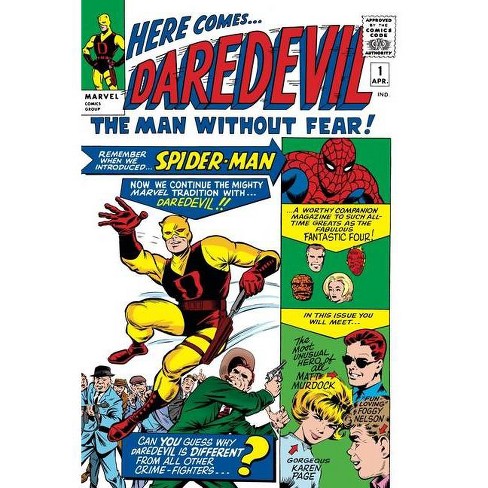
Marvel Masterworks Daredevil: Volume One

This is a review of Marvel Masterworks Daredevil: Volume One. For those not in the know, Daredevil is a masked crimefighter who dresses up in a red devil costume and swings around town on a trick billy club, which he also uses to beat up muggers. Daredevil’s alter ego is Matt Murdock, attorney. His gimmick is enhanced senses – four of his senses are hypercharged and he has a ‘radar sense,’ like a bat. Daredevil got his powers when a barrel of toxic waste hit him in the face, blinding him but enhancing his other senses, thus continuing the Marvel tradition of radiation granting superpowers instead of cancer.

Unfortunately, the first two issues of Daredevil don’t come flying out of the gate. My biggest problem with the first issue is the tone. Reading Spider-Man’s origin story, it’s obvious that Uncle Ben’s death is one of the top three traumatic events in Peter Parker’s life – the other two being Gwen Stacy’s death and the death of his Aunt May, which led to Peter making a deal with the devil and retconning his marriage out of existence.

Or it might be Peter discovering that his arch-nemesis the Green Goblin had sex with the aforementioned Gwen Stacy when she was just a teenager, leading her to give birth to secret twins before the Green Goblin threw her off the Brooklyn Bridge. Years later, those babies grew up to become little Green Goblins who delighted in tormenting a 30-something Peter Parker (in 2023, Peter is now a decade or so younger). Or maybe it was the time Peter grew four more arms, or when he transformed into a lizard-man, or when he smacked his ex-wife in the face. All of which happened. Whatever. The point is, Uncle Ben’s death is shattering and forever changes the course of Peter’s life.

When Matt Murdock’s father is murdered in the first issue, he doesn’t react at all. His attitude is like, ‘welp, time to catch the gangsters who murdered my father.’ He actually kills the guy who murdered his dad, but does it in a sneaky way (heart attack), all the while musing how it’ll save the state the expense of a trial. Sounds like a guy I’d want as my lawyer!

The second issue wastes no time bringing in the guest stars, in this case The Thing of the Fantastic Four. The FF want Matt to do an inventory of the Baxter Building, even though he’s blind and can’t see anything. Coincidentally, Electro tries to rob the Baxter Building at the same time. Electro is a member of Spider-Man’s rogue gallery, another bad sign. It’s true that two heroes can share the same villain (read: The Kingpin), but it can also be a sign of desperation.

Long story short, Electro dumps Daredevil into a rocket and blasts him into space. Daredevil’s super senses enable him to reverse the rocket and land in Central Park. This is exciting when it’s happening, but falls apart when you think about it because Daredevil’s superpower isn’t piloting rocket ships. I also started to wonder why Electro didn’t just electrocute him or stick a knife in his ribs.

This graphic novel finds its legs in later issues, when we get appearances by other members of Daredevil’s rogue gallery, The Owl, The Purple Man, and Stilt-Man. Most of the villains are outright goofy, although The Purple Man is later retconned as a serial killer. There’s also a standout issue featuring the Sub-Mariner that’s the highlight of this volume. But my favorite villain is the Eel, whose superpower is lubing himself up so he slips out of people’s grasp.

Perhaps coincidentally, the addition of artist Wally Wood coincides with the jump in the quality of this graphic novel. Mr. Wood redesigns Matt’s costume, changing the canary yellow duds to the red devil outfit we’ve all come to love. He also gives us an in-depth diagram of Matt’s billy club/cane. I learned that Daredevil’s horns double as transmitters, which I didn’t know. You learn something new every day!

Matt Murdock’s personal life isn’t as interesting, featuring a puerile love triangle between Matt, his partner Foggy, and their secretary Karen Page. Matt and Karen are in love, but Matt doesn’t say anything because he can hear heartbeats and he knows Foggy is in love with Karen, and – in his words – that wouldn’t be right. Karen doesn’t say anything because she’s unsure if Matt loves her, which he doesn’t because they’ve never even dated. As far as I can see, the only person in the love triangle who acts like an actual adult is Foggy, who proposes to Karen. I mean, this is some teenager shit– which makes sense, because the book’s aimed at teenage boys.  

I can see Matt not wanting to crap where he eats, as the earthy old aphorism goes, but he’s the guiding light of the law firm. He doesn’t really need Foggy. I guess he doesn’t want to hurt his partner’s feelings? This is truly shocking, because modern Matt Murdock has been written as a horndog if not an outright misogynist. Here, he’s likable with an endearingly goofy rogue’s gallery. Bottom line: once this graphic novel finds its legs, its very good.