Man-Thing Complete Collection: Volume One

This is a review of…look, if you ever told me I’d like a comic called Man-Thing, I wouldn’t have believed you. I thought Man-Thing was just a Swamp Thing rip-off, but apparently it’s the other way around. Man-Thing came first.

Man-Thing is Dr. Theodore Sallis, a chemist, who is in the Everglades working on a bio-weapon to produce the ultimate super soldier. Unfortunately, his love interest turns out to be an AIM operative. Sallis injects the formula into himself to prevent it from falling into the wrong hands, does a header into the waters of the Everglades, and is transformed into a mindless pile of swamp trash.

Unlike Swamp Thing, Man-Thing is truly mindless. He has an interesting power set. He’s strong. He can ooze through things like nets. If you cut Man-Thing, he does not bleed. He oozes swamp muck. Man-Thing is empathetic, sensing emotions, and fear is the emotion he hates most of all. Thus, Whoever Knows Fear Burns at the Touch of the Man-Thing! Literally.

Man-Thing spends all his free time shambling around the Everglades, fighting alligators and enormous snakes. I’m surprised that the Marvel team somehow knew that one day the Everglades would be overrun with discarded pet pythons, so kudos to them.

Now, you might think having a mindless protagonist with no desires at all would be tough to write about. Enter writer Steve Gerber. In this volume, Man-Thing confronts the issues plaguing 1970’s America, racism, biker gangs, Vietnam vets, peace protestors, unscrupulous land developers, and 500-year old Spanish conquistadors. Confront might be the wrong word. He kind of shambles into the picture. BTW, the swamp is also the Nexus of All Realities. I don’t know what that is, but it sounds important.

Then there’s nearby Citrusville, a dingleberry little town that is ground zero for Florida Weird. There are demons and cults and even wizards with honest to gosh wizard hats. Howard the Duck guest stars. There’s also an appearance by Wundarr, a baby blasted from an exploding planet to Earth. Wundarr comes out of his spaceship fully grown and thinks Man-Thing is his mother.

One of the funnest books I’ve read all year.
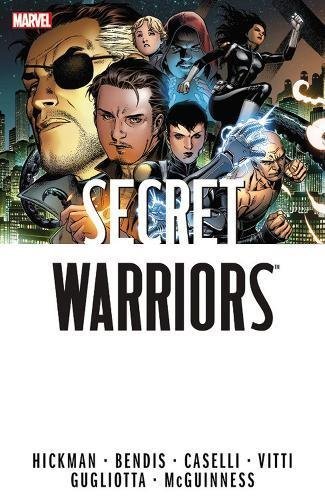
Secret Warriors Complete Collection Volume One

This is a review of Secret Warriors Complete Collection Volume One. The cover of this graphic novel is misleading. The writer of this volume is Jonathan Hickman, not Brian Michael Bendis. At the time Mr. Bendis was the biggest name in comics, so it makes sense they’d want him on the cover, and he did contribute material. However, Mr. Hickman wrote sixteen of the sixteen-plus (+) issues.

The question you have to ask yourself is do you like espionage comics? If yes, this is the graphic novel for you. Norman Osborne, aka The Green Goblin, has become the most powerful man in the United States. He’s in charge of HAMMER, which used to be SHIELD, a NATO based espionage outfit. That doesn’t sit well with Nick Fury, former head of SHIELD. He forms his own army, spearheaded by decommissioned SHIELD agents, the Howling Commandos (his outfit during the second World War), and three caterpillar teams. Caterpillars are kids with superpowers, btw.

HYDRA is undergoing its own renaissance, spearheaded by Baron Strucker. In this volume, HYDRA are portrayed as Nazis and ex-Nazis. Not to be undone, LEVIATHAN – a Soviet era secret organization – rises from the ashes. By the end of this graphic novel, HYDRA and LEVIATHAN have gone to war and one of Fury’s caterpillar teams has a traitor.

This volume has a large ensemble cast, but the main players are Nick Fury, Daisy Johnson (the leader of one of Fury’s caterpillar teams), and Baron Strucker. It is mostly self-contained, thank god. The twenty eight plus issues of this series are one BIG storyline, emphasis on the capital letters. The plot features lots of back and forth, twists and turns, backstabbing, wheels within wheels. Most of Mr. Hickman’s plot twists are foreshadowed.

This graphic novel takes place in the post-Secret Invasion Marvel era, called Siege, and IMO is the best thing to come out of that era. Highly recommended, especially for fans of espionage comics.

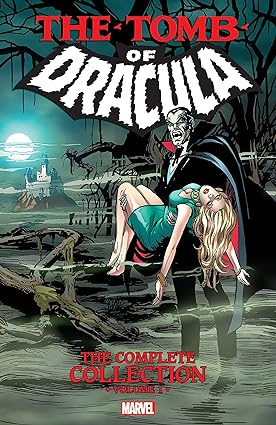
Tomb of Dracula Complete Collection: Volume One

This is a review of Tomb of Dracula Complete Collection Volume One. Reading the first volume of this series is a milestone for me, because my OCD fixated on this book, which means I read the first six issues repeatedly, with no prospect of ever finishing. But finish I did! Now how’s that book I finally read?

Very good, with the exception of some creaky material that hasn’t aged well (cringeworthy dialogue, racial stereotypes, make it up as you go along vampire lore). Dracula rises from his tomb in the first issue, courtesy of all-round idiot Clifton Graves. Graves becomes Dracula’s slave, and is so obnoxious and fawning that Dracula gets sick of him and lets him die in an exploding boat. But Grave’s best pal Frank Drake is worse. Frank is related to Dracula, and his solution to life’s problems is a left hook. Luckily, the focus of the book is Dracula himself and the ensemble cast. BTW, this series takes place in London in the 1970’s.

We have Dracula, self-proclaimed Lord of the Vampires, who is irredeemable. Depending on what issue you read, he’s either 100 or 500 years old. Then there are the ones who hunt him: Frank Drake, master of fisticuffs; Rachel van Helsing, who wields a crossbow, the most useless vampire hunting weapon in existence; Taj, who does not speak; Blade, a vampire hunter who’s part vampire himself. They’re led by Quincy Harker, who has a daughter named Edith. Long-time readers should be able to guess which cast member gets killed in the first volume.

The art, done by Gene Colan, is one of the best things about this series. Mr. Colan’s character designs are striking, and his art has lots of fun details (Dracula’s cufflinks are little bats). The writing gets off to a rocky start, with three authors (Gerry Conway, Archie Goodwin, Gardner Fox) scripting the first six issues. Marv Wolfman took over the writing duties starting with Issue #7, and after that the book finds its legs. One of the things I like about this series is that even though it’s part of the Marvel Universe, it feels mostly self-contained. Dracula doesn’t feel like some rubber-suited supervillain.

A must read for Dracula and horror fans.

Wolverine Epic Collection: Madripoor Nights

This is a review of Wolverine Epic Collection: Madripoor Nights. Wolverine, aka Logan, is one of Marvel’s most popular characters. Something about a guy with nonexistent social skills and a nasty temper resonates with comic readers. Wolverine is a mutant whose abilities include enhanced senses and the ability to heal from almost any wound. He also has metal bones and a set of matching claws that retract and unfurl at his command.

Wolverine is a member of the X-Men, but became so popular Marvel gave him his own series. The setting is Madripoor, a carbon copy of Casablanca. Logan hangs out in a bar dressed in a white tux and eyepatch and tells everyone to call him Patch. He thinks he’s incognito, which is stupid because he’s so recognizable, but it turns out everyone was just pretending not to know him, because you don’t upset a guy with nonexistent social skills and a rotten temper.

 The first storyline features a character called Tyger, who wants to be a crime lord. To do so she must kill the current crime lord, who commands a pet succubus and a guy with knives for hands. Wolverine helps Tyger because her brain was scrambled by villains in an issue of the X-Men. Other storylines include a sword that possesses its wielder, an encounter with Mr. Fixit (aka The Hulk), and fledgling crime lord Tyger’s first gang war!

One of the good things about this series is that the writer (Chris Claremont) does a fine job of producing credible villains. As the years passed, Wolverine has gotten more and more powerful, until he became an unstoppable killing machine. Nothing can kill Wolverine, which is dull as dirt. In this graphic novel, Logan gets his ass kicked all over Madripoor.

Anyway, good series with lots of action. Recommended.

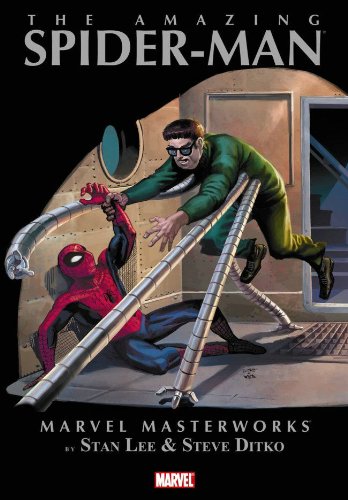
Marvel Masterworks: The Amazing Spider-Man Volume Two

This is a review of Marvel Masterworks: Amazing Spider-Man Volume 2. You can read my review of the first volume, here. In this volume, the classic Ditko/Lee run continues. The rogue’s gallery fleshes out, as we meet Mysterio, Kraven the Hunter, and The Green Goblin. Spider-Man has a great rogue’s gallery, right up there with Batman and The Flash.

Speaking of rogue’s galleries, who is Spidey’s arch-nemesis? I myself think it’s Doctor Octopus, but the Green Goblin is a fine choice also. Spider-Man’s first two encounters with the Green Goblin end in a draw, whereas by that point Spidey had beaten Doctor Octopus multiple times already. OTOH, Spider-Man has a longer history with Doc Ock, because Norman Osborne spent over a decade on the shelf (read: dead) before the powers-that-be resurrected him. Bottom line: they’re both good choices.

Peter’s personal life changes. He starts dating, Betty Brant and Liz Allan. Aunt May, who at this point is only 40,000 years old, has a heart attack. Peter also quits being Spider-Man for a few issues. Spider-Man throwing his costume in the trash has happened often enough that at this point it’s a cliché, but it wasn’t back then. Bottom line: this is a creative team working at the top of their game. A must-read for fans of Spider-Man and fans of superhero comics.

Marvel Masterworks: Captain America Volume One

This is a review of Marvel Masterworks: Captain America Volume One. This graphic novel is the work of Jack Kirby, which means its good. Stan Lee is listed as the writer, but I read an interview with Kirby wherein he claims to have done both the art and writing. Having read a bunch of Marvel material in the 60’s, I think there might be something to his claims.

Captain America was a war hero/propaganda figure in the 1940’s. When the war ended, he was frozen in a block of ice for twenty years. If you want more, read this volume or watch any of the Captain America/Avengers movies. The stories are split between the 1940’s and the present day (in this case, 1965). In the 40’s, Captain America and his youthful sidekick Bucky win World War Two. In the 60’s, Captain America is a member of the Avengers. Twenty years have passed, but Cap’s rogue gallery remains mostly the same, Baron Zemo and The Red Skull.

Many of the stories in this volume are multiparters, but there isn’t an overarching story arc. The stories feature lots of action, and stretch Cap to his limits. My favorite story set in the past is when the Red Skull captures & brainwashes Cap, and sends him to London to kill the Allied Supreme Commander.

There are a bunch of great stories set in the present. Cap fights a Nazi doomsday weapon, the Red Skull returns with the cosmic cube (a weapon that gives the user control over reality), and there’s a radioactive biohazard story featuring Batroc the Leaper, which feels timely today (substitute COVID).

Captain America doesn’t have much of a cast in the present day, mostly because of the split between the past and the present. Special shout-out to the Red Skull, Cap’s opposite and ultimate nemesis.

Great work from Jack Kirby.

Marvel Masterworks: The Mighty Thor Volume One

I have been reading comics since 1978, and I’m here to tell you that there’s a lot of bad comics out there. By bad, I mean racist, sexist, misogynistic, homophobic, full of clichés, nonsensical, and violent. Don’t get me wrong. There are also good comics, but Marvel Masterworks: The Mighty Thor Volume One does not number among them.

Here’s the good: Jack Kirby drew some of these issues. That sums up the good. I rate Thor above the first volume of Iron Man, but that’s not a high fence to hurdle. Thor’s creators were still figuring him out as a character, which means his powers fluctuate according to the needs of the plot. In one issue Thor destroys half the earth, and in the next he’s laid low by a mobster. Thor’s personality is also in flux, in that he doesn’t have one. Sixty years later and he still doesn’t!                                                                                         

These stories reminded me of the first volume of Iron Man, a never-ending series of twelve page one-shots. The most memorable villain in this volume is Thor’s evil step-brother Loki, who gets chained up as much as Wonder Woman. Other villains include The Cobra, Mr. Hyde, a lone Lava Man, and The Radioactive Man. Most of the plots revolve around 1. Thor losing his mighty hammer and transforming back into Donald Blake, usually in the middle of a fight; 2. Thor mooning over Jane Foster.

Thor’s alter ego, Dr. Don Blake, can’t express his love to his nurse Jane Foster because he’s lame and there’s no way she could love a cripple. That’s what he tells himself, anyway. When Blake musters up the courage to tell her he’s secretly Thor, his father the mighty Odin cock-blocks him.

Two things stand out in this graphic novel. The first is an extended fantasy sequence wherein Jane Foster imagines domestic bliss as Mrs. Thor, wherein she polishes his hammer, irons his cloak, and gives him a nice, short haircut so he doesn’t look like one of those beatniks. I hope the creators were laughing their asses off when they created that sequence, because I sure was.

I can sum up the second standout in two words: chromosomatic gland. Loki hits Thor’s chromosomatic gland, which reverses Thor’s brain and leads to him raising his hand against the mighty Odin and then destroying the earth with his crazed half-brother. The issue ends with Odin hitting Thor’s chromosomatic gland and re-reversing his brain, which leads to our beloved hero regaining his nobility. Of course, the earth is still destroyed, but Odin undoes all the damage and erases everyone’s memories of the event. I’m unsure if he raises all the people his sons killed from the dead, but am assuming the creators would say nobody died.

This issue might be the worst comic I’ve ever read, and (as mentioned) I’ve read a lot of comics. I wouldn’t be surprised if this is where they got the idea of retconning Spider-Man’s marriage.

For Thor junkies only.

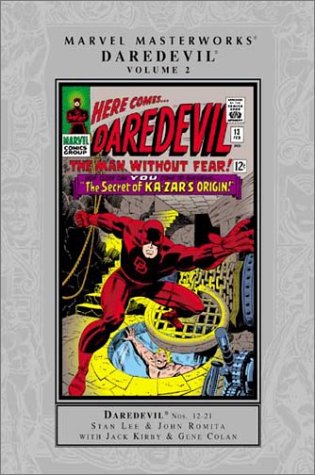
Marvel Masterworks Daredevil Volume Two

This is a review of Marvel Masterworks Daredevil Volume 2. I read the first volume back in January. The second volume contains the SINGLE GREATEST DAREDEVIL STORYLINE OF ALL TIME. Emotionally, I was unprepared. If you read my review of the first volume, found here, you know of the love triangle between Matt Murdock (aka Daredevil), his partner Foggy Nelson, and their secretary Karen Page. Perhaps ‘love triangle’ is misleading, as there’s no actual love or sex involved.

No, what we have is three adults acting like lovesick teenagers, which admittedly was Daredevil’s audience at that time. Things are at an impasse until the entrance of supervillain Masked Marauder, a purple-plumed goon who gets the bright idea of dressing his menagerie of thugs up as Daredevil and having them attack Spider-Man, so the two heroes will fight while he robs banks or whatever.

His plan works. Spider-Man bursts into the law offices of Nelson & Murdock and dangles Foggy out the window because he thinks he’s Daredevil. Foggy is not Daredevil, but he starts hinting to his secretary Karen Page that he is in order to impress her. It’s a version of the ole’ ‘I was in the CIA but can’t talk about it’ bit.

Foggy takes it a step further and buys a Daredevil costume. Unfortunately, he buys the costume at the shop of The Gladiator, frustrated tailor and budding supervillain, who suggests that Foggy hire a pretend thug to beat up when he’s dressed as Daredevil, in order to impress Karen. With me so far?

The Gladiator’s plan is to eviscerate Foggy, because reasons. Unaware, Foggy and Karen take a cab to a deserted wharf, where the Gladiator awaits. Will the real Daredevil arrive in time? Will true love – or whatever this is – triumph?

I have been reading superhero comics for decades, and I haven’t read many dopier storylines, but somehow the creators (Stan Lee & John Romita) pull it off. Foggy is on the portly side, and thus can barely fit into his Daredevil costume, just one of all sorts of magical details contained within. My second favorite storyline features The Owl, a supervillain who builds an enormous mechanical owl to attack Daredevil. Later in the volume, Daredevil rides that owl like a bronco.

My biggest issue with these issues is that this version of Daredevil is dead and buried. I do think writer Mark Waid’s version of Daredevil hearkens back to these issues, but for better or worse, artist/writer Frank Miller left an indelible mark on the character.

Read this!

Marvel Masterworks Nick Fury Agent of SHIELD Volume One

This is a review of Marvel Masterworks Nick Fury, Agent of SHIELD Vol. 1. Marvel put out a lot of material in the 1960’s. We all know the classics, but there are comics that aren’t as good. And then there are the stinkers. I try to be positive, but if you look through past reviews you can see what I’m talking about.

The Lee/Kirby run of Nick Fury, Agent of SHIELD is a classic. The stories are twelve pages long, but aren’t one-shots. Instead we have a meta story that goes on for over a year. Contrast this with a title like Iron Man, which produced a number of one-shot stories featuring a series of dopey villains (Mister Doll, Jack Frost, etc.).

Jack Kirby’s influence is plain to see. Stan Lee wrote a lot of stories, and the quality is variable. A lot depends on his co-creators. Daredevil wasn’t great until Wally Wood. Sometimes it’s a character. The Avengers didn’t find their groove until Captain America joined.

Sometimes you have synergy, where a creator and a character mesh. Nick Fury is a man of action, the type of character Jack Kirby loved. Captain America, The Sub-Mariner, Nick Fury. Fury has no powers, but he’s got plenty of good ole’ fashioned grit. He’s also the head of the most powerful spy organization in history, and has their resources at his disposal, so there’s that. Lately, characters like Nick Fury have become problematic, but not back in the 60’s.

Fury spends the first story arc fighting Hydra, a secret organization bent on world domination. Every issue you feel the actual stakes, mostly nuclear annihilation. There are lots of cool, exotic-looking weapons; Kirby gets to play with his toys. SHIELD and Hydra are evenly matched in terms of smarts, organizational know-how, and tactics – two sides of the same coin. Sometimes Hydra gets the upper hand, but they never win.

Series influences would be The Man from UNCLE and the 007 movies. I’m a bit embarrassed I didn’t know this series existed. In my defense, my prime comic reading years were the 1980’s. Anyhow, great stuff.

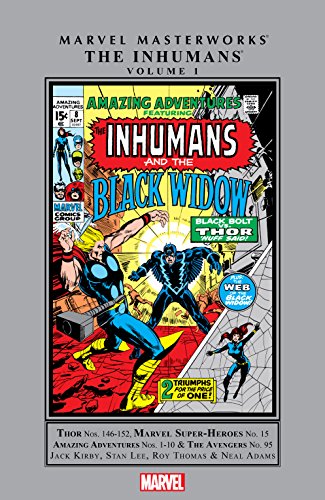
Marvel Masterworks The Inhumans Vol. One

This is a review of Marvel Masterworks Inhumans Volume One, a graphic novel featuring great art by Jack Kirby, Neal Adams, and Gene Colan. FYI, The Inhumans are a group of human beings genetically modified by the alien Kree. When mankind was still in diapers, the Inhumans lived in great cities.

Let’s get this straight. The Inhumans aren’t mutants. Inhumans are genetically modified by the fabled Terrigen mists. They aren’t mutants. I don’t believe the Inhumans are even on earth, anymore, but am not sure. When the Inhumans TV series was cancelled, the Marvel powers-that-be went back to not caring about them. In the Marvel cinematic universe – the only universe that matters – the most famous Inhuman of all, Kamala Khan, is a mutant.

 The Inhumans made their first appearance in the Fantastic Four, and made cameos in that series on and off for years. None of the Fantastic Four issues are reprinted here, not even the first appearance. Instead we have a bunch of back-up stories which makes it hard to get any sense of the characters.

Jack Kirby did a few of these stories. They’re okay. His Inhumans make grand proclamations, explain their powers, and sing hosannas to their leader, the Wondrous Black Bolt. Mr. Bolt cannot speak, because to do so would destroy a city. He’s got Nuclear Mouth, that Black Bolt.

After Kirby’s departure, The Inhumans jump the shark. Here’s a short summary: Black Bolt flies into the world of humans (San Francisco) to learn more about them. Since the Inhumans have lived in wondrous cities since men huddled in caves, you’d think they’d have television, or be able to reverse engineer a television. But no.

Black Bolt leaves his brother Maximus the Mad locked in an enormous iron coffin. The other Inhumans, suspicious that Bolt has killed Maximus the Mad, open the coffin. The Mad One breaks out wielding psychic powers and gives Black Bolt total amnesia. This happens right after Black Bolt changes clothes with a thug he knocked out in an alleyway in San Francisco.

Stay with me, here. Black Bolt is picked up by a man who has lost his hand to cancer and wants Bolt to destroy San Francisco, because reasons. Then Magneto kidnaps Black Bolt, because reasons. This isn’t the noble, silver fox Magneto we’ve all come to love; this is the psychotic, sneering Magneto who sinks nuclear submarines and looks like he enjoys eating boogers.

There’s more, involving the Avengers, but I won’t go into it. Suffice it to say that at no point during these issues – which I painstakingly read for YOUR benefit – do the Inhumans show any agency at all. The art is wonderful, but the story just isn’t very good. The last couple of issues are from Not Brand Ecch, Marvel’s humor magazine. Unfortunately, the writer can’t write humor.

Bottom line: I spent $1.99 for this graphic novel, so it’s all good, but don’t spend more than that unless you are an Inhumans fanatic.