Marvel Masterworks: The Invincible Iron Man Volume Four

This is a review of Marvel Masterworks Invincible Iron Man Volume Four. You can read my reviews of the first three volumes here, here, and here. This volume is written by Stan Lee and drawn by the great Gene Colan, who also drew Tomb of Dracula. Mr. Colan’s Iron Man is dynamic – twisting, contorting, always in action.

Thus far, Iron Man has been an on/off title to read. The main culprit is the writing, which can be kindly described as inconsistent. Nonstop action is great, but the plots need to make sense. The writing has a slapdash quality that I don’t like, such as when Iron Man leaves the widget he needs to defeat the Titanium Man on his coffee table because it slipped his mind. Series regular Happy Hogan retrieves the widget, only to be mortally injured, which leads to Happy’s transformation into a monstrous etc., etc., etc. This is known as plotting on the fly, aka making it up as you go along.

Happily, the writing in this volume is better. When Archie Goodwin takes over scribing duties – which seems like it might be a few issues before he’s credited – the plots get tighter. Yes, dumb cliffhangers still abound, but that is part of the joy of reading superhero comics. The Grey Gargoyle throws a petrified Iron Man off the roof, but lucky for him, there’s a handy truck full of sand nearby to fall on.

The villains in this volume are better. Unlike Mr. Doll (featured in Volume One), they look like real threats. Look at Titanium Man! He’s scary! Look at the Grey Gargoyle! He’s mean! There’s also Whiplash, who has a, uh, steel whip. Let’s not forget ultra-secret organizations Maggia and AIM, bent on world domination. Also: Madame Masque, minus the mask.

Series regulars Happy (chauffer) and Pepper (secretary) get written out of the book for reasons I don’t understand. I think it might have to do with Happy knowing that Tony is Iron Man. Instead of fridging him, the writers allow him to elope with Pepper. They are replaced by SHIELD agent Jasper Sitwell, the most annoying man in the universe. Sitwell debuts by trying to blow Tony Stark’s head off his shoulders, although that’s not how he frames it. Overall, this volume shows a lot of improvement from the last. Recommended for Iron Man fans and lovers of superhero comics!

Marvel Masterworks: Captain America Volume Two

This is a review of Marvel Masterworks: Captain America Volume Two. Back in the 1960’s, Captain America and Iron Man shared the same magazine – Tales of Suspense – for awhile. The difference being, Captain America had Jack Kirby and Iron Man didn’t. The characters might have been in the same magazine, but the stories are in different stratospheres.

I am sure you will all be fascinated to know that I rate all the graphic novels I read. The only thing preventing this from being a four-star book was the absence of Kirby in two storylines. The fill-in artists (one of whom was Gil Kane) did a fine job with the art, but the stories read as sloppy, unfocused, and rushed. Kirby was a craftsman. More than that, he cared. When you read his product you can tell he cared about what he was putting on the page.

Most of the storylines in this volume follow a template: a villain returns with an apocalypse device. When Cap teams with Agent Thirteen and The Black Panther (Kirby story), it’s a satellite that focuses solar energy into death rays. Okay, that’s scary. In Kirby’s absence, it’s a device that can enclose anything in indestructible bubbles. Which is stupid, especially when the villain ditches his bubble machine for a nuclear submarine. Anyway: Cap kicks the shit out of the villain so that he can go back to being depressed. What, you say Captain America’s depressed? If you were frozen in an iceberg for twenty years and then thawed out, you’d be depressed too!

There are two storylines I’d like to mention. The first involves the Super Adaptoid, a creation of A.I.M. (Advanced Idea Mechanics). The Adaptoid gets the jump on Cap and duplicates him exactly, and then proceeds to get his head handed to him by a Z-grade villain called The Tumbler. Although the Adaptoid has all of Cap’s physical prowess and skills, he doesn’t know how to fight. The Adaptoid goes down, and the real Cap recovers in time to beat the tar out of the confused Tumbler. This is a story built around an idea.

The second storyline is when Cap proposes to Agent Thirteen, the SHIELD agent he’s in love with (even though he doesn’t know her name). Agent Thirteen turns down his proposal to be Mrs. Captain America because she has a sense of duty – and she doesn’t want to quit her job, although she doesn’t say that. Unfortunately for them, it’s the mid-60’s so they can’t just shack up. Cap, depressed, publicly unmasks and quits so that he can have a life. This has real repercussions, in that a number of Captain America impersonators run amok in the city and the Syndicate starts trying to kill them all.

Recommended!

Marvel Masterworks: The Invincible Iron Man Volume Three

This is a review of Marvel Masterworks: The Invincible Iron Man Vol. 3. Note: this volume contains Iron Man and Captain America stories, but I only read the Iron Man material. You can peruse my reviews of the first two volumes here and here.

Iron Man is Tony Stark, multi-millionaire. Tony makes weapons for SHIELD and the U.S. Defense Department. Since he hails from the Marvel Universe, there’s a catch. Stark’s heart was damaged in Vietnam, and now he’s living on borrowed time. The only thing keeping him alive is the plate welded onto his chest, which he must charge whenever there’s an emergency or a supervillain appears.

The art – mostly by Don Heck and Gene Colan – is good. The stories are – well, they’re a mixed bag. No more Mr. Doll, which is a shame. Instead we have The Titanium Man, a big burly Russian who builds a big burly green suit of armor. TM challenges Iron Man to a battle royale, mano a mano, East vs. West – just like that exciting Rocky movie, which I’ve never seen! (Confession: I’ve never seen any of the Rocky movies).

Iron Man triumphs, but only after his chauffer Happy Hogan is almost killed bringing Shell-Head the MacGuffin, an object so integral to Tony’s battle with Titanium Man that he left it behind on his coffee table. Luckily, Happy is saved by the Enervator, which has the unfortunate side-effect of transforming him into an enormous hulking freak of nature. Hey, it happens.

After that, warlord and racist caricature The Mandarin stops by to test his enormous android, Ultimo, against Iron Man. And then the Sub-Mariner attacks! Lots of action, no let up. The problem being, the stories all start to blend together. There are a few points during the Sub-Mariner storyline where the creators forget their own plot points and contradict themselves, but I’d have trouble remembering it all also.

Iron Man started out as a propaganda war comic, and this volume possesses some of these elements. Stark’s main antagonist is Senator Byrd, a dedicated public servant who manages to shut down Stark Enterprises, because reasons. Actually, Byrd’s reasons aren’t bad – Mark Millar’s Civil War, penned decades later, riffs off this.

Nowadays, Iron Man is viewed as a semi-problematic character, depending on who writes him. He’s a millionaire. When you look up ‘capitalist’ in the dictionary there’s a picture of him next to the Monopoly guy. He’s good looking and assumedly gets all the sex he wants. He’s had substance abuse issues with alcohol and he’s the main villain in the first Civil War.

If you’re an Iron Man fan or completist, you might like this.

Marvel Masterworks: Spider-Woman Volume One

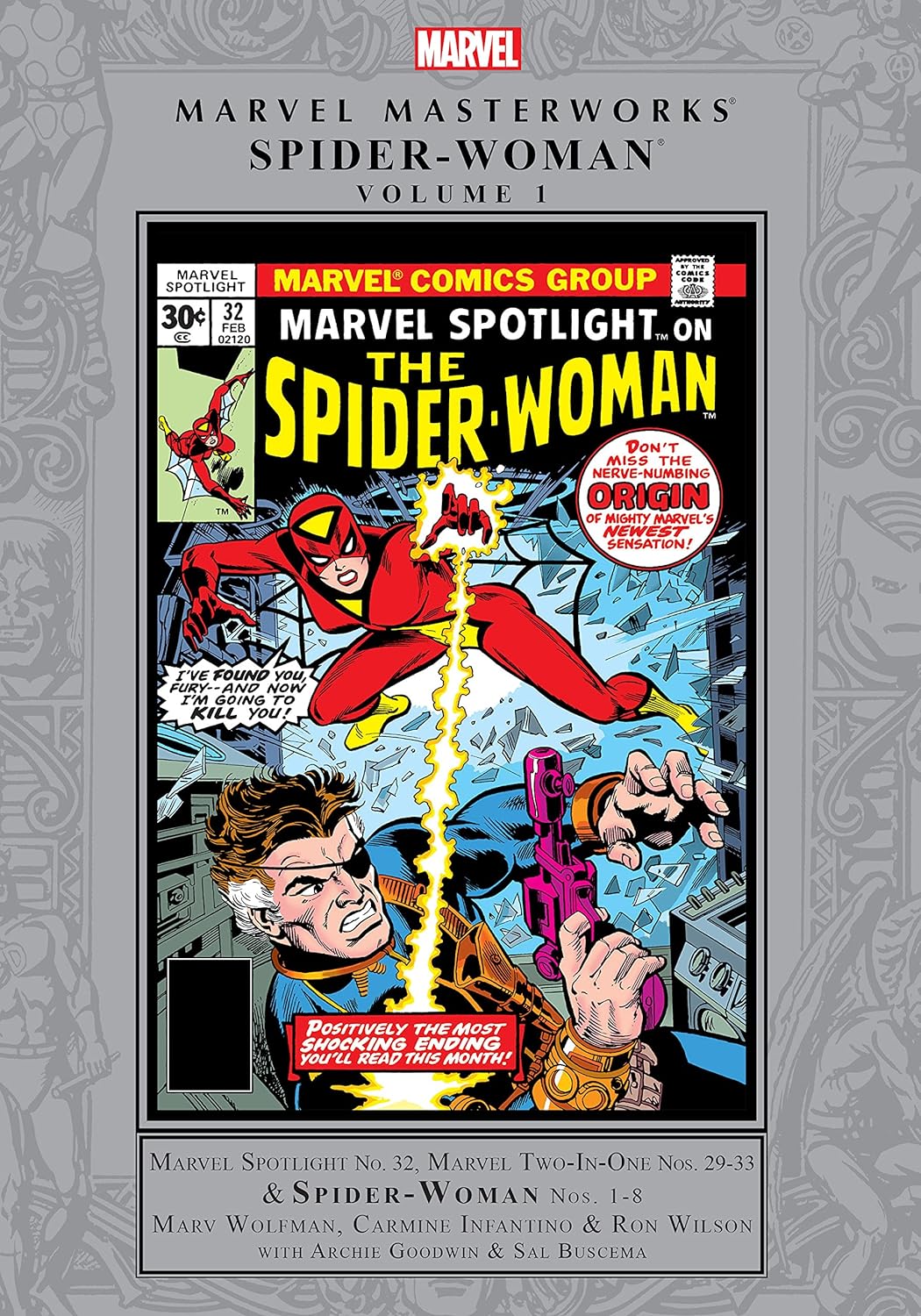
This is a review of Marvel Masterworks: Spider-Woman Volume One. Spider-Woman came into existence because of a copyright issue. Learning that another company was about to create a character named Spider-Woman, Marvel sprang into action and beat them to the punch! The result: a one-shot issue written by Archie Goodwin that is a marvel of efficiency. Spider-Woman, evolved from a spider by the High Evolutionary and then brainwashed by the terrorist organization Hydra, is sent to kill Nick Fury (the director of SHIELD). At the issue’s end, she throws off her brainwashing.

Spider-Woman’s next appearance is in Marvel-Two-In-One, a comic series which featured characters from the Marvel Universe teaming up with The Thing (of the Fantastic Four). This five-issue storyline, in which Alicia Masters (The Thing’s girlfriend) is transformed into an enormous psychotic spider/human hybrid that wrecks London, pretty much jumps the shark on every level. Spider-Woman’s origins become further muddled when Mordred the Mystic joins the party.

Next we have the Spider-Woman series, written by Marv Wolfman and illustrated by Carmine Infantino. Mr. Wolfman is a legendary comic writer who wrote Tomb of Dracula, Crisis on Infinite Earths, and the New Teen Titans, and under his guidance Spider-Woman becomes an uneasy hodgepodge – it has horror elements, it has superhero elements, it has elements of a fetish comic.

Wait, what? Yes, it’s true. In Issue #4 we have The Hangman, a villain who could double as a Rope Daddy. Spider-Woman finds herself in a jam, let’s put it like that, which makes no sense because she has super strength. It’s a scene that goes on for a number of pages, immortalized by Mr. Infantino’s skill at drawing Japanese rope bondage. Honestly, I have no idea how this issue made it past the Comics Code Authority.

If you read enough superhero comics, you know that this is hardly the only time a female character gets tied up. Still, as the most overt example of shibari bondage in mainstream comics I’ve ever seen, it’s worth a mention. When I read the mass market paperback 40+ years ago as a kid, this scene was the only thing I recalled decades later. Frederic Wertham was right, comics really do influence young minds!

Anyway, this is a weird graphic novel. If you ignore the Marvel Two-In-One storyline, it contains some pretty good comics.

Marvel Masterworks: Howard the Duck Volume One

This is a review of Marvel Masterworks: Howard the Duck Volume One. Howard is a walking, talking, cigar-smoking duck. He came to earth from another dimension in the pages of Man-Thing, reviewed here. The first six or so issues are send-ups of different genres – fantasy, quack-fu, gothic. This changes when Howard runs for president and loses because of a doctored photograph. He has a mental breakdown, is committed to an insane asylum in Cleveland because of a traffic incident, and ends up being possessed by Damian Hellstrom’s evil second soul. Alas, Howard’s career as Devil Duck is cut sadly short, just like this comic.

The highlight of this graphic novel is when Howard runs for President, because reasons, but the establishment doesn’t want him because he’s a duck. He loses because of a fake photograph of him in the bathtub with Beverly Switzler. Beverly is human, Howard is a duck. Neither Howard nor Beverly nor the creators of the comic itself deny that Howard and Beverly have a relationship…but the photo is fake because Beverly doesn’t like wet feathers.

Howard the Duck is satire, but it’s done well. Marvel in the 1970’s tended to be the place where messages were bludgeoned home with a hammer, but Howard the Duck isn’t overtly political. Man Thing is Steve Gerber’s (the writer’s) political strip, featuring a brain-dead monstrosity that thrashes about mindlessly and destroys things with a touch of its burning fingers. Howard the Duck is about isolation. As a duck living in a world of humans, Howard is the ultimate outsider. He has a single friend, Beverly Switzler, who has a thing for outsiders: her past two boyfriends were a security guard possessed by a cosmic turnip and a guy who commits crime dressed in a diaper. There’s also the magnificent Hell Cow and Howard’s greatest enemy, The Kidney Lady.

This is Marvel’s version of an underground comic. It’s PG-rated, and the writer is perhaps a little self-absorbed, but the journey itself is loads of fun. Recommended!

Marvel Masterworks: The Avengers Volume Three

This is a review of Marvel Masterworks Avengers Volume Three. If you read my reviews of the first two volumes, here and here, you will see that the Avengers got off to a rocky start and found its legs only after the powers-that-be revamped the team, getting rid of the heavy hitters in favor of Captain America and three ex-criminals. The Scarlet Witch and Quicksilver are former members of Magneto’s Brotherhood of Evil, and Hawkeye has tangled with Iron Man.

These stories have a formula: the Avengers bicker. The source of the tension is almost always Hawkeye, who has a king-sized chip on his shoulder. Quicksilver and the Scarlet Witch are mutants, Homo Superior, and possess wondrous powers. Captain America has his shield and the super soldier serum. Hawkeye is an ex-carny with a quiver full of trick arrows, so it’s natural that he might overcompensate.

Anyway, after bickering one of the Avengers quits or stalks off. The rest go on a mission, which goes badly until they are rejoined by the wayward Avenger. Rinse and repeat. The other thing that helps this book is that most of the stories are now two-parters, which adds a little depth.

This graphic novel doesn’t have great writing, or great art. What it does have is attitude and lots of action. My favorite storyline: the Avengers bicker. Hawkeye stalks off to hit the nightclubs and go dancing. The Avengers – alerted by guest star the Wasp – fight underwater warlord Attuma, who is a cross between the Sub-Mariner and Conan the Barbarian. Attuma wants to flood the surface world with his tidal wave machine.

The Avengers get their heads handed to them. Hawkeye returns to Avengers HQ, but can’t recall the password to access their comm-link system. Maybe he’s hungover? In case you haven’t figured it out, Hawkeye is an idiot. But it works.

In the meantime, Attuma decides to defeat the Avengers a second time, just to show how tough he is. Quicksilver gets flushed out of the torpedo bay but is rescued by a returning Hawkeye, who has managed to recall the password, and together the reunited Avengers destroy Attuma’s tidal wave machine. Etc., etc., etc.

It’s not rocket science, but it’s fun.

Marvel Masterworks: The Fantastic Four Volume Three

Version 1.0.0

This is a review of Marvel Masterworks: The Fantastic Four Volume Three. After reading Jack Kirby’s Kamandi, this volume felt like a letdown. Mr. Kirby’s art looks rushed in places here, there’s no meta story, and the issues have a ‘villain of the month’ quality. We have a single science fiction tale about a young godling, but the rest is mostly battles with the team’s growing rogue’s gallery – Doctor Doom, The Mole Man, The Red Ghost and his Super Apes, etc, etc., etc.

The highlight of this volume is the Thing’s battle with the Hulk. The not-so-jolly-green-giant invades Manhattan, because reasons. Most of the Fantastic Four is either sick or injured by the Hulk, so it falls to the Thing to fight the jade giant. And fight him he does, in a great battle sequence that lasts nearly an entire issue and ends with the Thing getting knocked on his ass. Never fear, the rest of the Fantastic Four and the Avengers join the fray in the next issue. It’s a great two-parter.

Other developments worth mentioning: the creators give Sue Storm the ability to cast invisible force fields, which gives them more to do with her character. Prince Namor arrives to propose to Sue, except his idea of proposing involves kidnapping and imprisoning her in an enormous bubble until she agrees to marry him. Reed Richards, feeling his manhood threatened, rushes to fight the Sub-Mariner, which is interesting because he’s usually written as a pretty mild guy. Afterwards, Sue puts Namor in the Friend Zone – actually he should be in the Don’t-Come-Within-Two-Hundred-Feet of my House Zone, but whatever.

This volume is a slight step back from the first two books, but the Hulk two-parter is a classic and worth the price of admission. Recommended.

Marvel Masterworks: Defenders Volume Two

This is a review of Marvel Masterworks Defenders Volume Two. The high point of this graphic novel is the six-issue Avengers/Defenders war, in which the two teams duke it out to retrieve what looks like a plumber’s helper. The plot has a slapdash energy that I liked, even though I’ve seen it a million times before. Other storylines include a romp in the past with the Black Knight, along with The Hulk fighting the Abominable Snowman. Also: The Squadron Supreme sells earth to aliens!

Being Marvel’s one and only non-team, The Defenders’ roster changes with the winds, but semi-regular members include Doctor Strange, The Valkyrie, and The Hulk. In the volume I read, Hawkeye and Nighthawk come to visit, but only Nighthawk stays. 1970’s superhero comics mostly consist of a bunch of one or two issue storylines and have a villain of the month quality – Loki, Mordred, The Squadron Supreme, Magneto, etc.

These issues read fine, but are mostly forgettable. Writer Steve Englehart leaves, and writer Len Wein arrives. Both Mr. Englehart and Mr. Wein do good work here, but both have done better elsewhere. This is perfectly decent comics schlock that doesn’t take itself too seriously.

Marvel Masterworks: Doctor Strange Volume One

  This is a review of Marvel Masterworks Doctor Strange Volume One. IMO, there are three classic Marvel titles to emerge from the early 1960’s. The first is Jack Kirby’s Fantastic Four, the second is Steve Ditko’s Spider-Man, and the third is Mr. Ditko’s Doctor Strange. I suppose you can also include Jack Kirby’s Captain America and SHIELD runs, which I believe took place in the same time period. The rest of the Marvel output from the early 1960’s is uneven (Daredevil and The Avengers), and some of it is just plain bad – early Thor and Iron Man were wretched.

Anyway, Doctor Strange is a standout. The reason for this is Steve Ditko, whose art for this series is bizarre, distinctive, and surreal. Besides the artwork, it wouldn’t surprise me if Ditko did much of the plotting, leaving Stan Lee to write the dialogue. I believe Steve Ditko to deserve the lion’s share of the credit for the quality of this title, but YMMV. The stories here range from five to twenty pages. The shorter stories are marvels of efficiency. Not a panel is wasted.

Doctor Strange lives in a mansion in Greenwich Village. He is Earth’s Sorcerer Supreme, a phrase that’s never really explained. The less said about his origin story – which is a take on a hoary old trope most people don’t use anymore – the better. Strange is written as an interesting mix of arrogance and humility – he will help anyone who asks, but there’s something that sets him apart from the rest of humanity. He’s not the type you’d like to have a drink with at a bar.

Doctor Strange’s foes include Baron Mordo, the Mindless Ones, and the Dread Dormammu. Strange has a cloak of levitation, and he can summon the all-seeing Eye of Agamotto and the Crimson Bands of Cytorrak. He’s a solitary figure, keeping to himself and not really fitting in with the rest of the Marvel Universe at that time. There’s an issue guest-starring Thor and also an issue where he shares the limelight with Spider-Man, but mostly the good doctor is a loner.

Highly recommended!

Marvel Masterworks Peter Parker The Spectacular Spider-Man Volume Two

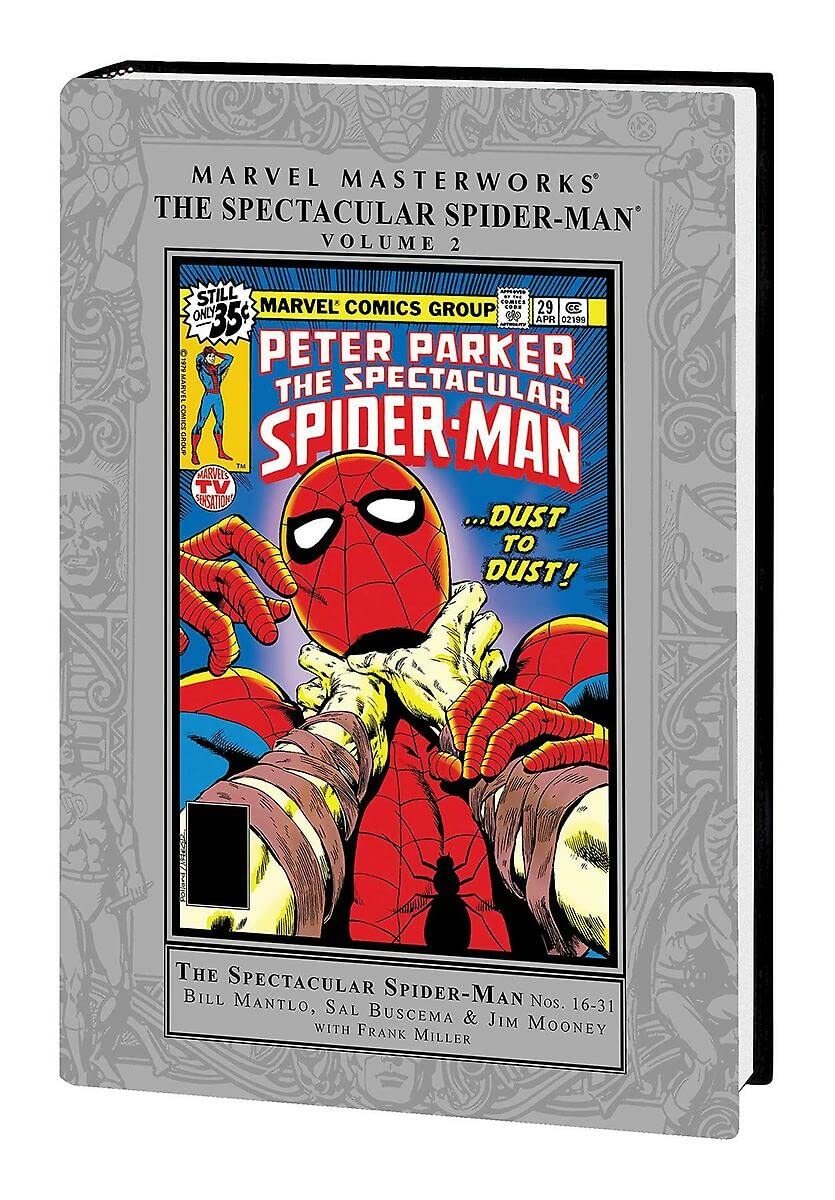
This is a review of Marvel Masterworks Peter Parker The Spectacular Spider-Man Volume Two. I read the first volume a few years back, but didn’t review it. This Spider-Man title features the art & writing team of Sal Buscema and Bill Mantlo, although Mr. Buscema didn’t draw everything in this volume. The issues are quick reads, as are so many Marvel titles of that time period (late 1970’s).

Mr. Mantlo wrote a lot of comics, many of which I’ve read. He also created lots of characters. In two volumes of Spectacular Spider-Man, he created Razorback, The White Tiger, Carrion, Spider Amoeba, and the Hypno-Hustler. Sure, there’s a few misses (read: Hypno-Hustler), but Mr. Mantlo also created characters such as Rocket Raccoon, who went on to star in the Guardians of the Galaxy movies.

This is a normal Spider-Man title for that time period. We have shorter story arcs, and an overarching storyline involving the Maggia that percolates for most of the volume. Peter goes to California, fights a brainwashed Iceman, and then battles the Masked Marauder and his dumb android. Coincidentally, I first read about The Masked Marauder and his dumb android earlier this month in Daredevil, reviewed here, but this time the character is handled a whole lot better, because Mr. Mantlo is not pulling plot points out of his ass. We have an appearance by Daredevil and Moon Knight, and last but certainly not least – the debut of the Spider Amoeba, which to my knowledge doesn’t survive more than a single issue. This is a real shame.

Frank Miller did some of the artwork, here, which is exciting. We also have a sneaky reference to Peter Parker having sex. Since the comic creators of that time couldn’t show the characters actually having sex, they used hints and tasteful cutaway scenes, and – well – at twelve years old I wasn’t a very astute reader. I spent my first thirty-plus years reading superhero comics convinced that none of them ever had sex. My attitude can be summed up by a scene in Brian Bendis’ New Avengers run, when Wolverine refers to his son and Spider-Man says – ‘wait a minute. You’ve had sex?!’ That was my reaction, sort of, when I finally read between the lines.

This graphic novel won’t set the world on fire, but it’s a fast, fun read from an underrated writer.