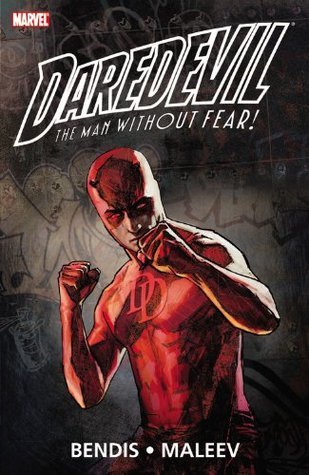
Daredevil Ultimate Collection Volume Two

This is a review of Daredevil Ultimate Collection Volume Two. Read my rambling review of the first volume, here and here. After being outed by an FBI agent in search of a payday, Matt Murdock’s (aka Daredevil) life lurches on. He beats up the Kingpin, declares himself the new kingpin of Hell’s Kitchen, and one year later finds him married (?!?!) and under surveillance by the FBI.

This volume contains four storylines. 1. The Owl sells MGH (Mutant Growth Hormone) using his own DNA. This is strange, since the Owl is not a mutant. 2. The Kingpin tries to reclaim his old territory, sending Typhoid Mary and Bullseye to distract Daredevil while he makes his move. 3. The Yazuka make a play for control of Hell’s Kitchen. 4. Black Widow’s ex – who is now a big muckety muck in Bulgaria – tries to get even. Maybe he doesn’t like paying alimony.

Give praise where praise is due. This graphic novel is extremely decompressed (twenty issues for four storylines), but it works because what we are reading is crime/noir, which Brian Bendis (the writer) cut his teeth writing. He’s great at it. Also: Alex Maleev’s gritty art is wonderful and fits the material to a tee. Artist and writer synchronize well together.

This graphic novel isn’t perfect. Certain plot elements are left unanswered (when did the Owl become a mutant?), glossed over (why didn’t the Kingpin have surgery to cure his blindness sooner?), or are just plain ridiculous (would you let a mentally ill mass murderer with pyrotechnic abilities out onto the streets, because she’s been cured through hypnosis?).

Yes, you say, but what about Daredevil getting married? Well, when Matt saves a blind woman (Milla Donovan) from an oncoming truck, she comes to his office the next day to thank him. Little Matt takes over, and it’s off to the races. Unfortunately, Milla is a penultimate damsel in distress who needs constant rescuing. At one point Matt finds her hiding in the closet. This is a tired old trope, which I am not defending, but here’s Mr. Bendis’ point (stated in the first volume): Whoever is around Matt Murdock is in danger, because his secret identity has been compromised. He knows this, but starts up a relationship with Milla anyway.

That doesn’t reflect well on Matt, especially since his track record with women is horrendous. A short summary: one of Murdock’s girlfriends commits suicide, perhaps partly because of his verbal abuse; two of his exes are stone cold killers (Black Widow & Elektra); and Bullseye kills two of his lovers (Karen Page & Elektra. Elektra got better, because reasons). Matt should know better, but he can’t help himself, especially when he’s the object of someone’s adoration.

Recommended!
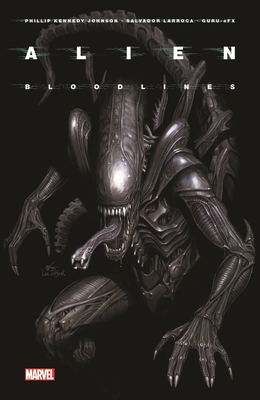
Alien: Bloodlines

This is a review of Alien: Bloodlines. Marvel now has the license to produce Alien comics! Lately, there seems to be a resurgence of comic companies producing licensed material – besides Alien, I’ve seen Predator, Godzilla, Conan, Planet of the Apes, etc. Anyway, the first Alien volume I read last year (not produced by Marvel, btw) wasn’t very good. If you don’t believe me, read the review!

How is this volume? I’m glad to announce that it’s solid. The action takes place sometime after the second Alien movie. Our hero Gabriel Cruz gets tossed from Weyland-Yutani, everyone’s favorite evil corporation, and moves back to Earth. Cruz is credited with bringing the Xenomorphs to earth – earth orbit, anyway. Is he a scientist or biochemist? No, he was impregnated by a facehugger, shoved into cryosleep, and had the baby alien surgically removed from his chest.

Anyway, Cruz wants to make peace with his son Danny, but Danny wants nothing to do with him. No, that’s not true. Danny wants Gabriel’s i.d. to get him and his radical friends onto the top-secret satellite orbiting earth that is chockful of Xenomorphs. Since Gabriel worked in security, of course he leaves his identification lying around his office instead of, say, a safe or locked cabinet. The radicals storm the satellite, and get more than they bargained for – or do they?

In the meantime, Weyland-Yutani sends Gabriel and two roadkill – I mean Marines – to the satellite. They are joined by Bishop (from the second Alien movie), because reasons. For Gabriel, it’s a rescue mission, but he’s well aware his superiors don’t give a crap and only want a Xenomorph. This leads to the scene where Gabriel shoots an infected man in the head to get a specimen, but the alien exits through the mouth instead of the chest, which leads to a Benny Hill style chase scene. Yakety Sax!

This is a good science fiction/horror comic. My main issue has to do with likability – i.e., nobody in this graphic novel is likable. I’m not sure why Gabriel wants to make peace with his son, but that’s his business; given their history, I have no idea why Gabriel thinks Danny wants anything to do with him.

Recommended for fans of the Alien franchise and fans of sci-fic/horror comics!

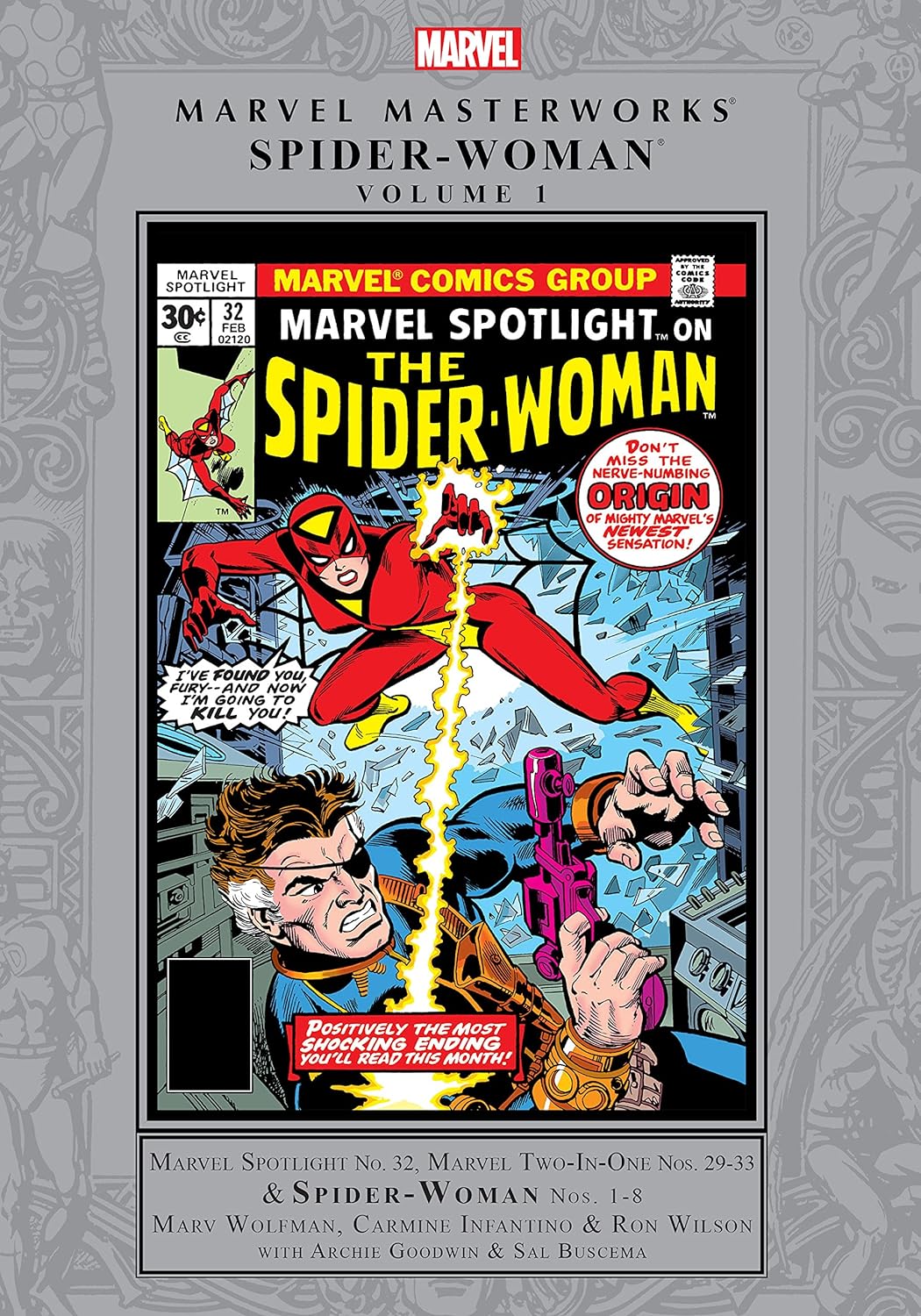
Marvel Masterworks: Spider-Woman Volume One

This is a review of Marvel Masterworks: Spider-Woman Volume One. Spider-Woman came into existence because of a copyright issue. Learning that another company was about to create a character named Spider-Woman, Marvel sprang into action and beat them to the punch! The result: a one-shot issue written by Archie Goodwin that is a marvel of efficiency. Spider-Woman, evolved from a spider by the High Evolutionary and then brainwashed by the terrorist organization Hydra, is sent to kill Nick Fury (the director of SHIELD). At the issue’s end, she throws off her brainwashing.

Spider-Woman’s next appearance is in Marvel-Two-In-One, a comic series which featured characters from the Marvel Universe teaming up with The Thing (of the Fantastic Four). This five-issue storyline, in which Alicia Masters (The Thing’s girlfriend) is transformed into an enormous psychotic spider/human hybrid that wrecks London, pretty much jumps the shark on every level. Spider-Woman’s origins become further muddled when Mordred the Mystic joins the party.

Next we have the Spider-Woman series, written by Marv Wolfman and illustrated by Carmine Infantino. Mr. Wolfman is a legendary comic writer who wrote Tomb of Dracula, Crisis on Infinite Earths, and the New Teen Titans, and under his guidance Spider-Woman becomes an uneasy hodgepodge – it has horror elements, it has superhero elements, it has elements of a fetish comic.

Wait, what? Yes, it’s true. In Issue #4 we have The Hangman, a villain who could double as a Rope Daddy. Spider-Woman finds herself in a jam, let’s put it like that, which makes no sense because she has super strength. It’s a scene that goes on for a number of pages, immortalized by Mr. Infantino’s skill at drawing Japanese rope bondage. Honestly, I have no idea how this issue made it past the Comics Code Authority.

If you read enough superhero comics, you know that this is hardly the only time a female character gets tied up. Still, as the most overt example of shibari bondage in mainstream comics I’ve ever seen, it’s worth a mention. When I read the mass market paperback 40+ years ago as a kid, this scene was the only thing I recalled decades later. Frederic Wertham was right, comics really do influence young minds!

Anyway, this is a weird graphic novel. If you ignore the Marvel Two-In-One storyline, it contains some pretty good comics.

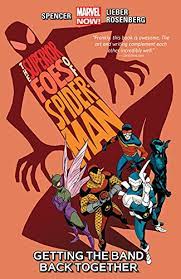
Superior Foes of Spider-Man Volume 1: Getting the Band Back Together

This is a review of Superior Foes of Spider-Man Vol. 1: Getting the Band Back Together. There’s a scene in this graphic novel where a kid tells Speed Demon, who used to call himself the Whizzer, that he’s stupid. Speed Demon tells the kid she might have a point, and then steals her dog.

Yes, that’s right. The Superior Foes of Spider-Man are villains. I won’t say super-villains, because there’s nothing super about them. They’re all too stupid. Boomerang, who throws boomerangs and has jets on his ankles, is stupid. Speed Demon, aka Whizzer, is stupid. Overdrive, the ultimate getaway driver, and the Beetle, the only girl in the group, are stupid. The Shocker differs from the others in that he’s really stupid.

The plot is too complex to explain. It involves the long-lost head of crime-boss Silvermane and a portrait of Dr. Doom. The plot doesn’t matter, though. The fun of this graphic novel lies in watching the characters double-and-triple cross each other. It’s a funny comic. Boomerang goes to a support group for super-villains. Speed Demon asks if objects get lighter when you move faster. Collective IQs fall fifty points when the Shocker enters a room.

This graphic novel reminds me more of a Dortmunder caper than a superhero comic. For those who don’t know, Dortmunder was the unluckiest criminal mastermind in the universe. Once he stole the same jewel five times. Recommended for people who like crime in their superhero comics.

Moon Knight Epic Collection: Shadows of the Moon

This is a review of Moon Knight Epic Collection : Shadows of the Moon. You can read my review of the first volume, here. Moon Knight resembles Batman, down to the millionaire alter-ego and the Batarang (Moonarang?), except he dresses in white and the symptoms of his mental illness are more in-your-face.

The moon has four cycles, and Moon Knight has four personalities. I will refer to Moon Knight as Marc Spector, because he is the original. But I do like the ambivalence – mysticism or mental illness? Even though this is an early 80’s comic series, and thus about as subtle as a sledgehammer, writer Doug Moench is surprisingly coy on that topic. The bulk of the art is done by Bill Sienkiewicz, who has a distinctive style that’s not always to my personal tastes. Most of the stories are one or two-parters.

The most interesting storyline in this volume features Moon Knight archenemy the Bushmaster, who destroys the statue of moon-god Khonshu (Spector is a follower of Khonshu). It’s a psychological attack, which scores a direct hit. Spector is devastated, and the only thing that allows him to function again is the fact that Marlene (his partner) made a copy of the statue, which is what the Bushmaster destroyed. Or maybe the Bushmaster destroyed the original, and this statue is the copy? Spector doesn’t want to know.

There’s more! We meet an assassin who dresses up as an enormous rat, and counts rodents as his best (only?) friends. And then we have Morpheus, who took an experimental drug that makes him unable to dream. This drug was administered by Marlene’s heretofore unknown brother. If I didn’t know better, I’d say the creators made him up for this storyline. Morpheus’ inability to dream lets him tap into primal dark energy, as often happens, and the ability to manipulate people’s dreams.

The penultimate storyline resembles a James Bond movie, including doomsday weapons, assassins, bizarre gadgets and deathtraps. It involves the Mossad, a plot to set Manhattan afire, and a super-terrorist named Arsenal & his bikini-clad bodyguards. Arsenal is an anarchist dedicated to the destruction of all governments. He kills a friend of Spector’s, which gets Moon Knight involved. Marlene goes undercover, becomes a member of Arsenal’s guard, and gets into a no-holds brawl with his two other bodyguards. All of them wear bikinis, because reasons.

A decent series that helped pave the way to more adult-oriented superhero comics, but might be an acquired taste.

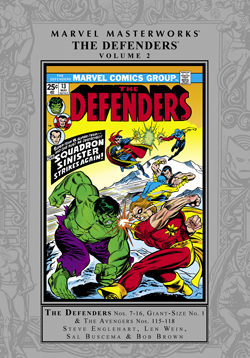
Marvel Masterworks: Defenders Volume Two

This is a review of Marvel Masterworks Defenders Volume Two. The high point of this graphic novel is the six-issue Avengers/Defenders war, in which the two teams duke it out to retrieve what looks like a plumber’s helper. The plot has a slapdash energy that I liked, even though I’ve seen it a million times before. Other storylines include a romp in the past with the Black Knight, along with The Hulk fighting the Abominable Snowman. Also: The Squadron Supreme sells earth to aliens!

Being Marvel’s one and only non-team, The Defenders’ roster changes with the winds, but semi-regular members include Doctor Strange, The Valkyrie, and The Hulk. In the volume I read, Hawkeye and Nighthawk come to visit, but only Nighthawk stays. 1970’s superhero comics mostly consist of a bunch of one or two issue storylines and have a villain of the month quality – Loki, Mordred, The Squadron Supreme, Magneto, etc.

These issues read fine, but are mostly forgettable. Writer Steve Englehart leaves, and writer Len Wein arrives. Both Mr. Englehart and Mr. Wein do good work here, but both have done better elsewhere. This is perfectly decent comics schlock that doesn’t take itself too seriously.

Marvel Masterworks: Doctor Strange Volume One

  This is a review of Marvel Masterworks Doctor Strange Volume One. IMO, there are three classic Marvel titles to emerge from the early 1960’s. The first is Jack Kirby’s Fantastic Four, the second is Steve Ditko’s Spider-Man, and the third is Mr. Ditko’s Doctor Strange. I suppose you can also include Jack Kirby’s Captain America and SHIELD runs, which I believe took place in the same time period. The rest of the Marvel output from the early 1960’s is uneven (Daredevil and The Avengers), and some of it is just plain bad – early Thor and Iron Man were wretched.

Anyway, Doctor Strange is a standout. The reason for this is Steve Ditko, whose art for this series is bizarre, distinctive, and surreal. Besides the artwork, it wouldn’t surprise me if Ditko did much of the plotting, leaving Stan Lee to write the dialogue. I believe Steve Ditko to deserve the lion’s share of the credit for the quality of this title, but YMMV. The stories here range from five to twenty pages. The shorter stories are marvels of efficiency. Not a panel is wasted.

Doctor Strange lives in a mansion in Greenwich Village. He is Earth’s Sorcerer Supreme, a phrase that’s never really explained. The less said about his origin story – which is a take on a hoary old trope most people don’t use anymore – the better. Strange is written as an interesting mix of arrogance and humility – he will help anyone who asks, but there’s something that sets him apart from the rest of humanity. He’s not the type you’d like to have a drink with at a bar.

Doctor Strange’s foes include Baron Mordo, the Mindless Ones, and the Dread Dormammu. Strange has a cloak of levitation, and he can summon the all-seeing Eye of Agamotto and the Crimson Bands of Cytorrak. He’s a solitary figure, keeping to himself and not really fitting in with the rest of the Marvel Universe at that time. There’s an issue guest-starring Thor and also an issue where he shares the limelight with Spider-Man, but mostly the good doctor is a loner.

Highly recommended!

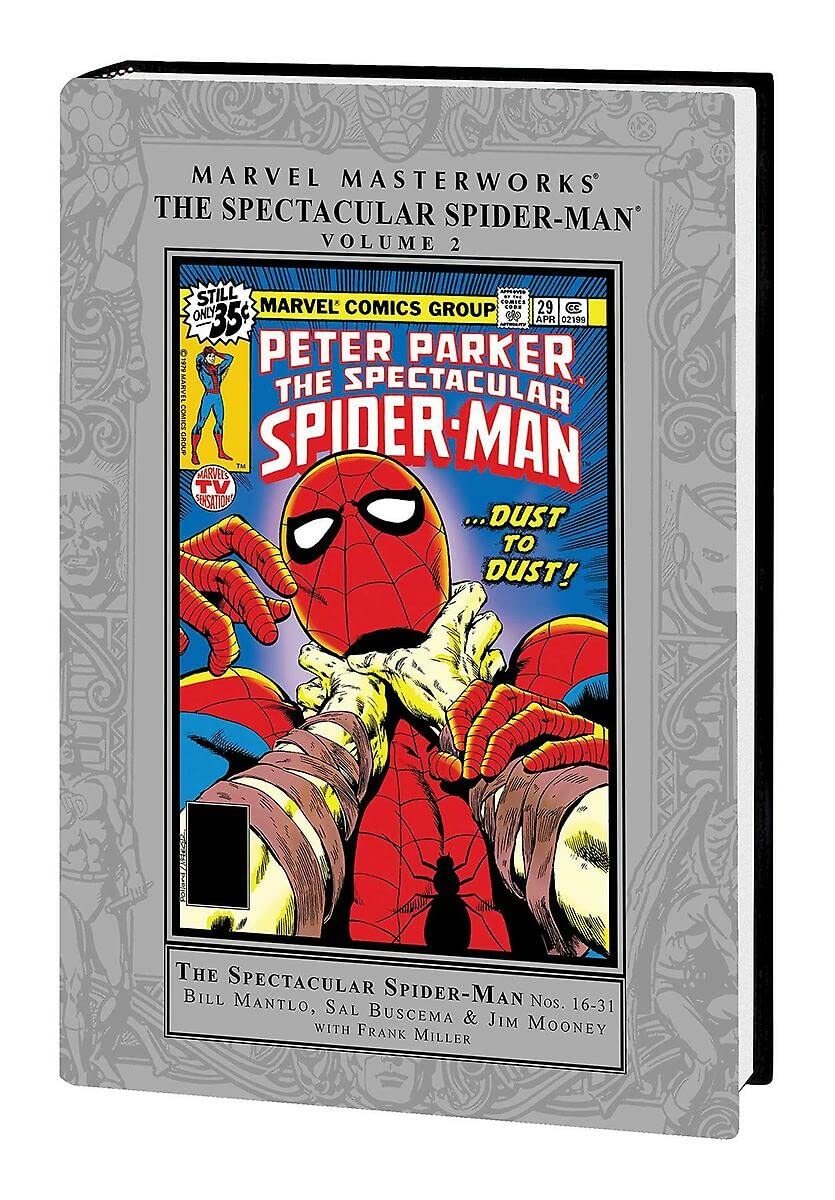
Marvel Masterworks Peter Parker The Spectacular Spider-Man Volume Two

This is a review of Marvel Masterworks Peter Parker The Spectacular Spider-Man Volume Two. I read the first volume a few years back, but didn’t review it. This Spider-Man title features the art & writing team of Sal Buscema and Bill Mantlo, although Mr. Buscema didn’t draw everything in this volume. The issues are quick reads, as are so many Marvel titles of that time period (late 1970’s).

Mr. Mantlo wrote a lot of comics, many of which I’ve read. He also created lots of characters. In two volumes of Spectacular Spider-Man, he created Razorback, The White Tiger, Carrion, Spider Amoeba, and the Hypno-Hustler. Sure, there’s a few misses (read: Hypno-Hustler), but Mr. Mantlo also created characters such as Rocket Raccoon, who went on to star in the Guardians of the Galaxy movies.

This is a normal Spider-Man title for that time period. We have shorter story arcs, and an overarching storyline involving the Maggia that percolates for most of the volume. Peter goes to California, fights a brainwashed Iceman, and then battles the Masked Marauder and his dumb android. Coincidentally, I first read about The Masked Marauder and his dumb android earlier this month in Daredevil, reviewed here, but this time the character is handled a whole lot better, because Mr. Mantlo is not pulling plot points out of his ass. We have an appearance by Daredevil and Moon Knight, and last but certainly not least – the debut of the Spider Amoeba, which to my knowledge doesn’t survive more than a single issue. This is a real shame.

Frank Miller did some of the artwork, here, which is exciting. We also have a sneaky reference to Peter Parker having sex. Since the comic creators of that time couldn’t show the characters actually having sex, they used hints and tasteful cutaway scenes, and – well – at twelve years old I wasn’t a very astute reader. I spent my first thirty-plus years reading superhero comics convinced that none of them ever had sex. My attitude can be summed up by a scene in Brian Bendis’ New Avengers run, when Wolverine refers to his son and Spider-Man says – ‘wait a minute. You’ve had sex?!’ That was my reaction, sort of, when I finally read between the lines.

This graphic novel won’t set the world on fire, but it’s a fast, fun read from an underrated writer.

Loki Agent of Asgard: Complete Collection

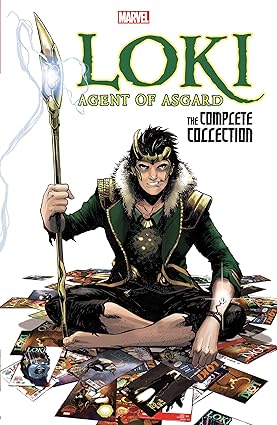
This is a review of Loki Agent of Asgard: The Complete Collection. Please note that this review contains SPOILERS, so be forewarned. I recall seeing the original Avengers movie when it came out in 2012. There are a number of things I could say about that movie, but the only thing that’s related to this review is the fact that the actor who played Loki (the villain) made him interesting enough so that people liked the character, and Marvel picked up the baton from there.

The concept behind this graphic novel is that there’s a new Loki in town, and he (sometimes Loki is a she, but I’ll use he because Loki spends most of his time as a man) acts as Asgard’s agent, and for every good deed he does another one of old Loki’s heinous deeds is wiped from existence. This status quo lasts for three or four issues before the old Loki comes back.

I don’t know if this is a sly bit of meta-commentary by the authors, because at that time iconic Marvel characters were being replaced left and right, only to return after a year or two. At the time of this series’ release, Jane Foster was Thor. You should feel bad for Loki, because while Jane’s story arc lasted years, Loki’s story only lasts a few issues.

Turns out, the old Loki is from the future and the ‘new’ Loki is his younger self. Old Loki killed the real new Loki and took his place, but the current Loki has trouble accepting this. I am unsure why the current Loki thought he could move on from murdering himself, but perhaps he needs therapy. Anyway, the old Loki is so butt-hurt about being called the God of Lies (even though that’s what he is) he decides to bring on Ragnarok. Can the current Loki stop him, and does he even want to?

I admire this series for not jumping the shark. It comes close, though. My only quibble are the two tie-ins with company-wide crossovers, but in this day and age that can’t be helped. The authors do a good job of humanizing Loki, which makes us care about him and thus creates suspense. Loki is a god, which means he’s a beaucoup powerful character. You can’t kill him, any more than you can kill a story.

Recommended!

Marvel Masterworks Iron Man Volume Two

This is a review of Marvel Masterworks: Iron Man Volume Two. I expected nothing from this graphic novel. That’s because the first volume – read my review here – was a mish-mash of bad art, clichés, propaganda, and poorly developed characters.

I am happy to report that the series finds its legs in the second volume. We have the usual Marvel love triangle, this being between Tony Stark, Pepper Potts (secretary), and Happy Hogan (chauffer). We have the introduction of Marvel mainstays The Black Widow and Hawkeye, as villains. The Black Widow is a Russian spy and Hawkeye is her boy toy.

I like the characterization of Hawkeye, here. Think Captain America, without Cap’s brains and sterling moral compass. In the Black Widow’s first appearance, she’s teamed with another spy named Boris (the Black Widow’s first name is Natasha). Since I watched Rocky & Bullwinkle as a kid, I found this very funny but YMMV.

We also have our first Iron Man multi-issue storyline. If you read my review of the first volume, you’ll know that Tony Stark has shrapnel in his chest and the only thing keeping him alive is his chest plate. When Tony’s heart problems worsen, he can’t take off his Iron Man armor, and his employees/only friends Happy & Pepper begin to suspect Iron Man of doing away with him!

I should mention my favorite scene of this volume. Tony invents an anti-gravity machine, but doesn’t recall exactly how he did it. When the Black Widow visits, Tony knows she’s a Russian spy, but little Tony makes him demonstrate the anti-gravity device in an effort to impress her. Thus, it is the Black Widow and not Mr. Doll or Jack Frost who comes closest to ending Iron Man’s life. Instead of putting a bullet through Tony’s head, Natasha merely gasses him and steals the device. It’s a lot of fun watching his increasingly frantic efforts to get it back.

There’s also the time Tony leaves the briefcase with his Iron Man armor behind. The armor is stolen, and Tony must use his ugly old golden armor to fight the interloper, who goes crazy during the course of their battle. Instead of telling the world that Tony Stark is Iron Man, he tells everyone that he’s Iron Man. Whew, that’s a lucky one!

Stark is written as being careless at best, unreliable at worst. I am unsure if the word ‘narcissist’ was used much back then, but it describes Tony to a tee. He’s a self-centered workaholic who is obsessed with money and has no real relationships to speak of. Maybe it’s because he’s living on borrowed time, or maybe it’s just the way he is.

A decent volume, especially if you like Iron Man!