
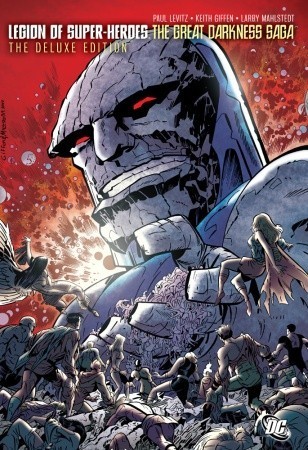
This is a review of the Legion of Super-Heroes: The Great Darkness Saga, written by Paul Levitz with art by Keith Giffen. You can read my review of Superboy and the Legion of Super Heroes Volume One here.
The Legion of Super Heroes are a group of 30th century youngsters with superpowers who have teamed up to defend the universe. Back in the Silver Age they were all teenagers. Thus, the monikers Cosmic Boy, Saturn Girl, Light Lass, etc. The stories in this volume, written in the late 1980s, treat them more as New Adults (early twenties). Think space opera combined with superpowers and dopey melodrama.
By dopey melodrama I’m talking romance, because let’s face it, everyone loves romance!!! How about an example? Light Lass convinces her beau Timber Wolf – who has a face that could scare a block of concrete – to undergo cosmetic surgery.
Soon afterwards Timber Wolf is shanghaied into a disastrous intel mission on the Khund (not-nice aliens) homeworld. They are rescued in the nick of time by a team led by Saturn Girl, which crashes on an asteroid. By the way, Saturn Girl is Light Lass’ sister-in-law.
Hey, why doesn’t Light Lass lead the rescue party? Wonder what’s up with that? Our hapless heroes are rescued by another search party led by Light Lass, who sees Saturn Girl and Timber Wolf hugging. Light Lass quits the Legion, giving Timber Wolf an ultimatum – stay or go with her. What will he do?
In the meantime, Princess Projectra and Karate Kid return to her homeland and are almost burned at the stake. Brainiac Five accidentally resurrects an old Legion foe, Computo, which marks his one billionth screw-up since he joined the team. Everyone forgives him, because they’re used to it. And someone stirs in a deserted old planet in backwater space.
The Legion receives a much-needed shot in the arm when Keith Giffen comes onto the title as artist and co-plotter. We have new Legionnaires – Blok, who is a living rock; Invisible Kid, whose little sister is host to genocidal computer Computo; and The White Witch, a sorceress.
This volume features the Great Darkness Saga, a five issue storyline that involves the awakening of cosmic menace Darkseid in the 30th century. I am not giving anything away because the cover of this volume shows us Darkseid, who terraforms an entire planet into his effigy.
Darkseid sends out degraded versions of cloned heroes as his emissaries – to collect items of power, and then people. The Legion is overmatched, especially when Darkseid learns of the existence of the planet Daxam, which orbits a red sun. He warps the planet under a yellow sun, which means billions of super-powered Daxamites under his control! Can the universe survive? Well, yeah, but it’s a big story.
Nowadays, the Great Darkness Saga would be a special event with multiple issues in twelve different titles. Instead it’s just there – the best Legion of Super Heroes storyline ever created, one of the top superhero comic storylines of the 20th century, and a high point of both of the creators’ careers. If you like superhero comics combined with space opera it doesn’t get any better than this.

 Abandoned Places