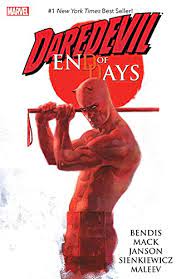
Daredevil: End of Days

Daredevil: End of Days

WARNING: contains spoilers.

The plot of Daredevil: End of Days is simple. Years in the future Matt Murdock, aka Daredevil, is killed in a brawl with his archenemy Bullseye. Before he dies, he says ‘Mapone’ to Bullseye. Perhaps Murdock says this because of the beating he’s taken from Bullseye, or the brain damage he’s undoubtedly suffering from, or it could mean something else. Nobody cares but Daredevil, Bullseye, and beat reporter Ben Urich. This is a potential problem, because I didn’t care what Mapone means either. What made Matt Murdock lose his sanity is a lot more interesting, in a car crash sort of way.

Urich is a strange choice for a narrator. He has a compulsion to know what happened, all the while understanding that the picture he paints won’t be pretty. He’s the picture-perfect portrait of the grizzled beat reporter, so much so that a cynic might say that he’s a parody of himself, especially when he does things like standing in a downpour (because it’s always either dark or raining in Hell’s Kitchen).

Urich decides to retrace Murdock’s last years. The last time Matt was seen in public as Daredevil, he killed the Kingpin in a brawl. This is the type of thing that is frowned upon by a civilized society, and there’s also the undeniable truth that pummeling a man to death with your bare hands in public is a clear sign that you have lost it.

So begins the journey of discovery. Even though Ben Urich has no social skills, we learn things. A man dressed as Daredevil is tailing Urich. The Black Widow is dead, either in a cosmic skirmish (according to Nick Fury) or murdered in a bathtub (according to the cover of Issue #6). Urich’s adopted son, Timmy, idolizes Daredevil. Former assassin Elektra is now a soccer mom. Bullseye kills himself a few days after murdering Murdock. Daredevil’s ex-foe Gladiator makes costumes for fetish parties. Oh, and all of Matt’s ex-girlfriends have children with red hair. This was funny the first time, but after the third or fourth child with red hair, it veered into eye-rolling territory. 

Urich reaches a dead-end when he visits the Punisher in prison. Old, grizzled Frank Castle gives the plot away, but Urich is either too dogged or too stupid to quit. He keeps on plugging away, scraping the bottom of Murdock’s rogue gallery, until he’s killed by the Hand. At which point we learn that the new Daredevil is Urich’s adopted son, Timmy, who was trained by none other than Murdock himself! We also learn that Mapone is the name of Matt Murdock’s and the Black Widow’s daughter. She may also be Murdock’s reincarnated teacher, Stick. 

We never learn what made Matt Murdock lose it, and what he was doing all those years in hiding. We also never learn why the name Mapone makes Bullseye kill himself. I have searched teh Googles in vain, but have found no answer as of yet. EDIT: it turns out Bullseye didn’t know what Mapone meant, but the fact that Murdock got in the last word tipped him over the edge. This is according to the writer’s blog, but I am unsure if the writer is trolling, because his answer makes no sense. I think it’s fair to say that the linking of Bullseye and Mapone as a plot point doesn’t work. The other thing that confused me are the covers, which depict the deaths of Daredevil & various Daredevil cast members, some of whom were still alive when I read the book. 

Overall, I enjoyed Daredevil: End of Days, even though plot-wise the book falls apart in the final issue.

Marvel Masterworks: Fantastic Four, Volume One

Marvel Masterworks: Fantastic Four, Volume One

When I was a kid, Marvel published a series of mass market paperbacks that featured the first six issues of their most popular titles. I bought the first three Spider-Man paperbacks along with the first volumes of the Hulk and the Fantastic Four. My favorite title was and continues to be Spider-Man, but rereading the first volume of Marvel Masterworks: Fantastic Four years later, I was surprised at how good these comics are.

The first ten issues of Jack Kirby and Stan Lee’s Fantastic Four run feature a hodgepodge of classic heroes and villains, including Alicia Masters, Doctor Doom, The Mole Man, The Puppet Master, The Sub-Mariner and the Skrulls. Each issue is a stand-alone, with no two-parters or trilogies. It feels like effort went into the creation of these stories.

Whatever the reason, this volume has juice. Maybe that’s because, like Spider-Man, the Fantastic Four are created when someone messes up. That someone is Reed Richards, who decides it’s a good idea to sneak into a military base with his fiancée and her teenage brother so that he can steal a rocket and blast off into outer space. When Ben Grimm, the ship’s pilot, points out that the rocket has no protection against cosmic rays, he’s shamed into coming along. Of course, Grimm is the guy who wins the booby prize. While the others gain cool powers, Ben transforms into a pile of orange rocks. His reaction to this development is realistic: he’s pissed off at everyone and everything, but especially his teammates.

Reading these comics gave me the impression that the members of the Fantastic Four are like a big, dysfunctional family whose members hate each other, but will stick together in a crisis. Grimm, who is dubbed The Thing by his loving teammates, gains super strength and is a danger to everybody. The only reason his teammates put up with him is because they made him.

The other members of the team aren’t quite as interesting as Ben Grimm, but they’re all flawed in interesting ways. Reed Richards, aka the Human Rubber Band, is heroic, but has a habit of making stupid decisions. Johnny Storm, who can burst into flames, is a typical 60’s-era teenager whose powers fluctuate depending on whatever the plot requires. His sister, Susan Storm, is the least interesting of the bunch. She has a weak power set (invisibility) and is too passive, but later gains the ability to project invisible force fields.

The stories are a blend of superhero action and 60’s era science fiction. The standout supporting character of the first volume is the Sub-Mariner, who appears in three of the first ten issues. Unlike Doctor Doom, who is the prototype of a moustache-twirling villain, the Sub-Mariner is more than a two-dimensional character. He’s a villain with sympathetic qualities, just like The Thing is a hero with villainous qualities. In one of the issues, he even saves the day; this after he betrays the Fantastic Four and is double-crossed by Doctor Doom. 

The first volume of Marvel Masterworks: The Fantastic Four is well-worth a read, and shows why the Fantastic Four used to be Marvel’s flagship title.

Comic review: House of X/Powers of X

House of X/Powers of X

The main players of the latest X-reboot are Charles Xavier, Magneto, and Moira MacTaggert. Moira, whose mutant power is reincarnation, rallies the mutant population around Charles Xavier and Magneto. Using the sentient island (?!?!) of Krakoa as their base, Xavier & company seeks sovereignty from humankind.

Shit gets real when a band of human scientists calling themselves Orchis seek to bring a Master Mold AI online, which will lead to the apocalyptic human/machine/mutant war. We see the results of that war, a hundred years from now, when the two remaining factions (mutant and machine) resort to breeding mutants as cannon fodder.

Moira, who is on her tenth (and final) life, fades from the spotlight halfway through this graphic novel. The creation of a new mutant society leads to all sorts of interesting factions: Apocalypse, the Hellfire Club, Mr. Sinister, Mystique, but the biggest wild card of all is the island of Krakoa, which in the future acts as a mutant breeding center.

This is foreshadowed when a group of X-Men die supposedly destroying the Master Mold, which is in orbit around the sun. Except they don’t die: Krakoa produces clones of the fallen heroes and Xavier has backed up their minds, so they are reborn. Thus, mutants are now immortal.

This graphic novel is as much science fiction as it is superhero comic, because Jonathan Hickman (the writer) is so good at blending the two. We learn about the Marvel Universe’s different galactic civilizations, and he even manages to make it sort of interesting.

The other interesting aspect of this book is the cult-like aspects of Xavier’s new civilization. Magneto dresses like Jim Jones, and Xavier himself – who is even more overtly messianic – wears a helmet with no eyes. The blind leading the blind. It’s an open question as to whether the X-Men are the heroes here, or if they are even meant to be.

A must-read for X-Men fans.

Flash: Savage Velocity

Ah, the 1980’s. MTV, Ronald Reagan, Rocky Balboa, The Terminator, Freddy Krueger, buddy cop movies, Pee Wee Herman, Jason Voorhees, Ollie North, contras. Sting, singing Russians. I could go on but I won’t, because boy the 80’s sucked but the decade did produce some great comics. Thus, when Comixology had their annual end of the year sale, I picked up a copy of this book. I read some – not all – of the issues back in the day, and wanted a complete collection. The writer, Mike Baron, wrote a number of quality comics in the 80’s – Nexus, Badger, The Punisher – and of course The Flash.

First things first: this is a very different Flash. Barry Allen, temporarily dead, is replaced by his youthful sidekick Wally West. Wally has been depowered– he can’t break the sound barrier, has to eat two or three times the amount of a normal person, and passes out after he uses his super speed.

Wally himself is written like a 20-year old. An immensely privileged, stupid lucky 20-year old. He buys a lottery ticket and becomes a multi-millionaire. His mom moves in with him and he can’t bring himself to throw her out. His girlfriend is a decade older than him. She’s also married, and when her husband finds out he injects himself with a steroid that gives him super strength and speed and tries to kill Wally. As happens in superhero comics.

Other standout villains in this volume include Vandal Savage, a caveman who dresses like a French lord and designs a highly addictive drug that grants its users super speed. The Chunk is a human event singularity who must consume 47x his weight or implode. The people Chunk consumes are transported to an apocalyptic hellhole. Despite this, Chunk isn’t exactly Doctor Doom, and is written more as a misguided soul than a villain.

This is a nice run by Mike Baron, who only stuck around for 14 issues plus an annual. The issues move fast, pun intended, and there’s an endearing weirdness to the stories, most of which are inspired by the 1980’s – Max Headroom, drug epidemics, the Cold War, ‘roid rage. Wally himself isn’t portrayed in a very heroic light, whether he’s having an affair with a married woman, puttering around his Long Island mansion, or going to parties hosted by Mafia Dons. He’s written as materialistic and horny, a man incapable of saying no to any woman. Unsurprisingly, most of his relationships are shallow and dysfunctional. This was all part of DC’s grand experiment of giving their heroes personalities. It didn’t go on long, but it sure was interesting while it lasted.

I recommend this graphic novel. The first comic book I ever bought was an issue of The Flash, back in 1978 when Barry Allen wore the scarlet tights. I’ve read a lot of Flash since then, and I am here to say that Wally is a more interesting character than Barry Allen ever was. The powers that be might have brought Barry back, but Wally will always be my Flash.