This is a review of B.P.R.D.: The Soul of Venice and Other Stories. The adventures of the Bureau of Paranormal Research & Defense continue. Read my review of the first volume here.
This graphic novel consists of five one-shot stories, ranging in subject from goddesses of domestic bliss to evil sentient toys. The best tale of the bunch is “Dark Waters,” drawn by artist Guy Davis, who brings a distinct visual flair to the B.P.R.D. Mr. Davis also helped design the creatures for Guillermo Del Toro’s Pacific Rim.
When a pond in the town of Shiloh, Massachusetts is drained, three women bound in chains are discovered in the ooze beneath. They were drowned as witches, hundreds of years ago, but are still preserved – and they smell like roses. It’s a miracle! Or is it? Shiloh’s crazy pastor – who looks like Charlie Manson – disagrees. The other standout tale is “Night Train,” wherein Liz Sherman and Roger the golem investigate a ghostly choo-choo train. The ghost of Lobster Johnson makes a cameo!
This is a review of Spectre: The Wrath of God, written by John Ostrander and drawn (mostly) by Tom Mandrake. What does it mean to be the Wrath of God? By definition, you’d see things in terms of black & white. If your host is an ex-cop who was murdered fifty years ago, you might be a tad out of touch. This is a problem, especially if you are beacoup powerful.
The Spectre, enraged at the death of his lover Amy Beitermann at the hands of a serial killer, decides to judge humanity. Translation: the Spectre is going to destroy the Earth as soon as he works himself up to do it. He’s opposed by the Phantom Stranger, who puts together a SWAT team (Doctor Fate, Zatanna, The Demon Etrigan) to stop him. He doesn’t include Madame Xanadu, which turns out to be a mistake.
If you want a snapshot of the hotspots of the planet Earth in the early 90’s, you will find them in this comic – the Spectre visits Northern Ireland, Israel, Brooklyn, and the imaginary country of Vlatava, where he shanghaies the opposing generals – just like that famous Superman comic, decades ago! Instead of urging the generals to settle the country’s civil war by fighting each other, he makes them watch while he kills every man, woman, and child in Vlatava.
This is serious Old Testament shit, and it has repercussions. The U.S. government retrieves the Spear of Destiny, a powerful magical artifact capable of killing the Spectre, and gives it to Superman. Unfortunately, the Man of Steel is vulnerable to magic…and the spear is imprinted with the psyche of Hitler.
John Ostrander is one of my favorite writers, and the trippy art by Tom Mandrake is great, so of course I recommend this graphic novel. Too bad the rest of this run isn’t available in trade or hardcover, because I’d snap it up in a minute.
This is a review of Tales of the Batman: Steve Englehart. I bought a bunch of Batman graphic novels over the holiday season. I’ve read and liked parts of Mr. Englehart’s West Coast Avengers and Green Lantern runs in the 1980’s, so I took a chance.
Reader, I was not disappointed. Mr. Englehart wrote the Joker Fish storyline, which apparently is famous even though I’ve never heard of it. Before this point, I’d never even heard of Silver St. Cloud. I don’t quite get why this run is so obscure, because Mr. Englehart has a unique take on the character. It might be because his original run on Batman is blink-and-you’ll-miss-it short, running eight issues in the 1970’s – but he makes those issues count. Mr. Englehart introduces a new villain, Dr. Phosphorous, and brings back two older villains (Dr. Hugo Strange and Deadshot) in an interesting way.
He also writes an awesome Joker. The Joker Fish storyline starts with the Clown Prince dumping toxic chemicals into the bay, which produces smiling fish. The Joker decides to cash in by copyrighting his Joker Fish, which means anyone eating a fish sandwich will owe him $$$. He then commences killing any bureaucrat that refuses to grant him the copyright.
And then there’s Silver St. Cloud, the love interest I’d never heard of. That might be because Mr. Englehart goes where few Batman writers have dared. Silver & Bruce start to date, and when it gets serious she figures out his secret identity. She leaves him, for a variety of reasons, and doesn’t return for 30 or so years (real time, not comic time), when the storyline is resolved – sort of.
As I’ve said, portraying Batman as an adult human being with certain, uh, needs, seems to be taboo amongst Batman writers. This is sad, because if you read more than two issues of Batman it becomes obvious that he really needs to get laid. So why doesn’t he? The simple explanation is the one Mr. Englehart went with. Batman declared war on crime as a boy, on a boy’s terms, which leaves no room for love. The simpler explanation, which is the one I go with, is that Batman is mentally ill.
I mean, whatever. Mr. Englehart pulls off the feat of having Batman be in a serious relationship with a woman that feels real, and it is additive rather than reductive to his character. The culmination of their affair occurs when Batman says something stupid, because he has no idea how to talk to women. This makes senses, as anyone who spends their nights dressed up as a bat will almost certainly lack basic social skills. The storyline as written in this volume feels unfinished, and I’m almost afraid to Google Silver St. Cloud’s name, as the easiest solution is to fridge her.
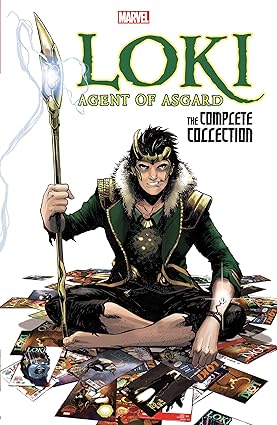
This is a review of Loki Agent of Asgard: The Complete Collection. Please note that this review contains SPOILERS, so be forewarned. I recall seeing the original Avengers movie when it came out in 2012. There are a number of things I could say about that movie, but the only thing that’s related to this review is the fact that the actor who played Loki (the villain) made him interesting enough so that people liked the character, and Marvel picked up the baton from there.
The concept behind this graphic novel is that there’s a new Loki in town, and he (sometimes Loki is a she, but I’ll use he because Loki spends most of his time as a man) acts as Asgard’s agent, and for every good deed he does another one of old Loki’s heinous deeds is wiped from existence. This status quo lasts for three or four issues before the old Loki comes back.
I don’t know if this is a sly bit of meta-commentary by the authors, because at that time iconic Marvel characters were being replaced left and right, only to return after a year or two. At the time of this series’ release, Jane Foster was Thor. You should feel bad for Loki, because while Jane’s story arc lasted years, Loki’s story only lasts a few issues.
Turns out, the old Loki is from the future and the ‘new’ Loki is his younger self. Old Loki killed the real new Loki and took his place, but the current Loki has trouble accepting this. I am unsure why the current Loki thought he could move on from murdering himself, but perhaps he needs therapy. Anyway, the old Loki is so butt-hurt about being called the God of Lies (even though that’s what he is) he decides to bring on Ragnarok. Can the current Loki stop him, and does he even want to?
I admire this series for not jumping the shark. It comes close, though. My only quibble are the two tie-ins with company-wide crossovers, but in this day and age that can’t be helped. The authors do a good job of humanizing Loki, which makes us care about him and thus creates suspense. Loki is a god, which means he’s a beaucoup powerful character. You can’t kill him, any more than you can kill a story.
This is a review of The Spectre: Crime & Judgments, which collects the first twelve issues of John Ostrander (writer) and Tom Mandrake’s (artist) 1990’s run of the Spectre. It is no secret that I’m a huge fan of John Ostrander, the man responsible for the creation of Grimjack and the modern version of The Suicide Squad.
The Spectre is an older character who appeared in the Justice Society way back in the 1940’s. Basically, The Spectre is the Wrath of God. His purpose is to wreak vengeance on evildoers, and since he’s beaucoup powerful, he can do whatever he wants. The Spectre’s anchor/human host is Jim Corrigan, a cop killed in the 1930’s. Corrigan’s ghost still hangs around, even though sixty years have passed. Evil never sleeps, and neither does he.
My favorite issue of The Spectre features a trio of kidnappers who bury a child alive and die before they can reveal the child’s whereabouts. The Spectre storms into Hell and fights a devil for one of the kidnapper’s souls. When the kidnapper reveals the child’s whereabouts, the Spectre tosses him back into the eternal flames like a piece of garbage.
I don’t want to say a lot about the plot. If you are the type who’s easily triggered, I might skip this book. I myself had trouble reading the last four or five issues, but then again I’m a sensitive sort. The B-storyline features a character who mirrors the Spectre, in that he says he’s destroying evil. This character is also an enormous monster. Make of that what you will.
Great art, great writing. Highly recommended, especially if you like nihilistic horror.
This is a review of Sandman Deluxe Edition Book Two. I read the first volume back in January. I think they might have changed the order of a few of the issues here and there, but am unsure. It’s been a long time since I read the original run.
The A-storyline begins with a meeting between Dream and his family, Dream, Death, Destiny, Desire, Despair, Delirium (known as The Endless). Desire goads Dream about the lover he banished to Hell for defying him. Dream, apparently unaware that he acted badly, notifies Lucifer that he’s coming to Hell to get his ex-lover back.
Lucifer responds by…retiring. Yes, you heard that right. Lucifer resigns as the Lord of Hell, kicks everyone out, locks Hell up, and gives Dream the key. Morpheus is now the proud owner of his own Hell, which turns out to be prime real estate. Pretty soon gods and entities from other pantheons are lining up to try to persuade the Dream Lord to give them Hell.
There are also a number of single-issue stories, featuring cats once owning the universe, an imprisoned Muse, Element Girl, a very special performance of The Tempest, Augustus Caesar, and Johanna Constantine vs. the French Inquisition. Top caliber!
This is a review of Batman: The Jiro Kuwata Batmanga Vol. 1. Did you know there used to be a Batman manga? I know because of Chip Kidd’s Bat-Manga, which chronicles a number of Batman’s Japanese adventures. This is not a review of Bat-Manga, as Mr. Kidd did not write or draw any of the stories featured in his book. The creator of the Batmanga stories is Jiro Kuwata.
Now that we’re clear on that, how’s the first volume? Pretty good! Batman – along with youthful sidekick Robin, the Batmobile, and his trusty batarang – keeps Gotham City safe from villains. Speaking of those villains…Mr. Kuwata makes the bold choice to add new figures to Batman’s rogue gallery, including Lord Death Man, Professor Gorilla, and The Human Ball!
This was the 60’s, when Batman comics were still goofy and you had a live-action TV show starring Adam West and Burt Ward. So if you are looking for hardboiled action, uh, I don’t know what to tell you. A fun, offbeat read that I liked.
The official start of Brian Michael Bendis’ run on Daredevil kicks off with the attempted assassination of the Kingpin, who is now blind. The palace coup is led by none other than Sammy Silke, a made guy from out-of-town. Silke’s dad and the Kingpin’s dad were friends, which is why Sammy is around. How an out-of-towner on the skids from his own crew ends up running a major crime syndicate (however briefly) is an interesting story. But is it a Daredevil story? Keep reading!
The Kingpin, like every girl Matt Murdock has ever slept with, knows that Murdock is Daredevil. Even though Daredevil is a crimefighter and the Kingpin is a crime lord, the two of them have come to an understanding. This is the sort of thing that happens in comic books all the time, but falls apart in the real world. What it amounts to is that the Kingpin leaves Daredevil alone, and Daredevil continues to beat the shit out the Kingpin’s men. This is a bad deal, if you are in the Kingpin’s crew.
The Kingpin’s disgraced son spreads the word, and pretty soon everyone in the Kingpin’s crew knows that Murdock is Daredevil. But they aren’t allowed to touch him. They’re pretty salty about it, so when Sammy comes along sowing the seeds of discontent, he finds a willing audience. TBH, in the real world a blind mob boss would last about thirty seven seconds.
Silke puts out a bounty on Matt Murdock, so we see assassination attempts from villains such as Nitro, Boomerang and Mr. Hyde, including a fight scene with an unnamed assassin that would normally take a single panel but goes on for pages. The fight is visually striking and looks great, but it’s also total page filler. There’s no way Daredevil is going to die at the hands of an anonymous killer.
Sammy leads the assassination attempt against the Kingpin, complete with knives. Despite not having read a book since the third grade, Silke quotes Shakespeare’s Julius Caesar, which leads to a plausibility hiccup. These are mobsters, trained killers, but they don’t make sure the Kingpin is dead. The easiest way to do that is to put a bullet through his head. They should have done that, because the Kingpin isn’t dead.
Vanessa Fisk, the Kingpin’s wife, exacts vengeance by killing everyone involved in the assassination attempt, including her son. Sammy escapes by the hair of his chinny chin chin and goes running to the FBI. The Feds tell him to take a hike, unless he gives them something. Sammy gives them Daredevil’s secret identity. This is squashed by the FBI higher-ups (it helps that Murdock has a SHIELD file), but one of the agents goes to the Daily Globe. The Globe runs the story, and Matt Murdock’s life goes to Hell.
The fallout from the expose is brutal. Foggy Nelson (Murdock’s law partner) wants him to hang up the tights. Foggy doesn’t pull any punches, pointing out that so many people know Murdock is Daredevil, it’s a wonder the secret didn’t come out sooner. He also plays the old ‘two of your exes were killed by your archenemy’ card, thus implying that Murdock is indirectly responsible for their deaths.
This argument isn’t exactly true, and it’s debunked by others, but it’s powerful nonetheless. What Foggy is saying is that Murdock’s lifestyle is dangerous, which is bound to lead to fallout and civilian casualties. Soon afterwards, Mr. Hyde attacks Murdock’s brownstone and almost kills Foggy.
Murdock hangs up the tights for a few issues. It is to the writer’s credit that he doesn’t even pretend that this will be permanent. Two of Murdock’s exes, Natasha Romanova and Elektra Natchios, pay a visit. Natasha and Elektra are the same character, in that they are both stone cold killers. Natasha used to be a Soviet spy. Now she’s an American spy. She’s killed tons of people, all off-camera. This is an uncomfortable truth, like pointing out all the people the Hulk has killed (which the same writer did). Elektra is an assassin, and the ultimate crazy ex-girlfriend.
They have different solutions to Murdock’s problem. Natasha wants Matt to play dress-up and beat up some muggers, and Elektra validates everything Foggy says. The issue fades away when Matt dons the tights again, except it doesn’t. Is Matt Murdock a noble hero who’s sacrificed everything for Hell’s Kitchen? Or is he a narcissist willing to risk the lives of his loved ones because he likes playing dress-up? Or is he both? To be continued…
The third storyline in this volume is the most powerful. Hector Ayala, aka The White Tiger, interrupts a robbery in progress and ends up accused of a police officer’s murder. Luke Cage, of Hero for Hire fame, wants Matt Murdock to represent Hector. Murdock tells Cage that if he takes the case, his pending lawsuit against the Globe will make the trial a media circus as well as a referendum on superheroes. Murdock ends up taking the case anyway, because reasons. Why does he do this, especially since everything he says to Luke Cage turns out to be true?
The trial begins. Luke Cage follows the trail of the junkies who killed the cop. We learn that the robbers left town, and then the plot thread is dropped. Why? Murdock has resources we can’t imagine, including access to the superhuman community. Instead of attempting to find the real perpetrators, Matt Murdock makes the case a referendum on superheroes, even though the prosecutor trying the case TELLS Murdock that making the case a referendum on superheroes will be playing right into his hands.
Hector is found guilty and commits suicide by cop. The story is insanely depressing, all the more so because we know that Hector is innocent. It also proves that Murdock is a narcissist. Why did he take the case to begin with, and then compound the error by making the trial all about him? Because – as he himself says – he has to do things his way. He just can’t help himself.
This is a review of the first four issues of Brian Michael Bendis’ run on Daredevil, Issues #16-19. The plot: young Timmy has become disassociated from reality. He constantly relives a fight between Leap Frog and Daredevil, which makes ace (?!?) reporter Ben Urich’s nose itch. It is Urich, and not Daredevil, who is our narrator and p-o-v character for the next four issues.
Timmy’s father is Leap Frog, a supervillain who dresses like a frog and hops around. Is this dumb? You bet it’s dumb, which I’m sure is why the creative team uses him. Leap Frog is a bad daddy, to say the least. He and his wife physically abused Timmy. Now Leap Frog has disappeared. He was last seen tussling with Daredevil, and what went on between them that night seems to be what put Timmy in a comatose state.
That’s the plot, and it takes four issues to resolve. Let me start by saying that the art & writing in these issues is top-notch. I was engaged, and wanted to know what happened to Timmy. That said…look, comic books are never going to be mistaken for reality. Daredevil is a blind guy who dresses like the devil while soaring around Manhattan using a trick billy club, so we aren’t talking about reality here. We are talking about plausibility.
The plot hinges on Ben Urich finding Daredevil, who knows what happened that night. Ben Urich knows Matt Murdock is Daredevil. Murdock has told Urich about the accident that blinded him and why he became Daredevil. Urich knows a lot about Matt Murdock, but despite that, despite being a beat reporter with access to the resources of a major media company, he doesn’t have Murdock’s phone number and he doesn’t know where Murdock lives. This is implausible, to say the least, and the reason it’s so glaring is that it feels like an excuse to stretch the plot to four issues. And the plot did feel stretched.
We don’t get a lot of Daredevil in these issues, but that’s fine. If I recall correctly, I had more than enough of Daredevil by the time this run ended. Urich and his wife end up adopting young Timmy, even though Timmy’s mom is still alive (maybe she gave him up for adoption?). Timmy makes an appearance as a teenager in Daredevil: End of Days, where he’s totally messed up. Anyway, these four issues are good but too long. The character of Daredevil has a storied history, and this run certainly adds to the legend.
Marvel Masterworks: X-Men, Volume 1 is a mixed bag. Jack Kirby’s art is wonderful. The writing is okay, the caveat being that the same two storylines are repeated ad nauseum in the first ten issues. For those not in the know the X-Men are mutants, aka Homo Superior. Their genes give them miraculous powers, which is good. What’s not so good is that plain old humans, Homo Sapiens, hate and fear them. The X-Men are led by benevolent telepath Charles Xavier, who is dedicated to protecting humankind from existential threats and also evil mutants. It’s interesting that Xavier works to protect humanity rather than his own kind, a paradigm that changes later.
The evil mutants are led by Magneto, who in this volume is a Dr. Doom clone. Magneto believes that human beings are scum. He’s assembled a group of mutants, aka The Brotherhood of Evil Mutants, to conquer humanity. Later, Magneto and Charles Xavier become two sides of the same coin, but here they are oil and water.
There are two storylines. In the first, Xavier discovers the existence of a new mutant. He sends his X-Men to recruit this new mutant, but the mutant always turns out to be evil. See: The Vanisher, The Blob, The Sub-Mariner, Unus the Untouchable. In the second, the X-Men fight Magneto and his band of evil mutants, as they try to a. conquer the earth; b. recruit mutants to their cause. Both Xavier and Magneto are terrible at recruiting mutants, Magneto because he’s a homicidal maniac, Xavier because he’s creepy. Would you want a teacher who could read your mind? At least with Magneto, you get to hang out in his cool lairs, asteroids and islands with big magnet skyscrapers.
Reading this volume gave me the impression that the creative team was in a state of perpetual deadline Hell. It’s not that the stories are bad, but reading the same two plots gets repetitive. One of the better issues is the introduction of Ka-Zar and the Savage Land, because it probably started life as a ten-second pitch session (Tarzan in Arthur Conan Doyle’s Lost World!) that gained legs.
Marvel Masterworks: X-Men is worth a read, because it’s Jack Kirby and also because it introduces a number of iconic characters in Marvel history, even if we don’t see a lot of these characters nowadays. These are the issues that laid the groundwork for some classic stories.




 Abandoned Places