The Exorcist

I have an Exorcist story, but you have to read my review first!

We’ve read a bunch of good books this semester, and The Exorcist is one of the best of the bunch. I’d rank it neck-in-neck with The Shining, probably my all-time favorite horror novel. In fact, I enjoyed all the books we read with the exception of two; I must confess to liking The Amityville Horror,which is craptastic but still fun to read in an awful sort of way.

If you have even a passing interest in horror movies, you know the plot of The Exorcist. The movie is faithful to its source material, even using a number of the book’s best lines. I believe Mr. Blatty wrote the screenplay. But hey, we’re not here to talk about the movie!

I have read The Exorcist a number of times. I’d say that number is less than ten, because that book never triggered my OCD, thus making it a must-read. So I know it pretty well. There is a sequel to The Exorcist, Legion, which is well-worth reading also. The main characters of Legion are Lieutenant Kinderman and Father Dyer, believe it or not.

Here are a few impressions, gleaned from reading the book again.

The biggest thing that struck me is how funny the demon is when it talks. Most of the things it says are blasphemous, but they are still funny. The demon has a sense of humor, something God seems to totally lack. This is an interesting decision on Blatty’s part.

Why? Well, there are theological implications. A sense of humor is a very human trait, especially considering I believe that one of the prerequisites for a sense of humor is suffering. That would mean that humans have more in common with demons than with god. Ah, you say, maybe the demon was a good mimic or channeling Burke Dennings, although Father Merrin states that there is only ONE entity possessing Regan. Possible, but unlikely. The demon has a PERSONALITY that comes through when reading the book, and that’s hard to fake.

One of the understated questions raised by The Exorcist is why do people suffer? It’s a good question (which the book doesn’t answer), explored in greater depth in Legion. People should read Legion, because Kinderman’s fabled carp in the bathtub makes an appearance.

Speaking of Kinderman…he’s based on Porfiry Petrovitch, the inspector in Crime and Punishment. The TV character Columbo is also based on Porfiry. Don’t be fooled by Kinderman; he’s a devious bastard. Denning’s death and the church desecrations are the book’s subplot, which hums along nicely beside Regan’s decline.

Here’s an interesting question: who is the main character of The Exorcist? The title refers to Father Merrin, who bookends the book but isn’t around enough to qualify. Father Karras is the demon’s intended target and a solid choice; Regan’s character has no drive of her own; Kinderman is a strong character, but in the same boat as Father Merrin. My personal choice would be Chris MacNeil, even though after a certain point she becomes little more than a spectator. One of The Exorcist’s strengths is the number of interesting characters; even the minor characters are fleshed out.

Anyway, here’s my Exorcist story. When they released the extended theatrical version, I went to see it in the movies. I was too young to see the original version back in 1973! Anyway, the theater was full of kids, and those kids laughed their asses off from start to finish. That’s the first time I realized I WAS GROWING OLD.
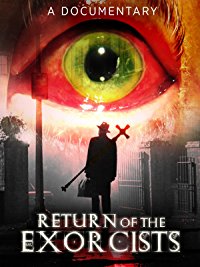
 

Return of the Exorcists

Return of the Exorcists

There are a few telling scenes in The Return of the Exorcists, a documentary about the resurgence of popularity of the practice of exorcism in Italy. But they aren’t what you might expect.

The first: a busy priest sits in front of a computer, clicking away on the mouse. He’s discussing the case of a person who might be possessed by Satan on the phone. When he hangs up we see the computer screen, which is broken. The exorcist was clicking on an empty screen.

The second scene takes place in a church whose leaders and parishioners are part of the Charismatic Movement. At this particular church you have to take a number to get an exorcism – it’s like being at a deli, but instead of getting roast beef or low-salt ham, you get exorcised.

I suppose you can tell what I think of Return of the Exorcists. I am not Catholic; I was brought up Lutheran. I am now agnostic. This documentary is not really for horror fans unless you are super-interested in exorcism. Even then, the documentary doesn’t go into much detail and at points outright contradicts itself.

We learn that possessed people go into trances. A priest tells us about the possessed woman who almost levitated. Of course, there isn’t any film of this. We do see footage of a number of disturbed people who may or may not be possessed. The filmmakers talk to a woman who has been going to an exorcist for years and now only cooks with olive oil and salt blessed by an exorcist.

The Return of the Exorcists isn’t interested in these people. The focus is on the men who perform the exorcisms, who are the real stars of the show. Or – depending on your point of view – the sideshow.

If you need your exorcism fix, watch The Exorcist again.

Hostage to the Devil

Hostage to the Devil is not a movie about exorcism, nor is it based on Malachi Martin’s book “Hostage to the Devil,” which deals with exorcism. This is a documentary about Malachi Martin himself. Full disclosure: I read Mr. Martin’s book “Hostage to the Devil” last year and formed definite opinions about the author.

Hostage to the Devil makes no claims to being unbiased about its subject. The movie is full of sincere people talking about what a great man Malachi was, making it clear that Mr. Martin attracted a band of devoted followers. Demonologists (Lorraine Warren) and conspiracy theorists (Art Bell) make appearances or pay tribute. There are clips of Mr. Martin being witty. The lone dissenter states that Mr. Martin was a huckster who started believing his own horseshit; he also thinks Mr. Martin had an affair with his wife, making it unclear if he’s a lunatic.

Mr. Martin was no longer a Jesuit when he wrote “Hostage to the Devil” and cashed in on the success of “The Exorcist,” but if this documentary is to be believed he and his posse went around performing exorcisms in New York City for years. The movie shows us footage of a few ‘possessed’ people being exorcised, which is disturbing in that we are watching the mentally ill being exploited. Mr. Martin does not appear in this footage, so I don’t know if he participated in these exorcisms.

Unless you are obsessed with Malachi Martin – and apparently some people are – Hostage to the Devil is a bore. The documentary tries to build suspense by reenacting an encounter Mr. Martin had with The Devil in Connecticut, and there are those who believe Satan murdered him. What can you say to that? I’m sorry Mr. Martin passed away.

If you want to learn more about Mr. Martin’s beliefs concerning exorcism I’d recommend his book “Hostage to the Devil.” Mr. Martin was a traditionalist, in that he thought Vatican II turned back the clock (before Vatican II, the Catholic Church conducted its services in Latin) and unleashed Satan upon an unsuspecting world. The book rails against such social ills as belief in evolution, sexual expression, self-exploration, yoga, the counterculture, women’s rights, etc., etc., etc. It’s quite a long list. Mr. Martin also believed The Satanic Panic of the 80’s really happened. Ironically, despite Mr. Martin’s professed hostility to New Age beliefs, the book “Hostage to the Devil” is at its core a New Age book because of the author’s willingness to believe anything couched in religious jargon.

I’ve seen a number of good horror documentaries over the past few years, including Cropsey, The Imposter, Killer Legends, Lost Soul and Room 237. I’ll even throw My Amityville Horror in there, because of Mr. Lutz’s onscreen charisma. Unfortunately, Hostage to the Devil was not one of them.

Not recommended.