Dracula Lives!

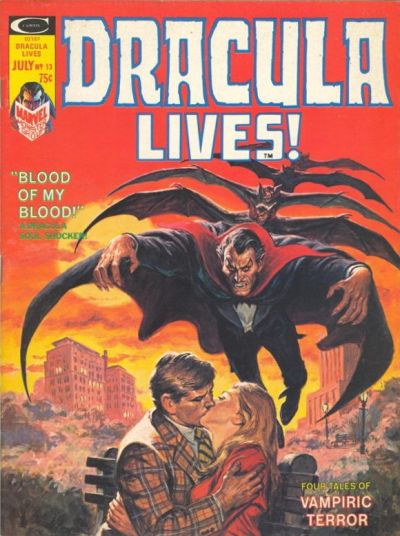
This is a review of Dracula Lives!, a black-and-white horror magazine published by Marvel in the 1970s. These thirteen issues are best viewed as a companion piece to the horror comic, Tomb of Dracula, also produced by Marvel. You can read my reviews of Tomb of Dracula Volumes One and Two here and here

Dracula Lives! is written by comic luminaries such as Roy Thomas, Tony Isabella, Doug Moench, and Steve Gerber. There is a rotating ensemble of illustrators, and in general the art surpasses the writing. The magazine features (mostly) three original Dracula stories per issue, along with trivia and short fiction. We are treated to ‘adult’ content in the form of semi-nudity, most of it female. Dracula himself is naked in a few panels, but we do not see the Vampire Lord’s junk. 

The stories are a mixed bag. Dracula’s origin is recounted. The best part of this tale is the art by the great Neal Adams, with the origin itself being boilerplate villain melodrama. Dracula gains vengeance on his enemies and declares everlasting war on the human race, blah-blah-blah. This story exists because the powers-that-be wanted to give Dracula an origin story, which he doesn’t need.

We have tales featuring a washed-up old horror film actor who believes he’s Dracula, Dracula stalking the halls of the Vatican, and the Count’s ongoing battle with the sorcerer Cagliostro during the French Revolution. Dracula bites a junky in New York City and has to go cold turkey! Dracula encounters a Voodoo Queen in New Orleans! Dracula enjoys the hospitality of Countess Bathory and Marie Antoinette! Dracula vs. The Silver Chastiser, Champion of the Puritans! That last one’s not true, but there is a story with Solomon Kane (a Robert E. Howard character) and werewolves that’s pretty good.

My favorite story is set during the second World War. The Nazis occupy Dracula’s castle and discover that a vampire stalks the halls of the ancient keep. This tale did not go the way I expected, and is the only one of the batch that I found genuinely unsettling. Close second goes to a story written by Gerry Conway about death stalking Dracula. Mr. Conway is a very workmanlike writer, but he can pull a gem out of his hat. 

These stories mostly appear in the first few issues of the magazine. As time goes on, the tie-ins with Tomb of Dracula end, which is both a good thing and a bad thing. No longer having to piece together storylines from multiple titles is a relief, but the magazine loses its identity and becomes a Tales from the Crypt anthology vehicle. Promising storylines are dropped. Dracula vs. Cagliostro goes bye-bye just as it was getting interesting.

In general, the material in later issues is more generic. A New York City street cop encounters Dracula on his last night on the job. A gunslinger stalks Dracula in Europe. A man tries and fails to protect his blind wife from Dracula. A fair bit of the prose in this series is truly purple, which befits a character of Dracula’s stature. In one of the stories, a woman calls Dracula pompous as she sticks a dagger into his belly. When it has no effect, she tells him she didn’t mean it.

Towards the end of Dracula Lives! run, we are treated to two installments of Lilith, Dracula’s Little Girl hanging out in Greenwich Village. Lilith, Mass Murderer is more accurate. After she murdered 75 people on an airplane (in Tomb of Dracula), I have issues taking her seriously as a protagonist. 

Perhaps that’s a Me problem, but I don’t think so. Do you know how much fan mail and how many marriage proposals Ted Bundy got in prison? Lilith may be a mass-murderer, but she sure looks good in those black tights! If you are attractive, you can get away with a lot of shit.

The serialization of Bram Stoker’s Dracula novel, which also takes place in later issues, fares much better. This is a competent retelling of the novel that features great artwork by Dick Giordano. Since Dracula is a melodramatic potboiler, it works very well in graphic format. Too bad they never finished it.  

As far as I know, the issues of Dracula Lives! have never been collected on their own. You can buy the individual issues or purchase them along with the Tomb of Dracula Complete Collection volumes . If you enjoy 1970’s monster magazines and can’t get enough of Dracula, it’s worth the price.

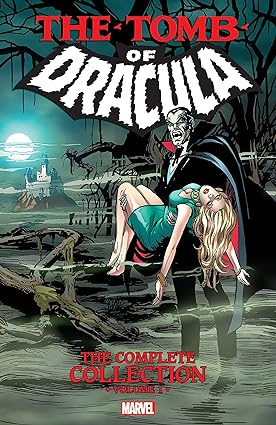
Tomb of Dracula Complete Collection Volume Two

This is a review of Tomb of Dracula Complete Collection Volume Two. You can read my review of the first volume, here. The premise of this graphic novel is simple. The Lord of Vampires awakens in the Swingin’ Seventies and moves to London, where he feasts upon an endless supply of nubile young women.

Dracula is opposed by a group of fearless vampire hunters – Buffy, er Rachel Van Helsing, crossbow wielder; Blade, vampire hunter; Taj Nital, who does not speak; Quincy Harker, mastermind; and last but least, Frank Drake, total loser. Please note that this comic series was released decades before Buffy.

Highlights of this volume include a visit from green-pants-lover Werewolf by Night. After that, Dracula and Rachel Van Helsing embark on the Hike from Hell in the Alps. The WTF Award goes to Rachel, who waits eight hours until nightfall to try and stake Dracula and misses. We also see the Lord of the Vampires being attacked by a psycho mountain goat.

After that, Dracula is captured by Dr. Sun – a pickled brain in a jar –  and must fight the good doctor’s proxy, a vampire biker dude who has all of Dracula’s memories. Dr. Sun is obsessed with vampires, because he needs an unending supply of human blood to survive. Instead of transferring his brain into the Lord of the Vampires, he decides to, uhhh…

…what the hell is Dr. Sun doing, anyway? I read this, and I honestly don’t know. Maybe I should read it again? Hell, no! Once is enough. Whatever he does, it fails. Let’s just say that the Dr. Sun storyline reads more like science fiction than horror and is the weakest storyline thus far, and leave it at that.

Dracula returns to London and a story set in a haunted mansion that reads like a parody of a Gothic novel. We have our Gothic heroine, Shiela (that’s how it’s spelled) Whittier, who is tormented by a poltergeist/father figure/BDSM daddy. She is rescued by Dracula, who is a thousand times worse. Things end badly for her, just as things end badly for most of the human cast of this book. Unlike Dracula, they are not immortal.

This volume also collects the Vampire Lord’s guest appearance in Frankenstein’s Monster. Yes, the Frankenstein Monster had his own comic in the 1970’s! Why doesn’t anyone remember it? Well, it might be because it wasn’t very good.

The Monster is adopted by a Gypsy (this is the term used in the comic, not a slur) woman at the behest of her grandmother, who turns out to be a vampire. She awakens Dracula and kills a villager. The villagers kill the Gypsies. The Monster rumbles into the village and kills villagers. The villagers try to burn the Monster at the stake.

The Monster leaves the village to kill Dracula after telling the villagers they shouldn’t judge people by appearances. The villagers think maybe they were wrong about the Monster, except in the previous issue he killed a bunch of them. The Monster kills Dracula, who turns into a skeleton so that the next rube can pull the stake from his heart.

We also meet Dracula’s Little Girl, Lilith, who is the daughter of the Vampire Lord’s first wife. Dracula claims he hates Lilith because he hated her mother – in a flashback, we see him slapping his first wife. This is untrue. Dracula hates Lilith because she is a woman, and in this comic he is written as a misogynist who views women as either playthings or a food source. That being said, Lilith is vicious. She is not worse than Dracula – that’s impossible – but she gives him a run for the money.

I will be honest, here. Gene Colan’s phantasmagoric art on Tomb of Dracula is incredible. With the exception of the “team-up” between Dracula and Spider-Man that takes place on a cruise ship and is a lot of fun, the writing is depressing. There is a lot of violence against women, much of it casual – women are slapped, punched, gaslighted, and treated as objects. 

To me, Tomb of Dracula gives off the same vibe as The Walking Dead. If I read too many issues at once, I want to rip my eyes out of my sockets. Perhaps I am feeling this way because I DID read too many issues at once. It’s hard for me to tell at this point. If you like vampire stories, Gene Colan’s art, or are a Dracula groupie, this is worth a read.

Nosferatu the Vampyre (1979)

This is a review of Nosferatu The Vampyre (1979), directed by Werner Herzog and starring Klaus Kinski and Isabelle Adjani. I rewatched this movie to see how it compared to the newest version of Nosferatu, now in theaters, but that’s another post. The plot: Jonathan Harker leaves his wife Lucy, traveling from Wismar, Germany to Transylvania to consummate a real estate deal with an eccentric count. Beforehand, he stops at the local inn, where in time-honored fashion the locals beseech him not to go.                

Spoiler: Harker goes. He walks to Borgo Pass, where a buggy with black horses takes him to the castle, which is a ruin. He’s met by Count Dracula himself, played by noted thespian and homicidal maniac Klaus Kinksi. Mr. Kinski is grotesque. He can pass for human – barely. His features are rodentlike, including a pair of jutting incisors. It’s a wonderful makeup job. The good Count only appears at night, speaks in a low voice, and seems depressed. Who wouldn’t be depressed, living in a shitty old castle for hundreds of years?                

After signing the contract, Dracula leaves Harker behind and travels to Wismar by ship, bringing rats, stormy weather, and the plague. Harker manages to escape, but part of him dies on the journey home. When he exits Dracula’s castle he is still human, but he loses his humanity on the journey back. The man is gone, replaced by something else.                

Dracula arrives in Wismar. The plague hits. The action shifts from Harker to his wife, Lucy. Dracula wants Lucy, but gives her agency. By agency, I mean he doesn’t just take her when she rejects him. The choice is hers. This is one of the more interesting parts of the movie. Does Dracula leave her be because of an obscure vampire rule? He has taken hundreds of men, women, and children against their will. What makes Lucy different? I will be honest with you, reader. I have no idea.

The plague worsens. The Count’s coming brings death and mayhem, and he can’t even bring himself to care. He’s dead, after all. The living do care. There is a scene towards the end, when Lucy walks amongst the revelers celebrating their last supper after the plague has ravaged the city. You can tell what she’s thinking: this can’t go on. Will goodness triumph, or will darkness cover all? Since this is a Werner Herzog movie, who knows?

Nosferatu might not move quickly enough for people, especially horror fans. It’s slow and brooding. The scenery is wonderful, lots of forests, canals, mountains, and old, decrepit castles. This is a monster movie that seems real. It has focus, and part of that is because of the level of detail. People have argued that the scenes inside Dracula’s castle are dreamlike, but I disagree. When Harker awakens after his night with the count, he finds the breakfast table crowded with food, including an unplucked chicken.

The problem is that reality is awful. Nobody knows this more than the Count, who I would argue is looking for an excuse to die. By not taking Lucy, he gives her the means to end his existence – if she has the belly for it. Spoiler: she does.

Recommended!

Tomb of Dracula Complete Collection: Volume One

This is a review of Tomb of Dracula Complete Collection Volume One. Reading the first volume of this series is a milestone for me, because my OCD fixated on this book, which means I read the first six issues repeatedly, with no prospect of ever finishing. But finish I did! Now how’s that book I finally read?

Very good, with the exception of some creaky material that hasn’t aged well (cringeworthy dialogue, racial stereotypes, make it up as you go along vampire lore). Dracula rises from his tomb in the first issue, courtesy of all-round idiot Clifton Graves. Graves becomes Dracula’s slave, and is so obnoxious and fawning that Dracula gets sick of him and lets him die in an exploding boat. But Grave’s best pal Frank Drake is worse. Frank is related to Dracula, and his solution to life’s problems is a left hook. Luckily, the focus of the book is Dracula himself and the ensemble cast. BTW, this series takes place in London in the 1970’s.

We have Dracula, self-proclaimed Lord of the Vampires, who is irredeemable. Depending on what issue you read, he’s either 100 or 500 years old. Then there are the ones who hunt him: Frank Drake, master of fisticuffs; Rachel van Helsing, who wields a crossbow, the most useless vampire hunting weapon in existence; Taj, who does not speak; Blade, a vampire hunter who’s part vampire himself. They’re led by Quincy Harker, who has a daughter named Edith. Long-time readers should be able to guess which cast member gets killed in the first volume.

The art, done by Gene Colan, is one of the best things about this series. Mr. Colan’s character designs are striking, and his art has lots of fun details (Dracula’s cufflinks are little bats). The writing gets off to a rocky start, with three authors (Gerry Conway, Archie Goodwin, Gardner Fox) scripting the first six issues. Marv Wolfman took over the writing duties starting with Issue #7, and after that the book finds its legs. One of the things I like about this series is that even though it’s part of the Marvel Universe, it feels mostly self-contained. Dracula doesn’t feel like some rubber-suited supervillain.

A must read for Dracula and horror fans.

Dracula

Dracula!

This is a review of Dracula, by Bram Stoker. First things first: by today’s standards, this is not a scary book. Dracula is an epistolary novel, which means it’s written in the form of letters, newspaper articles, and diary entries. Do you find reading letters frightening? I don’t know if the Victorians found this book to be scary. I think it more likely they found it shocking or even titillating. 

Nowadays Dracula is an indelible part of pop culture, bad movies and breakfast cereals and all. The original novel is valuable both as a historical and cultural document, giving us insight into the Victorian thought process. A friend of mine insists that Dracula illustrates how xenophobic the English were, terrified of foreigners stealing their women.  It’s an interesting argument, but Bram Stoker was Irish and not English, so I’m not sure I buy it.

Who cares about all that shit, how’s the book? Is it worth reading? Well…I don’t think Dracula is very good. I recently reread the novel, and it wasn’t as bad as I remembered, which a) doesn’t mean much, and b) doesn’t mean I didn’t like the book. I don’t finish most of the books I start, yet I’ve read Dracula four or five times. Take that for what it’s worth.

The plot: Jonathan Harker, realtor wannabe, travels to Transylvania to meet his boss’ newest client. Harker writes about train times and spicy paprika chicken in his diary. Thrilling stuff. The book perks up during Harker’s carriage ride to Castle Dracula, which involves sinister blue lights, wolves, and a mysterious coachmen. Upon reaching his destination, Harker is greeted by Dracula himself, who is getting ready to invade – er, I mean relocate to England. 

Technically, Dracula is a Voivode rather than a Count, but whatever. Harker soon has other things to worry about, like survival. Staying alive isn’t easy in Castle Dracula. Dracula enters and leaves by scaling the walls like a lizard. He has three ravenous wives, who want to drink his blood. Even worse, they’re voluptuous. And there’s always the hungry wolves, lurking outside.

One of the more interesting things about this book is the fact that Dracula doesn’t kill Harker. He leaves him alive in his castle while he travels to London. True, Dracula’s wives will finish Harker off, but there’s always the risk that he will get away and spill the beans. Which is what happens. Why not make sure? While never overtly stated, I believe it’s because Harker is Dracula’s guest, and killing him would violate the rules of hospitality. Dracula is a supernatural entity, and thus must abide by a number of rules. Leaving Harker alive means Dracula is following the letter of the law.

Dracula charters a boat to transport him and his fifty earth-filled coffins filled to England. He kills everyone on the ship, which sails into Whitby with the dead captain tied to the wheel. It is never revealed why the Count chose Whitby. Why not London or Liverpool? Anyway, Dracula wastes no time seducing Lucy Westenra. Lucy’s best friend, Mina, is Jonathan Harker’s fiancée. Coincidence? Part of the Count’s evil plan? Bad plotting?

Whatever the reason, soon poor Lucy is in her grave. This despite the efforts of her three suitors, Dr. Jack Seward, Lord Arthur Godalming, and Quincey Morris, who hails from the great country of Texas. Further reinforcements arrive when Dr. Seward consults his old tutor, Abraham Van Helsing, about Lucy’s bizarre anemia. Van Helsing doesn’t have a great command of the English language, and his solutions involve crosses and garlic flowers. Instead of confining Van Helsing in his sanitorium, Dr. Seward and company agree to a number of blood transfusions. Since people didn’t know about different blood types back then, it’s possible those transfusions helped kill Lucy.

Lucy rises from the grave, begins preying on children, and is dubbed the Bloofer Lady by the press. The sequences with her are the creepiest parts of the book. Somehow Van Helsing convinces the others to pound a stake through Lucy’s heart and then chop off her head. Meanwhile, a weakened Harker makes it back to England, only to lose it when he sees the Count strolling through London. One thing leads to the other, and the Harkers are united with Van Helsing & his crew.

Blah blah blah that’s a lot of plot, and I haven’t even mentioned Renfield the Fly Eating Lunatic. Is the book any good? Yes, and no. The plot is the weakest part of this novel. Dracula’s plan to conquer England is so bad that Stoker dedicates a half-chapter to Van Helsing talking about Dracula’s child-brain. Exhibit A: Dracula has spent several months in England and only made one vampire. Van Helsing and company find forty nine of his fifty earth-filled coffins in a single day. These are not the actions of a master tactician.

The book’s characters fare better. The standout humans are Van Helsing and Renfield the Fly Eating Lunatic, both of whom are crazy. And then we have Dracula. We never get to understand what makes him tick, which is part of what makes him interesting. His entrance to England, floating into harbor in a corpse ship, are the actions of a Voivode. His exit, wherein he scrambles for pocket change and spends weeks hiding in a boat, are the actions of a scared man. The apparent contradiction is never explained. Perhaps he’s acting according to an unstated set of rules that are never explained to us?

Parts of this book reek of a bizarre sickly sweet sentimentality, but much of Dracula was quite shocking to the Victorians. The novel brushes against sexual mores and taboos (A WOMAN’S BOUDOIR, INVADED!), and I think that’s what shocked people. In the end, Dracula dies and we have a happy ending, but sometimes it seems like we’ve brushed up against something we don’t quite understand, and I don’t know what it is, and maybe that’s why I keep coming back to this book.