The Flash, by Mark Waid: Book One

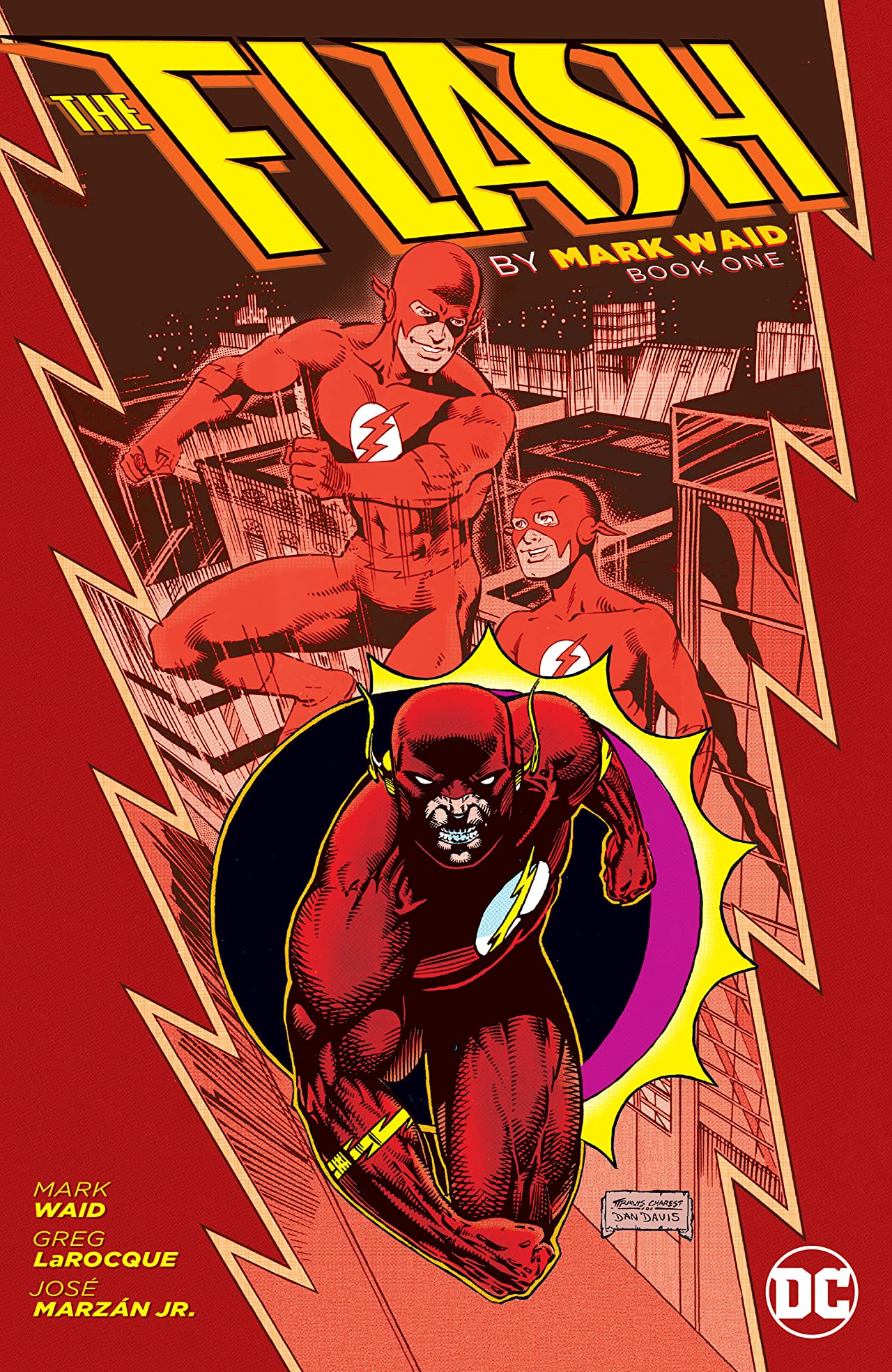
This is a review of The Flash by Mark Waid, Volume One. I have a soft spot for The Flash. I am not sure why this character speaks to me. Maybe it’s because The Flash is the first superhero comic I ever read. Or it could be because of The Flash’s rogue’s gallery, which is one of the best in superhero comics. Or maybe it’s the costume? It certainly isn’t Barry Allen’s personality, because he didn’t have one when I started reading his adventures back in the late 1970’s. No, my Flash is Wally West.

Let me explain. There are three Flashes who have starred in their own books – Barry Allen, Jay Garrick, and Wally West. I wasn’t around in the 1940’s when Jay Garrick was active. Wally became the Flash after Barry died (1980’s), which turned out to be a temporary setback.  Originally, Wally was Kid Flash. I read Wally’s origins in the Silver Age Flash. You can see the review, here. Back then, Wally was a comic book writer’s idea of what a teenager in the 1950’s should be. The results were horrifying.

Mike Baron’s short run on Flash – read my review here – gave Wally a personality. He’s callow and self-centered, like most people who are twenty years old. Writer Mark Waid’s run takes place several years – or whatever passes for time in the DC universe – later. Wally is older and wiser. He’s still paying off debts accrued from when he won the lottery and blew it all.

Mr. Waid gives Wally a personality – blue collar, not a rocket scientist, always tries to do the right thing – and a love interest. Mr. Waid is good at evoking emotion. His style is upbeat, which in the early 1990’s was decidedly old school. Stories in this volume include an updated version of Wally’s origin; a team-up with Aquaman, The King of the Seven Seas; and a looong annual starring Eclipso, back when DC made Eclipso a super-powered serial killer. Also, a rejuvenated Abra-Kadabra, minus his skin.

Run to Comixology to get this volume!

The Spectre Volume One: Crimes & Judgments

This is a review of The Spectre: Crime & Judgments, which collects the first twelve issues of John Ostrander (writer) and Tom Mandrake’s (artist) 1990’s run of the Spectre. It is no secret that I’m a huge fan of John Ostrander, the man responsible for the creation of Grimjack and the modern version of The Suicide Squad.

The Spectre is an older character who appeared in the Justice Society way back in the 1940’s. Basically, The Spectre is the Wrath of God. His purpose is to wreak vengeance on evildoers, and since he’s beaucoup powerful, he can do whatever he wants. The Spectre’s anchor/human host is Jim Corrigan, a cop killed in the 1930’s. Corrigan’s ghost still hangs around, even though sixty years have passed. Evil never sleeps, and neither does he.

My favorite issue of The Spectre features a trio of kidnappers who bury a child alive and die before they can reveal the child’s whereabouts. The Spectre storms into Hell and fights a devil for one of the kidnapper’s souls. When the kidnapper reveals the child’s whereabouts, the Spectre tosses him back into the eternal flames like a piece of garbage.

I don’t want to say a lot about the plot. If you are the type who’s easily triggered, I might skip this book. I myself had trouble reading the last four or five issues, but then again I’m a sensitive sort. The B-storyline features a character who mirrors the Spectre, in that he says he’s destroying evil. This character is also an enormous monster. Make of that what you will.

Great art, great writing. Highly recommended, especially if you like nihilistic horror.

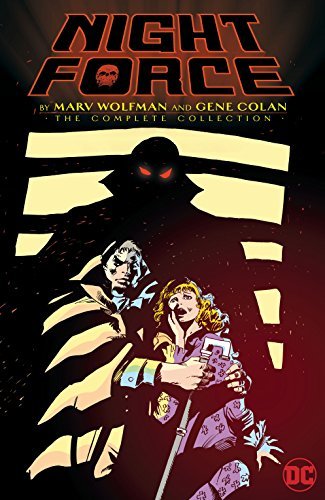
Night Force: The Complete Collection

This is the first comic I’ve ever read put out by a mainstream comic publisher (Marvel/DC) where one of the characters talks about his wife wanting an open marriage. Welcome to Night Force, one of the weirdest comics I’ve ever read.

Night Force is a horror comic put out by DC in the early 1980’s. It lasted fourteen issues before it got canceled. It’s written by Marv Wolfman and drawn by Gene Colan, a creative team with impressive credentials. Despite some issues, Tomb of Dracula is a classic. Unfortunately, Night Force is not a classic.

The plot: Baron Winters lives in a grand old mansion in Georgetown. The Baron has a pet cheetah and can’t leave his house, because reasons. However, his house has portals that allow him to travel into the past. We never find out why, because the book gets canceled and I don’t really care anyway. BTW, Georgetown is also the setting of The Exorcist. Vanessa Van Helsing, one of the characters in Night Force, is about the age Regan MacNeil would be in the early 1980’s.

Vanessa is a physical medium who can channel evil. She’s been institutionalized ever since she was a child, and spends most of this graphic novel getting beat up, kidnapped, and jabbed with hypodermic needles. She has absolutely no agency at all. Her only purpose is to be rescued, so she’s a damsel in distress on steroids.

The Russians want to kidnap Vanessa and channel her psychic powers. Baron Winters, who is Vanessa’s guardian (again: because reasons) assembles his Night Force to counter the Russkies. So who’s on the team? Jack Gold is a writer who can’t keep a job. His marriage is finito. Spurred on by the Baron, he takes a liking to Vanessa. They have sex. Since this title exists under the auspices of the Comic Code Authority, they only show the aftermath. One other thing: Vanessa is twenty years old, while Jack is at least twice that age.

Donovan Caine, the second member of Night Force, is a parapsychologist. He’s doing experiments on Vanessa for the CIA. This involves having his graduate students dress up in black robes, draw pentagrams on the ground, and perform pretend Satanic rituals. Caine wants to help Vanessa channel evil, and boy oh boy does he succeed. Unfortunately, that evil kills his wife.

Donovan Caine is important, not because he does anything (in some ways he’s as much a damsel in distress as Vanessa), but because he’s the only person in this comic who has any agency that makes sense. Caine blames the Russians for his wife’s death. He’s wrong about that. Picture this: say you know a person who can manifest evil in physical form. Say you start performing Satanic rituals to summon that evil, which indeed starts manifesting. Does that sound safe to you? Maybe you’d ask, what are your safety protocols? What, you say you don’t have any? Okaaaay.

When Vanessa is kidnapped and sent to Siberia, Caine and Gold try to bring her back. Caine hates Gold so much it’s comical, even though Gold saves his life three times (at least). The first storyline lasts seven issues and still feels truncated to me. The twist at the end is good, but also reinforces the unpleasantness of the characters.

There are two other storylines after this one. The second, which involves a criminal fighting a walking garbage mound that imprisons a bunch of people in a brownstone, is pretty good. The third and final storyline makes no sense.

My guess is that this was an experimental comic. The stuff about manifesting evil and psychic powers is interesting, but the characters are mostly unpleasant assholes, which makes it difficult to care. They’re led by the biggest asshole of all, Baron Winters. So I can honestly say I’m not sure what to make of this comic.

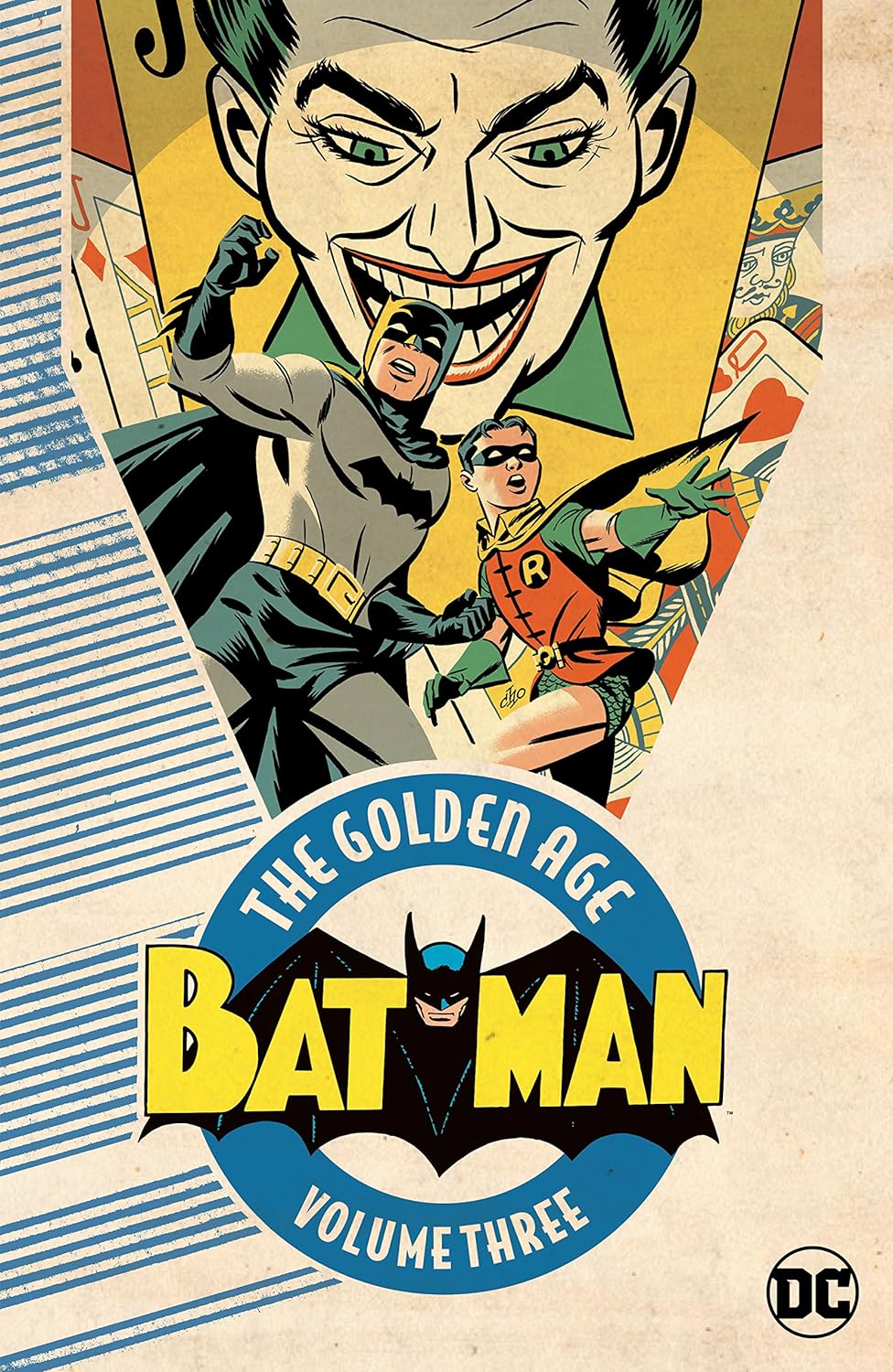
Batman The Golden Age Volume Three

This is a review of Batman The Golden Age Volume Three. You can read my reviews of Volumes One and Two here and here. Batman’s adventures continue in this volume. The Penguin makes his first appearance and evades capture three times. The Cat also appears, which is great because she’s an interesting character who adds something different to these stories.

But the real guest star of this volume is The Joker, who is basically in every other issue. The best Joker – er, Batman – story involves the Clown Prince turning himself in to the authorities and being tried and executed for his crimes. Luckily, the Joker just happens to have a serum that can raise him from the dead, if it’s injected within fifteen minutes of his death. Thus, the Joker is reborn with a clean record. Citizen Joker, lol.

I give this creative team props for consistency. All the stories so far have been one-shots, which can’t be easy. The downside is that they all blend. You’d think at some point the thugs that capture Batman would just put a bullet through his head rather than tie him up and put him in a deathtrap, which has been spoofed ad infinitum in the 1960’s Adam West Batman series, but no dice.

This is the first volume I’ve read where the creative team might break the fourth wall. Weird stuff happens, highlighted by a bizarre spanking scene. The other standout is the strange relationship between Batman and the Joker. There’s a point in most of these stories when the Joker has Batman in his power, but apparently he relishes capturing and putting Batman into deathtraps more than killing him. The Clown Prince has no such compunctions about murdering Robin, whom he almost kills – I think it’s twice – so far.

Entertaining for Batman fans, but don’t read more than two or three issues in one sitting.

Saga of the Swamp Thing, Book Two

This is a review of Saga of the Swamp Thing Book Two. This volume continues fabled writer Alan Moore’s run on Swamp Thing, aided and abetted by wondrous artwork by John Totleben and Stephen Bissette. You can read my review of the first volume, here.

This graphic novel features Abigail Arcane, who has patched up her marital disputes with husband Matthew. Matt has ditched the sauce for more important things – he buys a house, gets a job, all that good adult shit. True, there are flies all over that house, his co-workers resemble dead serial killers, and don’t look at him too close in a mirror – but besides that, Matt is doing great. He also has godlike powers, because reasons.

Turns out Abby’s wicked uncle Arcane is infesting Matt’s body. Arcane might be dead, but death can’t hold a good villain down. Before Arcane reveals himself, we see the beginning and aftermath of a sexual encounter between him and his unknowing niece, which qualifies as incest and wins an award for one of the grossest moments in mainstream comic book history.

It also qualifies as a problematic scene. Later in the book, Swamp Thing and Abigail enter into an honest-to-God consensual relationship that feels real, something exceedingly rare in comics. Comic book relationships usually feature a lot of the other half being ditched at dinner or being held hostage by Lex Luthor, and often culminate in a fridging when the new writer wants to get rid of the character. It’s interesting that the same author wrote both scenes.

Not to overstate things, but this is a groundbreaking series. Alan Moore casts a shadow over comics that spans decades. His Watchmen miniseries was instrumental in bringing about something called the Dark Age of Comics. One can argue whether this was a good thing, but there’s no denying his influence. And this is the series where he made his bones (amongst Americans, that is).

So yeah, if you like horror comics you should read this.

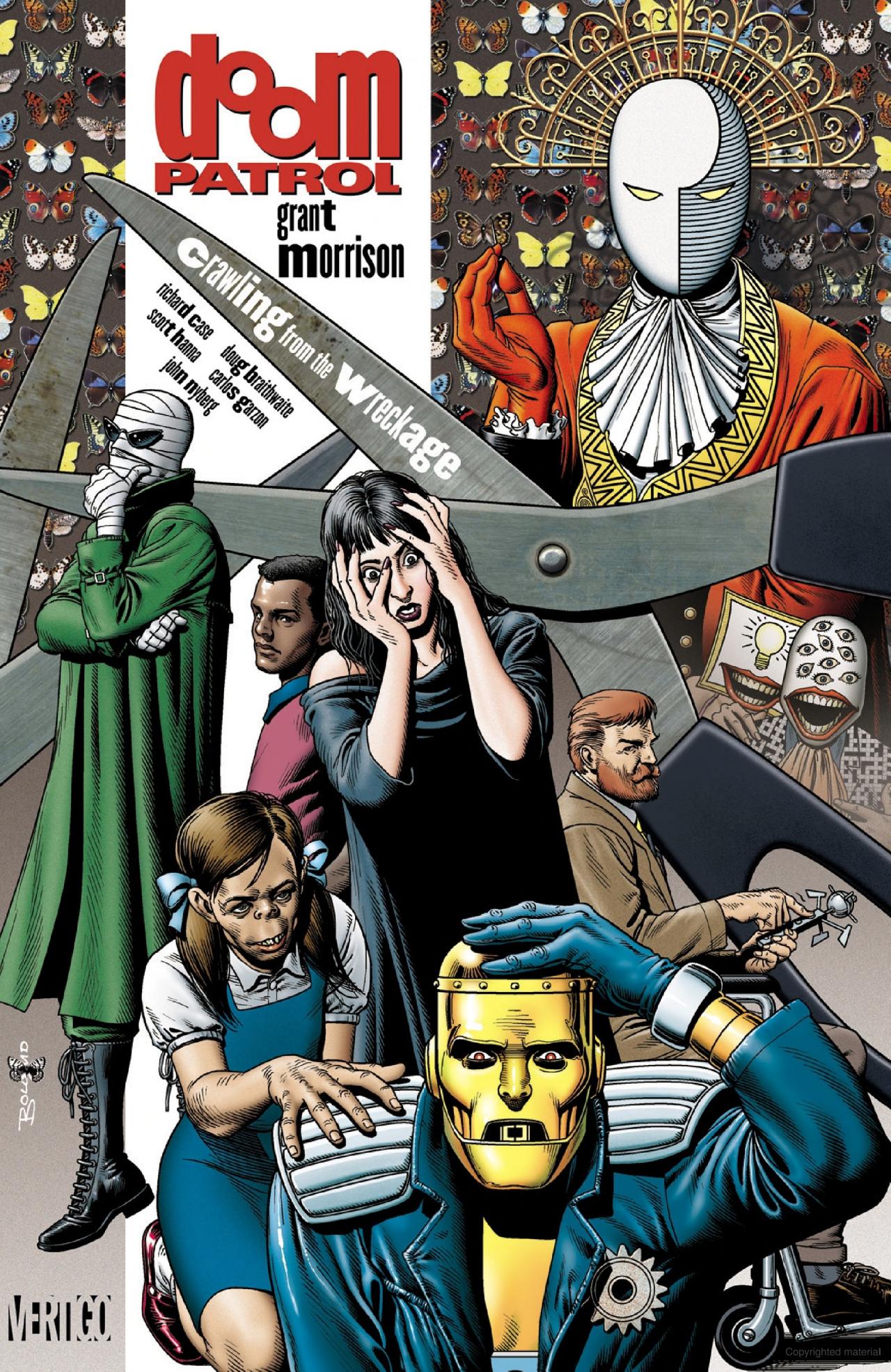
Doom Patrol: Crawling from the Wreckage

This is a review of Doom Patrol: Crawling from the Wreckage, written by Grant Morrison in the late 80’s/early 90’s. The Doom Patrol have been around since the 1960’s and are the ugly stepsisters of superhero teams. They aren’t powerful, or good looking, or important; they’re an obscure bunch of weirdos in tights. Luckily, the late 80’s were sort of the heyday for obscure weirdos – in comics, anyway.

A confession: I adored this version of the Doom Patrol. By the time this series came out, I’d read thousands of comics. This one was just different. It felt like someone took a Philosophy/Modern Art class (focused on surrealism & Dada) and jammed it all into a comic book.

Cliff Steele, aka Robotman, is the normal member of the group. He’s just a Regular Joe, stuck in a robot body. It’s not even an interesting robot body, but that will change. There’s also Rebis, an amalgamation of man, woman, and negative being, who has covered their body in bandages. Finally, Crazy Jane (the writer’s name, not mine), who has a superpower to go along with every one of her 64 personalities.

The Doom Patrol’s first encounter is with the Scissor Men, emissaries of the imaginary city Orqwith. Orqwith is staging a hostile takeover of earth, overwriting it into its own image. And then there’s Red Jack, aka Jack the Ripper, aka God, who likes collecting butterflies and looks like an escapee from a deck of playing cards. The writing is great, the art a little less so. Still, a strong start to one of my favorite series.

The Flash: The Death of Iris West

This is a review of The Flash: The Death of Iris West. A few firsts. Flash #278, which resides in this volume, is the first superhero comic I read. Well, it might be Fantastic Four #210, which I bought around the same time, but my memory says it’s the Flash. A second first: the title of this volume is The Death of Iris West, aka Mrs. Barry Allen (as she’s referred to in this volume), aka The Flash’s wife. If you don’t want the details of her fridging, don’t read any further.

This volume doesn’t come flying out of the gates. The Flash fights a villain named The Clown. At first glance, this is a mismatch – The Flash can run faster than light and has total control of his molecular structure (I have no idea how these two powers are related). The Clown throws cream pies. Thus, it comes as a surprise when The Clown nails The Flash in the face with the aforementioned cream pie. Heck, it comes as a surprise that any fight with The Flash lasts more than two seconds. Thank god I’m not the writer, who has to think of creative ways to make the Flash’s villains seem like credible threats.

Maybe The Flashster has other things on his mind. He’s been neglecting his lovely wife, Iris, who responds by pulling out the stops – romantic candlelight dinners, new hairdo, etc. The Flash claims he’d like to spend more time with his wife, but Gorilla Grodd has a hangnail or whatever, and he needs to deal with that. Then there’s the 16-year-old psychic teen with a crush on The Flash. Since Barry is thirty and could be her dad, this seems creepy, especially considering what happens to his wife.

I am not saying I didn’t enjoy this volume, because I did. The art is good, and I like writer Cary Bates’ scripts. It wasn’t Mr. Bates decision to kill Iris Allen. This was an editorial call, done to boost sales (I read this in an interview with Cary Bates). There’s no build-up or foreshadowing to Iris West’s death. Barry and Iris go to a costume party, which is crashed by ex-convict-Clockwork-Orange-fan-psychic-vampire Clive Yorkin. BTW, Yorkin is one of the best things about this volume. The Flash, shot up with angel dust, makes the mistaken assumption that Yorkin killed his wife. He’s wrong. The killer is Professor Zoom, denizen of the 25th century, who takes up supervillaining as a hobby because he’s bored.

If you’re a Flash fan, this is an important chapter in Barry Allen’s life, even though I’ve lost track of the number of times his character has been rebooted. If you’re not a Flash fan, it might take a few issues to figure out what’s going on. Still an enjoyable read.

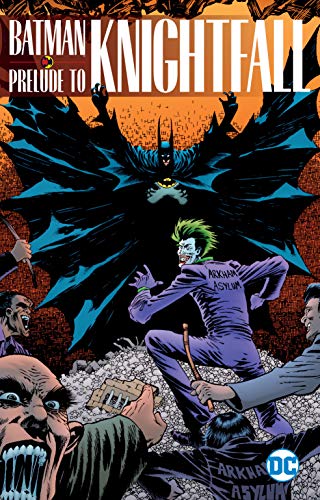
Batman: Prelude to Knightfall

This is a review of Batman: Prelude to Knightfall. I read Knightfall when it came out in the early 90’s. Since this is the prelude, I didn’t read most of the issues in this volume. The plot is simple: Bane is a superhuman steroid freak who wants to break Batman. His timing is impeccable; The Dark Knight is suffering from heavy-duty burnout, driving himself to go without sleep or food. To further wear Batman down, Bane releases all the lunatics in Arkham Asylum, where his greatest foes are housed.

The writing of this graphic novel, which features Doug Moench and Chuck Dixon, is good. The art is a little uneven, but we do get a few issues drawn by Jim Aparo, one of my favorite Batman artists. There are a few nice touches, such as Batman wearing a black Superman armband (Superman had just been ‘killed’ by Doomsday).

The creators of this volume understand Batman. At one point a cop tells The Dark Knight that he is the one who attracts all the weirdos and lunatics that plague Gotham City, an argument Batman doesn’t even try to rebut. The other eye raiser of this graphic novel is how burnt-out Bruce Wayne becomes, which adds a touch of realism. Honestly, a guy who dresses up like a bat, gets no rest, has no real friends, social life, or sex life, and is constantly injured would burn out.

Standout villains in this volume include The Black Mask, a misogynistic would-be crime boss; a pumped-up Riddler; and The General, an underage Napoleon with a penchant for assault rifles. We also meet Jean Paul Valley, aka Azrael, who gets put into a backbreaker while posing as Batman. The creators are foreshadowing future events, and not even being all that subtle about it.

Vintage Batman.

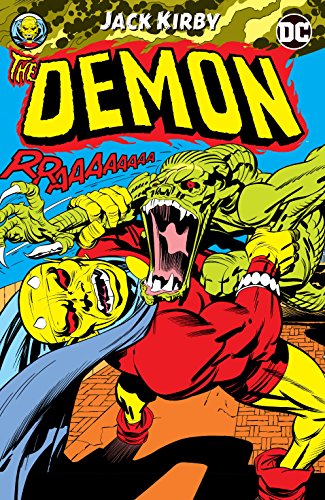
The Demon

This is a review of The Demon, a comic series written, drawn and edited by Jack Kirby. The Demon is one of the projects Mr. Kirby worked on when he went to DC in the 1970s. I read part of the first issue in an anthology, somewhere, but that’s it.

Short summary: The Demon is Merlin the Magician’s pet monster. The first time we meet him is during the fall of Camelot, where he fights the demon hordes of Morgan Le Fay, and then we fast-forward to modern day (1970’s) New York City. Jason Blood is a demonologist; unbeknownst to him, he’s also a Demon.

This is a short run, sixteen issues. The art is great. My favorite character design is Klarion the Witch Boy. In his first appearance, Klarion is more of a pest. He doesn’t turn evil until his second appearance, which is one of my problems with this series. More on that later.

Make no mistake about it, this is a horror comic. I wouldn’t call it disturbing, exactly, but I was surprised at the level of violence. In one issue, Baron von Evilstein is going to cut Blood’s head off. In another, a demon marks Blood’s forehead with a white-hot poker. A Frankenstein’s monster is tormented and killed by his ‘master.’ The bad guys and girls are really bad, and the stories don’t always have happy endings.

This series is written & drawn by Jack Kirby, which means it’s good. All I can say is that it didn’t hit me where I live, and I am not sure why. It might have been good if Mr. Kirby had an editor, because the stories feel slightly unfocused. Klarion the Witch Boy’s transformation into a villain is one example.

Here’s another: in the first few issues, The Demon is more threatening. One of the high points of the early issues is Blood’s ‘nightmare,’ where he’s chained to The Demon. This sequence – Blood wondering if he’s losing his humanity, or maybe he’s already lost it – is the real thing. Unfortunately, The Demon mellows as the series progresses and misplaces its crazy energy. Bottom line: to me, this title loses its legs, and that’s something an editor can help with. It’s still worth a read, especially if you’re a Jack Kirby fan.

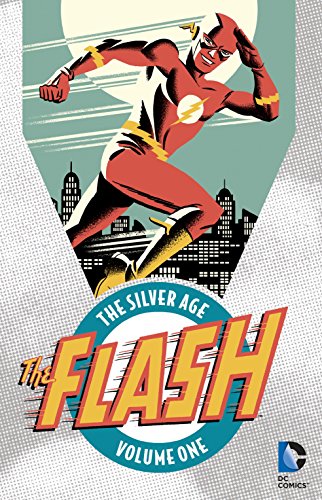
Flash Silver Age Volume One

This is a review of Flash: The Silver Age Volume One. I am behind on my reading, because last week I self-diagnosed with COVID. The good news is that after a miserable few days, I am ramping up my reading again. Anyway, The Flash is the first superhero comic I ever read. It wasn’t my first comic – I read a bunch of those Archie digests you used to be able to find at supermarkets – but I have a soft spot in my heart for the character.

The Flash is Barry Allen, police scientist. One night Barry is proudly examining his collection of chemicals (he’s that type of guy), when a bolt of lightning strikes, saturating him with a hodgepodge of those selfsame chemicals. Instead of being transported to the burn unit, Barry discovers that he has super speed. He dons a red costume with yellow lightning bolts, and the Flash is born!

 So far, so good. How are the stories? Well, they’re less stupid than the Batman & Superman stories of that time period, but that’s a low bar to hurdle. What we get is a heaping dose of junk science, wherein Barry’s speed allows him to do anything you can imagine. Forget faster than light travel; The Flash can break the time barrier!

 The Flash’s rogue gallery is a menagerie of bizarre characters. Thus far, the people’s champion is Gorilla Grodd, a super-intelligent talking gorilla with awesome mental powers. There’s also Captain Cold, The Pied Piper, The Weather Wizard, and Mr. Element. We have a fair number of invaders from outer space stories, along with tales that are plain weird. In one issue, the Flash fights a group of sentient thunderheads by cloud-skipping from cloud to cloud.

I’d be remiss in not mentioning Kid Flash, DC’s version of a teenager of the late 50’s. Wearing a bow-tie to school, calling every adult sir or ma’am, young Wally West is doomed to never have sex. I confess that I’m sort of surprised that Barry himself ever gets sex. When we first meet him, he’s in the police cafeteria drinking milk, which is as perfect a character moment as you will ever see. Barry is always late for his dinner dates with his girlfriend Iris, so she thinks he’s the slowest man on earth. Of course, she adores the Flash. The hero’s love interest disliking or being meh about him while adoring his alter ego is a tired trope, but to be fair, this was the 60’s.

A good read for Flash fans.