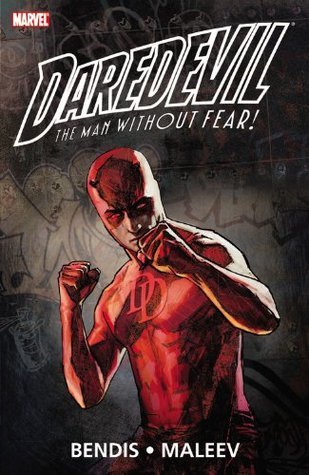
This is a review of Daredevil Ultimate Collection Volume Two. Read my rambling review of the first volume, here and here. After being outed by an FBI agent in search of a payday, Matt Murdock’s (aka Daredevil) life lurches on. He beats up the Kingpin, declares himself the new kingpin of Hell’s Kitchen, and one year later finds him married (?!?!) and under surveillance by the FBI.
This volume contains four storylines. 1. The Owl sells MGH (Mutant Growth Hormone) using his own DNA. This is strange, since the Owl is not a mutant. 2. The Kingpin tries to reclaim his old territory, sending Typhoid Mary and Bullseye to distract Daredevil while he makes his move. 3. The Yazuka make a play for control of Hell’s Kitchen. 4. Black Widow’s ex – who is now a big muckety muck in Bulgaria – tries to get even. Maybe he doesn’t like paying alimony.
Give praise where praise is due. This graphic novel is extremely decompressed (twenty issues for four storylines), but it works because what we are reading is crime/noir, which Brian Bendis (the writer) cut his teeth writing. He’s great at it. Also: Alex Maleev’s gritty art is wonderful and fits the material to a tee. Artist and writer synchronize well together.
This graphic novel isn’t perfect. Certain plot elements are left unanswered (when did the Owl become a mutant?), glossed over (why didn’t the Kingpin have surgery to cure his blindness sooner?), or are just plain ridiculous (would you let a mentally ill mass murderer with pyrotechnic abilities out onto the streets, because she’s been cured through hypnosis?).
Yes, you say, but what about Daredevil getting married? Well, when Matt saves a blind woman (Milla Donovan) from an oncoming truck, she comes to his office the next day to thank him. Little Matt takes over, and it’s off to the races. Unfortunately, Milla is a penultimate damsel in distress who needs constant rescuing. At one point Matt finds her hiding in the closet. This is a tired old trope, which I am not defending, but here’s Mr. Bendis’ point (stated in the first volume): Whoever is around Matt Murdock is in danger, because his secret identity has been compromised. He knows this, but starts up a relationship with Milla anyway.
That doesn’t reflect well on Matt, especially since his track record with women is horrendous. A short summary: one of Murdock’s girlfriends commits suicide, perhaps partly because of his verbal abuse; two of his exes are stone cold killers (Black Widow & Elektra); and Bullseye kills two of his lovers (Karen Page & Elektra. Elektra got better, because reasons). Matt should know better, but he can’t help himself, especially when he’s the object of someone’s adoration.
The official start of Brian Michael Bendis’ run on Daredevil kicks off with the attempted assassination of the Kingpin, who is now blind. The palace coup is led by none other than Sammy Silke, a made guy from out-of-town. Silke’s dad and the Kingpin’s dad were friends, which is why Sammy is around. How an out-of-towner on the skids from his own crew ends up running a major crime syndicate (however briefly) is an interesting story. But is it a Daredevil story? Keep reading!
The Kingpin, like every girl Matt Murdock has ever slept with, knows that Murdock is Daredevil. Even though Daredevil is a crimefighter and the Kingpin is a crime lord, the two of them have come to an understanding. This is the sort of thing that happens in comic books all the time, but falls apart in the real world. What it amounts to is that the Kingpin leaves Daredevil alone, and Daredevil continues to beat the shit out the Kingpin’s men. This is a bad deal, if you are in the Kingpin’s crew.
The Kingpin’s disgraced son spreads the word, and pretty soon everyone in the Kingpin’s crew knows that Murdock is Daredevil. But they aren’t allowed to touch him. They’re pretty salty about it, so when Sammy comes along sowing the seeds of discontent, he finds a willing audience. TBH, in the real world a blind mob boss would last about thirty seven seconds.
Silke puts out a bounty on Matt Murdock, so we see assassination attempts from villains such as Nitro, Boomerang and Mr. Hyde, including a fight scene with an unnamed assassin that would normally take a single panel but goes on for pages. The fight is visually striking and looks great, but it’s also total page filler. There’s no way Daredevil is going to die at the hands of an anonymous killer.
Sammy leads the assassination attempt against the Kingpin, complete with knives. Despite not having read a book since the third grade, Silke quotes Shakespeare’s Julius Caesar, which leads to a plausibility hiccup. These are mobsters, trained killers, but they don’t make sure the Kingpin is dead. The easiest way to do that is to put a bullet through his head. They should have done that, because the Kingpin isn’t dead.
Vanessa Fisk, the Kingpin’s wife, exacts vengeance by killing everyone involved in the assassination attempt, including her son. Sammy escapes by the hair of his chinny chin chin and goes running to the FBI. The Feds tell him to take a hike, unless he gives them something. Sammy gives them Daredevil’s secret identity. This is squashed by the FBI higher-ups (it helps that Murdock has a SHIELD file), but one of the agents goes to the Daily Globe. The Globe runs the story, and Matt Murdock’s life goes to Hell.
The fallout from the expose is brutal. Foggy Nelson (Murdock’s law partner) wants him to hang up the tights. Foggy doesn’t pull any punches, pointing out that so many people know Murdock is Daredevil, it’s a wonder the secret didn’t come out sooner. He also plays the old ‘two of your exes were killed by your archenemy’ card, thus implying that Murdock is indirectly responsible for their deaths.
This argument isn’t exactly true, and it’s debunked by others, but it’s powerful nonetheless. What Foggy is saying is that Murdock’s lifestyle is dangerous, which is bound to lead to fallout and civilian casualties. Soon afterwards, Mr. Hyde attacks Murdock’s brownstone and almost kills Foggy.
Murdock hangs up the tights for a few issues. It is to the writer’s credit that he doesn’t even pretend that this will be permanent. Two of Murdock’s exes, Natasha Romanova and Elektra Natchios, pay a visit. Natasha and Elektra are the same character, in that they are both stone cold killers. Natasha used to be a Soviet spy. Now she’s an American spy. She’s killed tons of people, all off-camera. This is an uncomfortable truth, like pointing out all the people the Hulk has killed (which the same writer did). Elektra is an assassin, and the ultimate crazy ex-girlfriend.
They have different solutions to Murdock’s problem. Natasha wants Matt to play dress-up and beat up some muggers, and Elektra validates everything Foggy says. The issue fades away when Matt dons the tights again, except it doesn’t. Is Matt Murdock a noble hero who’s sacrificed everything for Hell’s Kitchen? Or is he a narcissist willing to risk the lives of his loved ones because he likes playing dress-up? Or is he both? To be continued…
The third storyline in this volume is the most powerful. Hector Ayala, aka The White Tiger, interrupts a robbery in progress and ends up accused of a police officer’s murder. Luke Cage, of Hero for Hire fame, wants Matt Murdock to represent Hector. Murdock tells Cage that if he takes the case, his pending lawsuit against the Globe will make the trial a media circus as well as a referendum on superheroes. Murdock ends up taking the case anyway, because reasons. Why does he do this, especially since everything he says to Luke Cage turns out to be true?
The trial begins. Luke Cage follows the trail of the junkies who killed the cop. We learn that the robbers left town, and then the plot thread is dropped. Why? Murdock has resources we can’t imagine, including access to the superhuman community. Instead of attempting to find the real perpetrators, Matt Murdock makes the case a referendum on superheroes, even though the prosecutor trying the case TELLS Murdock that making the case a referendum on superheroes will be playing right into his hands.
Hector is found guilty and commits suicide by cop. The story is insanely depressing, all the more so because we know that Hector is innocent. It also proves that Murdock is a narcissist. Why did he take the case to begin with, and then compound the error by making the trial all about him? Because – as he himself says – he has to do things his way. He just can’t help himself.


 Abandoned Places