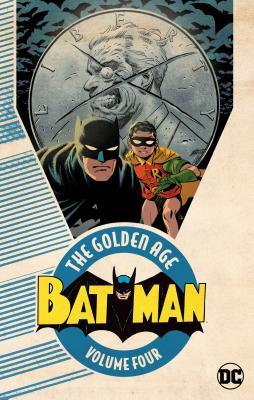
Batman The Golden Age Volume Four

This is a review of Batman: The Golden Age Volume Four, written by Bill Finger with art by Bob Kane and published in the 1940’s. Read my reviews of the first three volumes here, here, and here. In this volume, we have Two Face’s origin story, along with appearances by Catwoman, The Scarecrow, and The Penguin. The Joker appears so often he should be given billing on the strip: Batman, Robin & The Joker has a nice ring to it!

There are also the usual thugs, fifth columnists, and gangsters, which is where we see the interesting stories. Batman’s Rogue Gallery always gets top billing, but with tales not featuring weirdo villains the creators need to come up with an angle. Thus, we have stories about the two feuding brothers whose father is killed by a bad guy, a tearjerker about the kindly neighborhood druggist, and the boy who wants to be Robin, but is hampered by the fact that he’s way too stupid to be Robin.

My personal favorite issue features Batman and Robin splitting up. Batman tells his young ward their partnership is dissolved and throws his Robin picture in the trash. A devastated Dick Grayson leaves to become a hobo – I don’t recall if he has a bindle over his shoulder, but I sure hope he does. Turns out that evildoers threatened Robin, which is why Batman decides to go it alone!

After Batman is captured and sealed in a room, a ‘la Edgar Allen Poe, Robin returns – and is captured. The thugs have a brainwave and unseal the room, which allows Batman to beat the crap out of them, and the Dynamic Duo are reunited, with Robin having no hard feelings at all. Nothing dysfunctional about that relationship!

I must say a few words about the deathtraps. During the 1930’s and 1940’s, movie serials were very popular. Serials appeared in chapters, with every chapter ending in a cliffhanger, usually involving the female lead being tied up. The same thing happens in Batman stories of that time period. The Dynamic Duo are captured, usually by being whacked over the head. Instead of killing them, the thugs put them in deathtraps. If you think about it – which you shouldn’t – there is no reason for this. Why tie someone up and shove them in a car loaded with dynamite, when you can shoot them in the head and drop them into Gotham harbor?

This is a fun read recommended for fans of golden age comics and Batman completionists.

Kingdom Come

Kingdom Come is a four-issue DC comic event written by Mark Waid and drawn by Alex Ross. Kingdom Come is a Superman story. Kingdom Come is also an optimistic story, despite featuring a million-plus person body count. As event comics go, it is blessedly short and not bloated. Everything you need for a perfect reading experience is contained in this four-issue miniseries.

Kingdom Come can be viewed as a direct response to Frank Miller’s The Dark Knight Returns, which was about authoritarianism; and Alan Moore’s The Watchmen, which was about nihilism (what the author intended is irrelevant). Kingdom Come deals with authoritarianism and nihilism and rejects them both in favor of – that would be telling. I am curious as to whether the folks at Marvel sent Waid & Ross a fruitcake when Civil War came out, because they sure cribbed from it. You can even see the seeds of this graphic novel in Jonathan Hickman’s X-Men run.

The frame story concerns the Spectre choosing a new host, pastor Norman McKay. Who cares? Well, as the Spectre’s human anchor, Norman will have to judge humanity and thus holds the fate of the world in his hands. What brought about this sad state of affairs, you ask? The superhuman community is left in disarray after the Joker visits Metropolis, goes on a killing spree (which includes Lois Lane), and is killed by Magog, who is a hero. At least the public sees Magog as a hero. Magog’s exoneration makes Superman quit, and the superhuman community falls apart. What rises are a band of out-of-control young men and women with superpowers and no impulse control, ala Garth Ennis’ The Boys.

Sparks fly when a pitched battle with the Parasite leads to a nuclear explosion. Millions die, and Kansas becomes a nuclear wasteland. This leads Superman, spurred on by Wonder Woman, to return from his self-imposed exile. Many members of the superhuman community (minus Batman) join him. The superhumans who refuse to submit are placed in a prison in Kansas until they learn the error of their ways.

We know this is stupid because Batman thinks it’s stupid. You’d think a superhuman prison is something Batman might endorse, but you’d be wrong. Batman is a human being, but Superman is too busy playing god to consult any normal humans about this. Will The Man of Steel be the unwilling harbinger of the apocalypse? And where does the Big Red Cheese fit into all this?

Kingdom Come is a Superman story, but it features DC’s version of the trinity – Superman, Batman, Wonder Woman. Superman is either overly idealistic or naïve, depending on your point-of-view; Wonder Woman is too militaristic; Batman is a loner with authoritarian tendencies. Separately they are flawed; together, they cancel out each other’s weaknesses.

Kingdom Come features great writing and awesome art. Alex Ross’ character designs are breathtaking, especially with such a large cast. There are Easter eggs – both visual and written – interspersed throughout the graphic novel, which reads more like a painting than a comic. Highly recommended!

Tales of the Dark Knight: Norm Breyfogle, Volume One

This is a review of Legends of the Dark Knight: Norm Breyfogle, Volume One. Mr. Breyfogle filled the art duties on Batman very capably in the 1980’s and early 1990’s. He mostly worked with English writers Alan Grant and John Wagner, who is best known for his work on Judge Dredd. If you haven’t read Judge Dredd, you don’t know what you’re missing.

Who cares about Dredd, how’s those Batman comics? Well, pretty good! We don’t see much of Bruce Wayne or his life at all here. Batman is depicted as an obsessive man who despises criminals. The art is great at showing him breaking and fracturing bones, which he seems to relish. This is a very violent comic – people are murdered in the most callous and stupid ways in almost every issue.

A few of the stories are ridiculous – the anti-drug story is an eye-roller – and a few would be controversial today. When a terrorist kills a group of Vietnam veterans and flees to London, Batman follows. It turns out the terrorist is a diplomat, and he tells Batman – jeez, it’s wonderful how your country has never overthrown governments or killed any innocent people lulz. Considering the events of 1993 and 2001, this comic seems almost prescient. The other high point of this issue is watching Batman drive around London, asking people how to get to Parliament.

The creators give us a number of new Batman villains. We have the Ratcatcher, who has trained sewer rats to attack human beings and who imprisons the men who put him in jail, years ago. There’s also Cornelius Stirk, who has weird psychic abilities – he can look like Jesus, or Honest Abe Lincoln. Stirk feeds off fear, and will use his psychic powers to scare you to death.

But my favorite Bat Villain of this volume is the Corrosive Man, who was double-crossed and seeks vengeance. An explosion in a toxic waste factory means that he’s a walking chemical factory, as happens sometimes, and his touch is deadly! The writers opt to find the humor in the situation, with the Corrosive One falling out of chairs, through floors, and down flights of stairs.

The highlight of this volume is the Mud Pack saga, when the four people who have taken on the mantle of Clayface team up. Well, it’s three people and a hunk of clay, because the second Clayface is dead. I kept waiting for him to spring back to life, but it didn’t happen. The original Clayface was a ham actor who murdered a bunch of people. He’s joined by Clayface #3, who has just broken up with his mannequin girlfriend, and Clayface #4, a woman who can mimic anyone and gain their abilities. They team up, because reasons, and end up giving Batman a psychic lobotomy. Luckily, guest star Looker – of Batman & The Outsiders fame – is there to help!

This is a solid volume, but it’s pricey, so wait until it goes on sale.

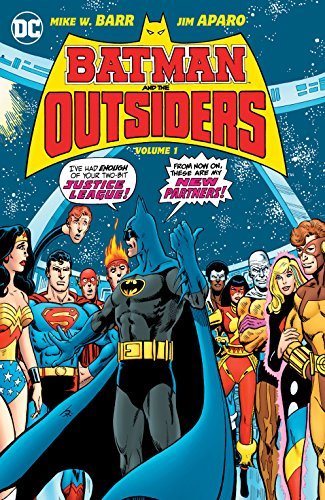
Batman and the Outsiders, Volume One

This is a review of Batman and the Outsiders Volume One. This book scores huge nostalgia points for me. I recall reading the first issue at my local drugstore whilst drinking a Cherry Coke at the counter, and that’s your slice of life for today. Interestingly, many of the pleasant memories of my youth involve comic books.

Hot off art duties for the Brave & the Bold, artist Jim Aparo and writer Mike W. Barr create a new superhero team. The plot: when his friend/employee Lucius Fox is trapped in the imaginary Eastern European country of Markovia, Batman quits the JLA (who won’t help) and goes it alone. The team comes together when he and Black Lightning, who loses his lightning powers for a grand total of one issue, travel to Markovia to rescue Lucius.

There they find Metamorpho, the goofy elemental, along with three new characters – Katana, Halo, and Geo Force. Katana is a samurai who wields a cursed sword possessed by the spirit of her dead husband. Halo can fly, possesses powers derived from light, and is a tabula rasa. Geo Force possesses earth-based elemental powers and is the brother of Tara, aka Terra, a character known to anyone who read New Teen Titans in the early 1980’s.

Anyway: after a few speed bumps, the Outsiders are formed. They’re led by Batman. I mean, who wouldn’t want their own super team, especially if you get to make the rules? The Outsiders are powerful, but not very experienced. This is done to make the villains seem like real threats. Most of the storylines are two issues and move along at a nice clip. The interplay between the characters is enjoyable.

My favorite part of this graphic novel is the Halo solo story. Halo joins the high school marching band, and is about to participate in a high stakes Battle of the Bands competition – no, seriously – when their leader/drum major is kidnapped by a gang of dudebros from the opposing school. Halo flies to the rescue, and even manages to hook her best friend up with the drum major, which is nice. I do enjoy comics that don’t take themselves so seriously.

The first volume of this is a fun, entertaining read. None of the other iterations of the Outsiders have ever really stuck, but DC keeps on trying! Unfortunately, these volumes are expensive, so keep that in mind. Recommended.

Tales of the Batman: Archie Goodwin

This is a review of Tales of the Batman: Archie Goodwin. Mr. Goodwin was a prolific writer and editor. This volume collects his Batman stories, with a bonus being his entire Manhunter run (reviewed last week, here). What impressed me most about these tales is how Mr. Goodwin had a vision of Batman and stuck to it. Batman’s origins are grounded in the pulp tradition, and these stories reflect that, hearkening back to Batman’s early adventures when he fought crooked politicians, mobsters, and fifth columnists.

None of the members of Batman’s rogue gallery make appearances here. His foes are evil men and women, period. Batman himself doesn’t get tied up and put into a deathtrap once. This reflects the truism that most criminals will go for the tried & true – a bullet to the head, knife to the heart, etc. – when killing an enemy. Paraphilias aside, killing a person by tying them to a conveyer belt is stupid on multiple levels.

All the stories in this volume are great, but the standout is the final tale, which deals with child abuse. There’s a serial killer in Gotham who is killing parents who abuse their kids. The killer dresses up in a mask, just like Batman The difference being that Batman doesn’t kill criminals, he just beats the snot out of them.

Commissioner Gordon almost hits his own son, Jimmy – who grows up to become a serial killer. Batman himself is obviously mentally ill, because that’s what you call people who dress up as enormous bats and send people into intensive care. Mr. Goodwin puts the elements out there, but leaves it to the reader to connect the dots. Or not, as the case may be. This issue takes a fairly blunt look at child abuse and the trauma it causes, without offering any answers, so please be warned.

There’s also a storyline involving the Yakuza, and another that hearkens back to the days of Bruce Wayne’s grandfather. Silver St. Cloud makes an appearance that feels gratuitous and almost gets fridged, which is really the only low point of this volume.

Recommended for Batman fans, only because of the volume’s high price. Bat-fans should know that Comixology’s Batman sale ends today (8/12).

Tales of the Batman: Gerry Conway Vol. One

This is a review of Tales of the Batman: Gerry Conway Vol. 1, which consists of comics penned by famed comic writer Gerry Conway in the late 70’s/early 80’s. Unfortunately, the most impressive thing about this volume is the price tag, so wait until Comixology has one of their periodic Bat-sales to purchase.

Anyway, this graphic novel is the proverbial mixed bag. Mr. Conway writes Batman as a detective/escape artist, which means the trope of him getting bashed in the Bat-skull and then tied up in a Bat-Death Trap persists. It’s a strange thing, perhaps a call-back to the Bat-TV show. We have storylines involving Solomon Grundy – I mean Blockbuster, a Z-grade Batman villain – and another evildoer named The Black Spider, a vigilante who kills drug dealers just like the Punisher (whom Conway co-created).

The highlight of this volume is the two-issue storyline about Alfred’s (Batman’s butler) days in the French Resistance during World War Two. This story is affecting and features a proper ending; when I read a few of the older comics in this volume, it felt like I was getting the cliffs note version of the story.

I also enjoyed the stories from The Brave and The Bold, one of the first series I cut my comics-reading teeth on. The Brave and The Bold features team-ups, and in this volume Batman joins forces with Adam Strange, Wonder Woman, Firestorm, and the Guardians of the Universe. I enjoy the art of Jim Aparo, who did many of the Brave and Bold team-ups and draws a great Batman.

It’s tough to judge Mr. Conway’s work here, as he’s mostly writing fill-ins, single issues, and one-shots, but if such things are of interest, you can trace his growth as a writer within the pages of this volume. If you are a Batman fanatic or completist, go for it, otherwise you can skip this graphic novel.

Batman in the Fifties

This is a review of Batman in the Fifties. I will be honest here and say that I did not expect to enjoy this graphic novel, which was purchased in a buying frenzy a few years back. DC’s Silver Age might have laid the foundations for decades to come, but it also produced a lot of dreck. When you come down to it, Batman is a crime comic and the character doesn’t do well in science fiction stories. I can prove this, having read two volumes of The World’s Finest – which features Batman & Superman teaming up against aliens, crackpot inventors with salad colanders on their heads, and traveling back in time to become the Three Musketeers.

Imagine my shock when I found myself liking the stories in this volume. This is a curated collection, which means all the content has been hand-picked. My favorite story features The Bat Ape, with Ace the Bat Hound coming in a close second. The Bat Ape lives in a circus. When his trainer is framed for stealing the box office take for the day, the Bat Ape springs into action. He follows the Dynamic Duo to the Bat-Cave, where he dons a Batman outfit and aids Batman & Robin in corralling the real criminals! Ace the Bat Hound follows the same formula.

We also meet Batwoman, aka heiress Kathy Kane, who doesn’t quite mesh with the Dynamic Duo, but paved the way for Batgirl’s arrival in the 1960’s. We witness the origins of Mr. Freeze and the mighty Killer Moth, and learn more about the Joker’s origins (he was the Red Hood). Kudos to the creative team, Bill Finger and Bob Kane, who spent well over a decade working on the same comic, and still managed to make it entertaining.

Recommended for Batman fans!

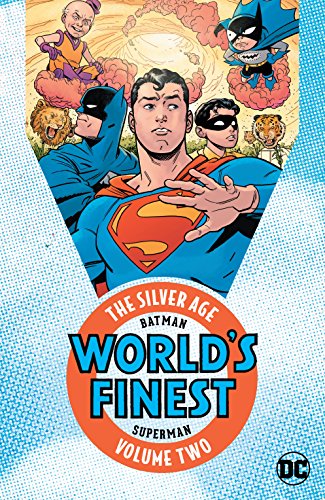
World’s Finest Silver Age Volume Two

This is a review of World’s Finest Silver Age Volume Two. You can read my review of the first volume, here. These aren’t the worst comics I’ve read by any means, which isn’t the same thing as saying they’re good. I plowed through them because I bought both volumes on sale at the same price.

If you want to see Batman, Robin & Superman team up in sci-fic inspired scenarios from the Silver Age, then this volume is for you. A few examples: Superman loses his memory and becomes the chief of a lost Indian tribe. A man with a salad colander on his head (i.e., a crackpot inventor) gains super-powers/uses an invention to torment the Dynamic Trio (there are many variations of this story). After making a million dollars, Batman becomes a big spender, buying looney inventions that don’t work. Superman makes a new friend, a bizarre little alien that goes berserk when it’s not around him. Bat-Mite and Mr. Mxyzptlk duke it out! Red kryptonite makes Superman behave strangely! Aliens of all kinds: invading earth, kidnapping Batman & Robin, asking the Dynamic Trio for help!!!

If this all sounds good, then by all means buy this volume. If it doesn’t, you’ve been warned.

Tales of the Batman: Len Wein

This is a review of Tales of the Batman: Len Wein. The comics in this volume are amongst the first Batman material I ever read, over forty years ago. I enjoyed the five-part Ra’s Al Ghul story in a mass market paperback before there was such a thing as graphic novels. The Joker’s Birthday Bash story is the first Batman comic I ever bought. For some reason, I thought the writer was Gerry Conway but it’s Len Wein.

Anyway, this is a hefty volume. Over thirty issues of 70’s Batman goodness, which if you like the Dark Knight turns out to be pretty good deal. I’d suggest waiting until Comixology has another sale, though, as these volumes are pricey.

The stories are mostly one-shots, and feature Batman’s rogue gallery as well as villains from other titles. Hawkman villain the Gentleman Ghost makes an appearance here, as well as Captain Boomerang (a Flash foe). Two-Face, The Joker, Kite Man, Calendar Man, Firebug, Signal Man, etc., etc., etc. also make appearances. Selina Kyle, aka Catwoman, is present, but this time it’s mostly as Bruce Wayne’s love interest.

Selina and Bruce manage to have sex, off-screen, a fact I missed because I was twelve years old. This leads into a two-part story where it turns out Selina is dying of some rare unnamed disease she caught as Catwoman, which okay. The only cure is an urn full of even rarer Egyptian herbs, because the ancient Egyptians knew so much more about medicine than us. When the herbs are stolen from the museum, Selina becomes suspect #1. You know, the usual nonsense.

I like Mr. Wein’s portrayal of Batman. Instead of being portrayed as a sociopathic asshole, the Dark Knight manages to achieve balance in both sides of his busy life. His powers of detection are highlighted, as well as his escape artist skills. There are a number of instances where Batman is knocked out and put into a death trap, which he always manages to escape. I’m assuming the villains who choose to tie him up instead of just putting a bullet through his head either have a bondage fetish or watched too many episodes of the 60’s TV show.

Recommended for Batman fans!

Batman: Dark Victory

This is a review of Batman: Dark Victory, which is a direct sequel to Batman: The Long Halloween, reviewed here. Batman is younger in this graphic novel, but by the end of it he seems to have aged a hundred years. At the start of the story, Catwoman is flirting with him; by the end, he’s stepping on her neck. This is something I didn’t notice on my first read, years ago. The progression from Young Batman to mega-bleak Asshole Batman is depressing to behold.

Batman is a loner, but there are three people in this storyline he considers confiding to. The first, Harvey Dent, would have been an enormous mistake. From reading Long Halloween, it’s my opinion that Harvey was way off-kilter before getting the acid treatment. The second, Catwoman, is more interesting. Tom King played with this concept in his Batman run. The third is Dick Grayson, whose acrobat parents were murdered by mobsters in this very volume.

Bruce chooses to confide in Dick Grayson. My guess is that it’s partly because he empathizes with Dick’s anger and grief, and partly to keep Dick – who’s determined to solve his parents’ murders on his own – alive. I get that, but bringing a twelve or thirteen-year old into your war against crime (Dick Grayson is the first Robin) isn’t what a rational person does.

I’ve read a lot of Batman comics, and believe me Dick takes a beating. The second Robin, Jason Todd, was bludgeoned to death by a crowbar-wielding Joker, in a shameful 900-Number Scandal (call this number to vote if you want him to die!). They brought Jason back as the Red Hood, but when I read the original comic, he sure looked dead to me.

This doesn’t have much to do with the plot of Dark Victory, which is a lot easier to follow than The Long Halloween. Dark Victory lives up to its name, and includes one shock murder in the final act that I think is effective, because it knocks the magic pixie dust out of Batman’s eyes and shows that Dent is truly irredeemable.

Bottom line, this is one of the top ten Batman storylines I’ve ever read, but finish The Long Halloween first. Highly recommended.