Avengers Forever

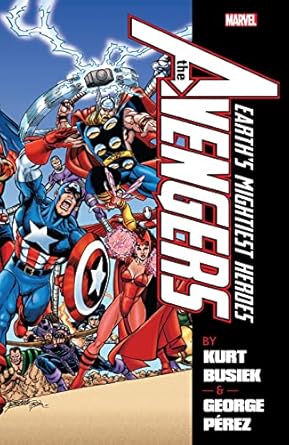
This is a review of Avengers Forever, a 12-issue miniseries by Kurt Busiek (writer) and Carlos Pacheco (artist). This miniseries appears in Avengers Earth’s Mightiest Heroes Omnibus Volume One, which I didn’t finish because it’s over 1,000 pages. Kurt Busiek has the distinction of writing one of the best runs in Avengers history. Years later, all that’s been undone, but these stories stand the test of time. This miniseries came out when Marvel still cared about correcting their continuity goofs and plot flaws.

Speaking of which…this miniseries has a lot of story. Here is the Cliffs note version of the plot. At the behest of his masters the Time Keepers, the time traveling villain Immortus attempts to murder Rick Jones, because Jones is the conduit to a power activated by the Kree Supreme Intelligence. This is the same Supreme Intelligence that destroyed its own race because they reached an evolutionary dead end.

In some timelines, Rick Jones’ power surge leads to the Avengers turning bad and conquering the universe. Note I said, some timelines. The exact number is 42%, which turns to 0% if Rick dies, so the Time Keepers have a valid argument! Fortunately for Rick, the Avengers disagree. So does Kang the Conqueror, who is Immortus’ younger self. So does someone called Libra, and the Kree Supreme Intelligence.

Avengers are plucked from different timelines to deal with the threat. We have mainstays Hawkeye and Captain America, who are still hanging around. There’s also Goliath and the Wasp. This is before Hank Pym ran off with Ultron and Jan Van Dyne died, because Brian Bendis wanted to kill a character (who played a miniscule part in the plot) at the end of Secret Invasion. Someday there will be a discussion of why a person who hated the Avengers ended up writing them, but that’s for another day.

Captain Marvel Jr. and Songbird are part of the team, too. If you aren’t a big comic geek, like yours truly, you might not know them. Yellowjacket is – wait a minute, Yellowjacket? Isn’t he also Goliath? That’s right! Hank Pym has almost as many nom de plumes as nervous breakdowns. In this one, he claims to have killed Hank Pym (bringing self-hatred to new heights!), so he’s not in the best of shape.

The Avengers waste no time figuring out what’s going on. This involves a number of time anomalies, along with Martians, dinosaurs, and a Skrull Richard Nixon. After which, we are treated to two solid issues worth of exposition. If you are interested in seeing how Marvel tried to correct a bunch of their editorial goofs, you might find these issues interesting. This is followed by a rousing climax that wraps up all loose ends.

The only thing that stops this miniseries from being a classic is the aforementioned exposition, and the fact that some of the characters are a tad obscure. It is not the best introduction to Busiek’s Avengers run. That would be the first issue, contained in this selfsame volume. I still recommend this miniseries, but only after you read the first nine issues!
Marvel Masterworks: The Avengers Volume Four

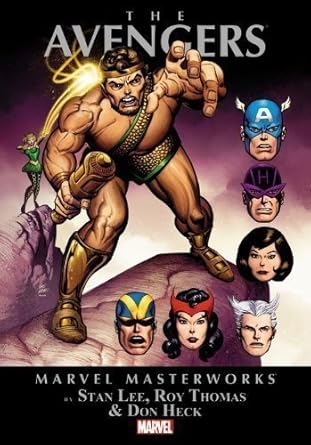
This is a review of Marvel Masterworks: The Avengers Volume Four. See what I thought of the first three volumes here, here, and here. A quick review of the first forty issues of the Avengers –started slow, but got better once the creators started making the team members fight each other more than the villains. Jack Kirby (comic creator) is gone, Stan Lee (writer) is leaving, and Roy Thomas’ (writer) time is upon us.

This volume, the roster expands as Hank Pym – aka Ant Man, aka Goliath, aka Yellowjacket, aka Ultron’s Daddy – and The Wasp rejoin the team. The Greek God Hercules, who at one point we see playing ukulele at a tiki bar, also joins after a mild misunderstanding – Herc tries to kill them all – gets ironed out. Hawkeye wants his girlfriend The Black Widow to join the team, also, and she’d be an interesting addition, but it doesn’t happen because reasons.

The tension between Hawkeye and Captain America is gone, replaced by tension between Goliath and Hawkeye. Goliath is written as a loose cannon. Besides that, he’s sort of a dick. He is also the team’s strong-man, which is weird considering he’s a scientist. What kind of scientist, do you ask? If forced to answer, I would call Pym a physicist, just because the power to grow and shrink seems to be quantum physics. What he has, of course, is a doctorate in handwavium.

The team fights the Sons of the Serpent, a two-issue storyline that today would be an 18 part event. The Living Laser storyline features one of the first realistic depictions of a stalker in comic books I’ve ever seen. There are Ultroids in Bavarian villages and yet another battle with the Sub Mariner, who manages to uncover the Cosmic Cube.

I have a confession to make. Sometimes reading 60’s era Marvel comics (besides Jack Kirby and Steve Ditko) is a real slog, but I look forward to these volumes. After a rough first volume, this series is a must-read. Recommended!

Marvel Masterworks: The Avengers Volume Three

This is a review of Marvel Masterworks Avengers Volume Three. If you read my reviews of the first two volumes, here and here, you will see that the Avengers got off to a rocky start and found its legs only after the powers-that-be revamped the team, getting rid of the heavy hitters in favor of Captain America and three ex-criminals. The Scarlet Witch and Quicksilver are former members of Magneto’s Brotherhood of Evil, and Hawkeye has tangled with Iron Man.

These stories have a formula: the Avengers bicker. The source of the tension is almost always Hawkeye, who has a king-sized chip on his shoulder. Quicksilver and the Scarlet Witch are mutants, Homo Superior, and possess wondrous powers. Captain America has his shield and the super soldier serum. Hawkeye is an ex-carny with a quiver full of trick arrows, so it’s natural that he might overcompensate.

Anyway, after bickering one of the Avengers quits or stalks off. The rest go on a mission, which goes badly until they are rejoined by the wayward Avenger. Rinse and repeat. The other thing that helps this book is that most of the stories are now two-parters, which adds a little depth.

This graphic novel doesn’t have great writing, or great art. What it does have is attitude and lots of action. My favorite storyline: the Avengers bicker. Hawkeye stalks off to hit the nightclubs and go dancing. The Avengers – alerted by guest star the Wasp – fight underwater warlord Attuma, who is a cross between the Sub-Mariner and Conan the Barbarian. Attuma wants to flood the surface world with his tidal wave machine.

The Avengers get their heads handed to them. Hawkeye returns to Avengers HQ, but can’t recall the password to access their comm-link system. Maybe he’s hungover? In case you haven’t figured it out, Hawkeye is an idiot. But it works.

In the meantime, Attuma decides to defeat the Avengers a second time, just to show how tough he is. Quicksilver gets flushed out of the torpedo bay but is rescued by a returning Hawkeye, who has managed to recall the password, and together the reunited Avengers destroy Attuma’s tidal wave machine. Etc., etc., etc.

It’s not rocket science, but it’s fun.

Marvel Masterworks: The Avengers Volume Two

This is a review of Marvel Masterworks: The Avengers Volume Two. You can read my review of the first volume, here. This series has the distinction of being the only title I’ve reviewed so far that finds its legs twice.

I will be honest: the first few issues of this volume are pretty wretched, mostly because of the art. But the stories aren’t great, either. In one issue the Avengers fight a Spider-Man robot in Mexico; Spider-Robot has been sent from the future by Kang the Conqueror. The Wasp is shot at the very end of an issue, mostly for shock value (it happens off-panel), and the Avengers’ search for the specialist to save her leads them to space aliens living in the North Pole. The Wasp is back the very next issue, none the worse for wear, and nobody refers to this issue again, although it does foreshadow the first signs of mental instability in Hank Pym.

The Masters of Evil make another appearance, giving Jack Kirby a chance to tie up the Baron Zemo storyline, and then the book’s creators shake the book up. They disband the old team, which wasn’t working, and give us a new lineup – Captain America, Quicksilver, The Scarlet Witch, and Hawkeye. This is a much more interesting lineup and pays dividends immediately. This volume also gives us the first appearance of The Swordsman, an intriguing character.

Uneven, but good.

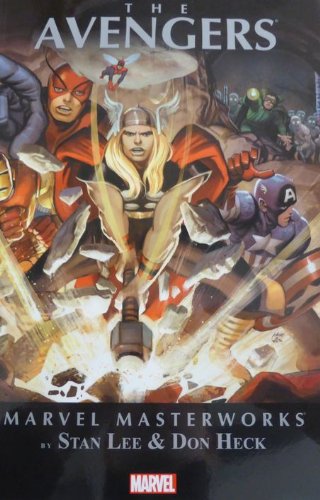
Marvel Masterworks The Avengers Volume One

This is a review of Marvel Masterworks: The Avengers Vol. 1. I won’t bother explaining the Avengers, because everyone on earth has seen the movies. Instead I’ll talk about how it takes four issues for this title to find its legs. The first three issues aren’t great, but perhaps the creative team was figuring things out on the fly. The first issue introduces the team – Giant Man, The Wasp, Iron Man, Thor, and The Hulk – who band together to fight Loki, Thor’s evil step-brother. The Hulk quits next issue. I can’t recall the details, but it involves the Space Phantom impersonating various Avengers.

The Hulk sticks around for a few more issues, fighting alongside frenemy The Sub-Mariner and then aiding his former team against The Lava Men, and then he’s gone. The Hulk’s colors are green and purple, which are villainous (see: Kang the Conqueror) – make of that what you will. In this volume, he’s written as a carbon copy of the pissed-off Thing (see: first volume of The Fantastic Four).

The Hulk isn’t a good fit for The Avengers, but have no fear! Help is on the way when all-purpose villain Sub-Mariner unwittingly frees Captain America from a block of ice in the fourth issue. The title picks up when Cap joins the Avengers. Reading these issues, it’s obvious that Captain America was a favorite of the creative team. He’s a dynamic presence, and injects much-needed life into the title.

The newly formed Avengers fight The Masters of Evil, led by Captain America villain Baron Zemo, whose mask has been super-glued to his face. Thor villains The Enchantress & The Executioner check in next, along with Kang the Conqueror and Immortus, who are the same person. We also meet future member Wonder Man, who betrays and then saves the team.

Comparing this book to the first volume of the Justice League of America is an interesting exercise. The Avengers are less powerful than the JLA, but they act more like real people. They bicker all the time, and have personalities, and are thus a lot more interesting. Unlike other Marvel superteams of that era, The Avengers doesn’t have much in the way of a creative direction – the Fantastic Four are a family, the X-Men are outcasts – but it’s still a fun read.