Borrhomeo the Astrologer

This is a review of the short story Borrhomeo the Astrologer, written by Sheridan Le Fanu and published in his collection Green Tea and Other Weird Stories. Read my review of The Haunted House in WestminsterGreen Tea, An Account of Some Strange Disturbances in an Old House in Aungier-Street, and The Watcher herehere, here, and here. Sheridan Le Fanu was an Irish writer who wrote ghost stories in the 19th century. His most famous work is Carmilla, a vampire story that predates Dracula.

Borrhomeo is an astrologer and alchemist who lives in Milan during a plague in the 17th century. Seeking the elixir of life, he makes a deal with the devil and pays the price. Historical note: in the 17th century, astrologers and alchemists were viewed with suspicion by the Church. During bad times – and a plague qualifies – they were very often accused of witchcraft and/or being in league with Satan.

It does not seem that Le Fanu was particularly religious, so this does not feel like a morality tale. It reads more like a 19th century episode of Tales from the Crypt. Borrhomeo is promised an elixir granting him 1,000 years of life in exchange for spreading the plague to churches and other holy places. Seems like a fair bargain, right? Think again! Satan and his minions make sure that Borrhomeo is seen desecrating those holy places. He’s arrested, tortured, and given a detailed death sentence, hanging for one night and one day, followed by a three-day impalement, followed by burial.

Borrhomeo isn’t worried because he’s taken the elixir, which means they can’t kill him. That’s true, but the devil’s in the details. The elixir puts the aged alchemist into a comatose state, where he will spend those thousand years buried alive, paralyzed but able to hear and feel everything, suffocating forever. But don’t worry, kids! Borrhomeo doesn’t stay buried alive forever. After fourteen years, he’s dug up and thrown into a pit, which is then filled with rocks. The moral of the story is to not make deals with the devil.

This is a surprisingly lurid tale for its time period. It is also experimental, because Le Fanu switches from past to present tense to build suspense. Unfortunately the slush reader in me was too busy wondering if he did it on purpose to appreciate the craftsmanship. There is not a lot of psychological depth to this story, which is what Le Fanu is known for, but it is a worthwhile read nonetheless. It is interesting how the Devil tells Borrhomeo multiple times not to proceed, but that’s because Old Scratch knows his warnings will be ignored. Recommended for lovers of Gothic supernatural stories and weird fiction.
The Watcher

This is a review of the short story The Watcher, written by Sheridan Le Fanu and published in his collection Green Tea and Other Weird Stories. Read my review of The Haunted House in WestminsterGreen Tea, and An Account of Some Strange Disturbances in an Old House in Aungier-Street here, here, and here. Sheridan Le Fanu was an Irish writer who wrote ghost stories in the 19th century. His most famous work is Carmilla, a vampire story that predates Dracula.

The Watcher takes place in Dublin in the 1790’s and features Sir James Barton, a retired navy captain. Barton settles in Dublin and begins collecting the accoutrements of a respectable life after years spent in the navy, even getting engaged to a woman half his age. The Captain is an atheist given to fits of melancholy and self-contemplation.

One night, walking down an empty stretch of street, Barton is trailed by ghostly footsteps. Soon he sees the source of those footsteps, a shrunken little man who seems to know him and sends him nasty letters. Eventually Barton falls into despair, because he thinks he’s being haunted by a demon. His social peers – it is implicit that Barton has no actual friends – think he’s suffering a nervous breakdown. They are correct. Barton becomes a recluse, hiding in a compound locked away from the outside world, and even that’s not enough to save him…

The Watcher is a portrait of guilt. It is also a study of the psychological effects of stalking, because someone or something is stalking Barton. Others see the shrunken little man, so he is real. Whether his tormentor is human or demonic doesn’t matter, because Barton comes to believe his tormentor is a demonic entity out to punish him for his sins.

Why? Well, the narrator mentions a disagreement involving a sailor’s daughter. The young woman dies, perhaps because of her father’s mistreatment, and an angry (jilted?) Barton has the sailor flogged mercilessly until he deserts and dies of his injuries. Unless the man doesn’t die. We do not know.

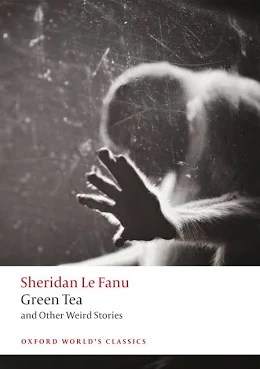
We do not even know if Barton did anything wrong. What’s important is that he believes he’s done something wrong. The fact that Barton is an atheist could mean he’s unprotected from evil spirits, but Le Fanu also wrote a story (Green Tea, here) where a Reverend Jennings is tormented by a ghostly monkey. If I was to play Devil’s advocate, I’d say that the demonic monkey could not harm Jennings physically, whereas Barton’s stalker was a more physical threat. It might also have something to do with the fact that Jennings does nothing to deserve what happens to him.

Le Fanu’s stories are more about the haunted than the hauntings. Focus past the wordiness, and you will be floored by the psychological realism, especially when it comes to issues like mental illness. Recommended for lovers of Victorian horror stories who like a bit of substance to their ghosts.

Green Tea

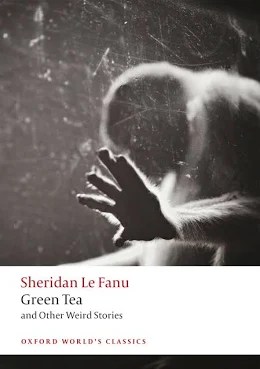
 This is a review of the short story Green Tea, written by Sheridan Le Fanu and published in his collection Green Tea and Other Weird Stories. Read my review of The Haunted House in Westminster here. I’ve kicked off 2025 reviewing Victorian-era ghost and horror stories.

Green Tea is set in London, where Dr. Hesselius attempts to treat Reverend Jennings, who is being tormented by a demonic monkey. Jennings’ symptoms match OCD almost perfectly, upsetting visualizations, trouble performing normal, everyday tasks, and increasingly angry, abusive thoughts.

Dr. Hesselius recognizes Mr. Jennings’ symptoms at once, although the story is coy about whether he misinterprets the cause of his patient’s malady. I am not talking about the trigger, green tea (which the doctor identifies), but whether or not his tormentor is a hallucination or a demon from Hell. It might not matter: if symptoms are treated sometimes the sufferer will be able to deal with the cause, especially if we are talking about mental illness, which is what this story is really about.

Unfortunately, Mr. Jennings dies before the doctor can even begin treatment. Dr. Hesselius is M.I.A. when his patient needs him the most. This is not because of a plot-based emergency. The doctor simply leaves town for a day or so, and Jennings – who is in crisis – does away with himself. I am unsure why Dr. Hesselius, an intellectual prodigy, didn’t leave notice of where he’d be in case of an emergency, but since I am not myself an intellectual prodigy I’m sure I wouldn’t understand the answer.

Dr. Hesselius isn’t the type to blame himself – and I don’t know how much blame he deserves, since he was willing to treat Jennings – so he blames his patient, FOR NOT WANTING TO BE CURED. This is typical, especially when mental health is concerned. It also applies to medical professionals! Ever go to a doctor and realize you know more about the nature of your disease than your physician?

Green Tea is a longer story, and the language is a bit of a slog, but it’s worth the time and effort. I wouldn’t call this story scary. I think unnerving would be the better word, especially the idea of devils appearing as animals. The scariest thing is the indifference of the doctor to poor Mr. Jennings, who must suffer alone. Recommended for lovers of horror fiction/weird fiction.

The Haunted House in Westminster

This is a review of the short story The Haunted House in Westminster, aka Mr. Justice Harbottle, written by Sheridan Le Fanu and published in his collection Green Tea and Other Weird Stories. I have been reading and reviewing ghost stories for the past three months, and this tale – which is set in Victorian era England – fits that mold.

The hero (?!?) of our story is Judge Harbottle, who is old, corrupt, and ridden with gout. He has just sentenced the husband (a Mr. Pyneweck) of his mistress/housemaid to death. Sounds like a Victorian melodrama, right? Well, not exactly. The author does not explicitly say whether Pyneweck is innocent or guilty. Pyneweck’s wife shrugs off her husband’s death. Le Fanu tells us mourning is not in her nature, which he describes as coarse and unrefined. Whatever the reason, there are very few tears shed for the condemned man.

Pyneweck is important because he symbolizes the judge’s corruption, and is sentenced to death because Harbottle decides he must die. So was Pyneweck innocent? I suppose it doesn’t matter, and neither do the finer details of his character. But to me he morphs into something sinister, becoming the agent of the judge’s presumably supernatural downfall.

The story begins with the judge meeting a strange old man, who might be Pyneweck in disguise. The problem with this theory is that Pyneweck is in jail. A brother is mentioned. After Pyneweck is hanged, the judge falls asleep in his carriage and has a vivid dream/hallucination where he is tried by the Kingdom of Life and Death and found guilty.

Since the judge loves to indulge in vice, maybe it’s a hallucination brought on by overindulgence. This is possible, but later in the story everyone in the Judge’s household sees the ghosts. If that’s what they are. These apparitions seem solid for ghosts, but they appear and reappear like phantoms. I’d make more of this, except the frame story explicitly tells us that they are supernatural creatures.

Judge Harbottle is a nasty character, who in his youth fought his fair share of duels and never backed away from a fight. Of course, those days are long gone. Nowadays the Judge does most of his fighting on the bench, where he browbeats juries into giving whatever verdict he sees fit. In short, he’s an unlikable s.o.b. Nobody in this story is very likable.

Le Fanu, though, is likable! This is my first time reading him, and I enjoyed the story. He is famous as the author of Carmilla, a vampire story predating the more famous Dracula. Recommended for lovers of Victorian ghost stories.

The Mezzotint

This is a review of the short story The Mezzotint, written by M.R. James and published in his collection Ghost Stories of an Antiquary. Read my review of Lost Hearts, the last story I reviewed, here. M.R. James was a Cambridge scholar who wrote ghost stories in the early 20th century.

A mezzotint is “a print made from an engraved copper or steel plate on which the surface has been partially roughened, for shading, and partially scraped smooth, giving light areas (source: Oxford Languages).” I mention this because I didn’t know what a mezzotint is. Basically, it’s the proverbial picture of a vase of flowers on the wall, or the volumes of Classic Authors collecting dust on the bookshelves. Boring decoration, which is why the author uses it.

Like all of Mr. James’ protagonists, Mr. Williams is an academic. He is an Oxford man. James, who hails from Cambridge, takes the opportunity to poke some (assumedly) good-natured fun at the rival university. Mr. Williams takes the mezzotint ‘on approval,’ which means he can return it if he doesn’t like it. This mezzotint depicts a manor house at night. Dull, right? Except the picture changes when you don’t look at it, which isn’t so dull. Add in a figure draped in a black robe and a child, and you’ve got a creepy little ghost story.

I’d be remiss not mentioning the Sadducean Professor of Ophiology, the unnamed personage who makes a brief appearance at the story’s end. Sadducean Professor of Ophiology translates to a skeptical professor of snakes, or perhaps an atheist professor of snake handling. I don’t know which. It’s a joke. James loved making up official sounding academic titles that mean nothing. Besides writing creepy stories, he also had a sense of humor!

This is the last short story in Ghost Stories of an Antiquary. I also reviewed Lost Hearts, The Ash Tree, Oh, Whistle and I’ll Come to You, My Lad, Number Thirteen, Canon Alberic’s Scrapbook, Count Magnus, and The Treasure of Abbott Thomas. If you are a fan of ghost stories, there is no excuse not to read M.R. James, and this volume collects some of his best ghost stories. I say ‘some,’ because his later ghost stories are excellent also. Recommended!

Lost Hearts

This is a review of the short story Lost Hearts, written by M.R. James and published in his collection Ghost Stories of an Antiquary. Read my review of The Ash Tree, the last story I reviewed, here. M.R. James was a Cambridge scholar who wrote ghost stories in the early 20th century.

Recently orphaned Stephen Elliott comes to Aswarby (an actual village in England) to live with his elderly cousin, Mr. Abney. Mr. James begins by describing the architecture of the hall, which has no bearing whatsoever on the story, and then tells us that Mr. Abney is an expert in Greek paganism. This is important, mainly because Mr. Abney is planning on sacrificing his 11-year old young cousin.

Why is Stephen’s age important? I don’t know. Mr. Abney seems to think it’s important, because he makes sure that he’s under twelve years old. The voluminous expository text at the story’s end states that the human sacrifice must be under 21 years, but there is no way anyone – even an old coot like Mr. Abney – could mistake an 11-year old for a 21-year old. My guess is that the text at the end should read as twelve years old.

Neither Stephen Elliott nor any of the servants knows that Mr. Abney wants to sacrifice him, but it should be fairly obvious to the reader of this type of tale, especially when we learn that two other children under his ‘care’ mysteriously vanished. Mr. Abney certainly qualifies as one of James’ absentminded academics, with a twist. Evil or crazy, take your pick.

Lost Hearts contains two unsettling images, one involving a dream sequence in a bathroom and the other occurring on the night of the sacrifice – except Mr. Abney is the one who loses his heart. The old man wants to move to another plane, which describes death pretty well, so I guess we have a happy ending!

Lost Hearts is a good story, with more plot than most of the other tales reviewed in this volume. From the modern point of view, the main issue is that it is overwritten, but that is typical for tales of this time period. Also, young Stephen (the protagonist) could be more involved. Maybe he lets the ghost children in, or whatever. Right now, he is just a spectator.

Recommended for fans of ghost stories, especially Victorian/Edwardian ghost stories!

The Ash Tree

This is a review of the short story The Ash Tree, written by M.R. James and published in his collection Ghost Stories of an Antiquary. Read my review of Count Magnus, the last story I reviewed, here. M.R. James was a Cambridge scholar who wrote ghost stories in the early 20th century.

The tale begins with Mr. James telling us how he’d like to own a manor house, and thus be the Lord of All He Surveys. He segues to England’s witch trials, and how a woman (Mrs. Mothersole) was hanged because of the testimony of Lord Matthew Fell, who did own a manor house. Lord Matthew’s testimony amounts to him seeing her acting strangely, which doesn’t mean she is a witch, but it’s enough to hang the old woman. Lord Matthew dies horribly in bed soon afterwards. His limbs turn black and swollen, and anyone who touches his skin with their bare hands gets very sick.

Nowadays, there is consensus that the victims of the witch hunts during the Middle Ages were innocent, misguided, or perhaps mentally ill women. However, Mrs. Mothersole is not innocent, misguided, or mentally ill. She’s the real deal. Years later, Matthew’s grandson Lord Richard sleeps in his grandpa’s room, which has been shut up for decades. He keeps the windows open, and the next day is dead as a doornail. When the ash tree growing next to the window is examined, they find some things they don’t expect.

Doing research (i.e. Google), I was surprised to learn that ash trees were viewed as sacred in pagan folklore. Since the characters of this story are mostly Good Christian Folk (patent pending), they would not share this worldview. Ash trees are also associated with children, which is ironic given the nature of the creatures. And, of course, Mothersole could mean ‘sole mother,’ and the text of the story links the creatures in the ash tree to her. In a way, they’re her children.         

Sir Richard himself is what I’d term giddy, or perhaps contrary. James doesn’t do a lot in the way of character development, but he does enough here. Sir Richard is not very likable. Does he deserve what happens to him? Well, yes and no. Sir Richard oversteps when he sleeps in his grandfather’s old room, which has been shut decades for a reason. It’s a naturalistic interpretation of a curse – what lives in that tree is real and not supernatural, and only dangerous under certain circumstances: i.e., if the Lord of the Manor sleeps in his bed. That’s enough.

I would not call this story scary or spine-tingling, but if you don’t like bugs it might squick you out. Recommended for fans of ghost stories and weird fiction!

Count Magnus

This is a review of the short story Count Magnus, written by M.R. James and published in his collection Ghost Stories of an Antiquary. Read my reviews of The Treasure of Abbot Thomas, Canon Alberic’s Scrap Book, ‘Oh, Whistle, And I’ll Come to You, My Lad,’ and Number Thirteen. M.R. James was a Cambridge scholar who wrote ghost stories in the early 20th century.

A scholar and gentleman-of-means named Wraxall travels to Sweden to write a guidebook and becomes interested in one Count Magnus, a deceased Swedish nobleman with a nasty reputation. Among other things, it’s said the Count went to Chorazin on the Black Pilgrimage and brought something/someone back with him. Before this, I’d never heard of Chorazin or the Black Pilgrimage. Reading is educational!

Wraxall, who talks to himself and easily loses track of his surroundings, seems like the type who walks into trees and other people’s houses. His cluelessness proves fatal when he unwittingly resurrects the Count and his companion, who looks like Cthulhu’s bratty kid brother.

Does this sound familiar? Maybe it does, because it’s the same plot as the past four stories in this volume. It goes like this: a scholar and man-of-means with wanderlust encounters the supernatural during the course of his travels. Sometimes he escapes with a few bad memories and minor phobias; sometimes his curiosity costs him his life.

None of James’ narrators have much in the way of a personality. All overstep a boundary, often without knowing it.  In this case, Wraxall summons Count Magnus by saying out loud he’d like to meet him. He has no way of knowing that the Count is ready and eager to accept visitors!

Lastly, the star of James’s stories is always the ghost, whether it’s a dancing and singing ghost, a ghost made out of bedsheets, or a ghost with the skin of a toad. James’s ghosts – and the way he describes the ghosts – are why he is still known and read today. Recommended for ghost story lovers!

Number Thirteen

This is a review of the short story Number Thirteen, written by M.R. James and published in his collection Ghost Stories of an Antiquary. You can read my reviews of The Treasure of Abbot Thomas, Canon Alberic’s Scrap Book, and ‘Oh, Whistle, and I’ll Come to You, My Lad’ here, here, and here. M.R. James was a Cambridge scholar who wrote ghost stories in the early 20th century; if you like ghosts in horror literature, you should read him.

Anderson is a scholar and gentleman-of-means who travels to Denmark in order to study the last days of Roman Catholicism in that country. James tries to make Danish history interesting and fun by telling us about the holes in the murdered King Erik Glippling’s head. It’s a trap, just like when they told you reading is fun or eating broccoli is good for you. Don’t fall for it!

Since this story isn’t about the history of the church in Denmark, you should read it. Anderson retains Room 12 in The Golden Lion. There is no Room 13. That evening, Anderson peeks out his window and sees the shadow of his neighbor, who favors red lamps and wears a hood. Oh, and the Room 13 phases into existence after the sun falls.

Anderson, doubting his own sanity, invites the inn’s garrulous landlord to his room that night to smoke a cigar and perhaps be an eyewitness. In the interim, he peeks out his window again and sees the shadow of his next-door neighbor dancing quite vigorously. When the landlord arrives, that selfsame next-door neighbor starts to sing in a cracked, cackling voice. Unfortunately, the shenanigans end when the cock cries dawn. There’s some nonsense about a corrupt archbishop and his hidden dwelling place, but don’t be fooled. This story exists because James wanted to make a ghost dance.

This is one of my favorite M.R. James’s stories. In a normal ghost story of that era, the hero/heroine would be awakened in the middle of the night by an apparition, and then swoon. James has his ghost auditioning for America’s Got Talent. Its actions are so bizarre and unexpected and funny, and that only adds to the story.

Highly recommended for lovers of ghost stories and Victorian/Edwardian literature!