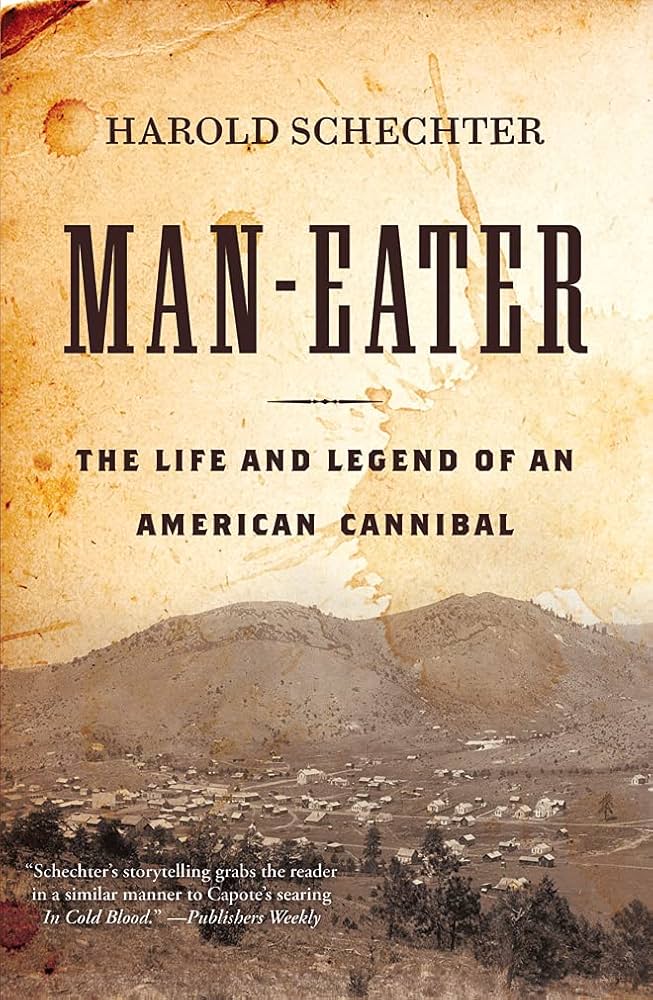
Man-Eater: The Life and Legend of an American Cannibal

This is a review of Man-Eater: The Life and Legend of an American Cannibal, written by Harold Schechter. Ah, cannibals. If you want to get technical, use the term anthropophagy and watch people scratch their heads. We all know about the Donner Party, but there have been other cases of cannibalism, especially on the American frontier.

Consider the case of Alfred Packer, wilderness guide, Civil War veteran, and the sole survivor of a party of six prospectors intrepid or stupid enough to brave the Colorado wilderness. They set out in the winter of 1873-1874, got lost/stranded in the snow, and ran out of food.  Mr. Packer claimed that a crazed butcher (the man’s real profession!) slaughtered the others while he was out searching for food, and then attacked him with an axe upon his return. Mr. Packer, who had a gun, killed the man and then hunkered down for the rest of the winter.

What can not be disputed is that Mr. Packer ate the remains of some of his fellow prospectors, because search parties found the evidence. Or to put it in the jargon of the newspaper reports of the time, HE FEASTED UPON THEIR CORPSES. Whether or not he committed a crime is a question, since he ate his fellow man to survive. History shows that he’s not alone in that, either.

Mr. Packer went to jail, but not for cannibalism. The charge that stuck was manslaughter. What was his motive? Well, theft. The prosecution pushed the robbery angle, although why anyone would subject themselves to starvation to commit a robbery makes no sense. Packer was brought to trial – several times – convicted, and sent to prison rather than being hanged. As time passed, the legend of the Colorado Cannibal grew.

The press took up his cause, including sob sister and gossip columnist Polly Pry. Back in those days, the press didn’t exactly have a savory reputation. Some things never change! One of the best scenes in this book is when a shyster lawyer shoots up a newspaper office, gets away with it, and is feted as a minor celebrity.

Packer was released, years later, and became a minor celebrity himself. He denied any wrongdoing until he died. He is portrayed as a tough, rather unsavory, man, with a striking appearance. People seemed to like or hate him. Did he kill his companions? I don’t know. Nobody does.

What do I think? Well, I doubt anyone considered murder until the food ran out. I also don’t believe that the party was taking a jaunt through the beautiful winter wilderness, making snow angels and catching snowflakes on their pink tongues, while all around them abundant game animals frolicked. The prosecution made this argument, btw. What happened is that they ran out of food and started eating their own boots, which is what you do when you are starving to death.

The other members of Mr. Packer’s group did not love him. He must have known that if it came to it, nobody would’ve bothered drawing lots; they would’ve eaten him first. He was convicted on circumstantial evidence, which means the prosecution had nothing but hearsay. Which doesn’t mean he’s innocent, it means the prosecutors managed to convince a jury he was guilty. Take that for what it’s worth.

If you like true crime, this is a great beach read. It’s entertaining as a slice of history, also, and reads like a potboiler. There are lots of great details from that time period, and the author has an engaging style. Recommended!
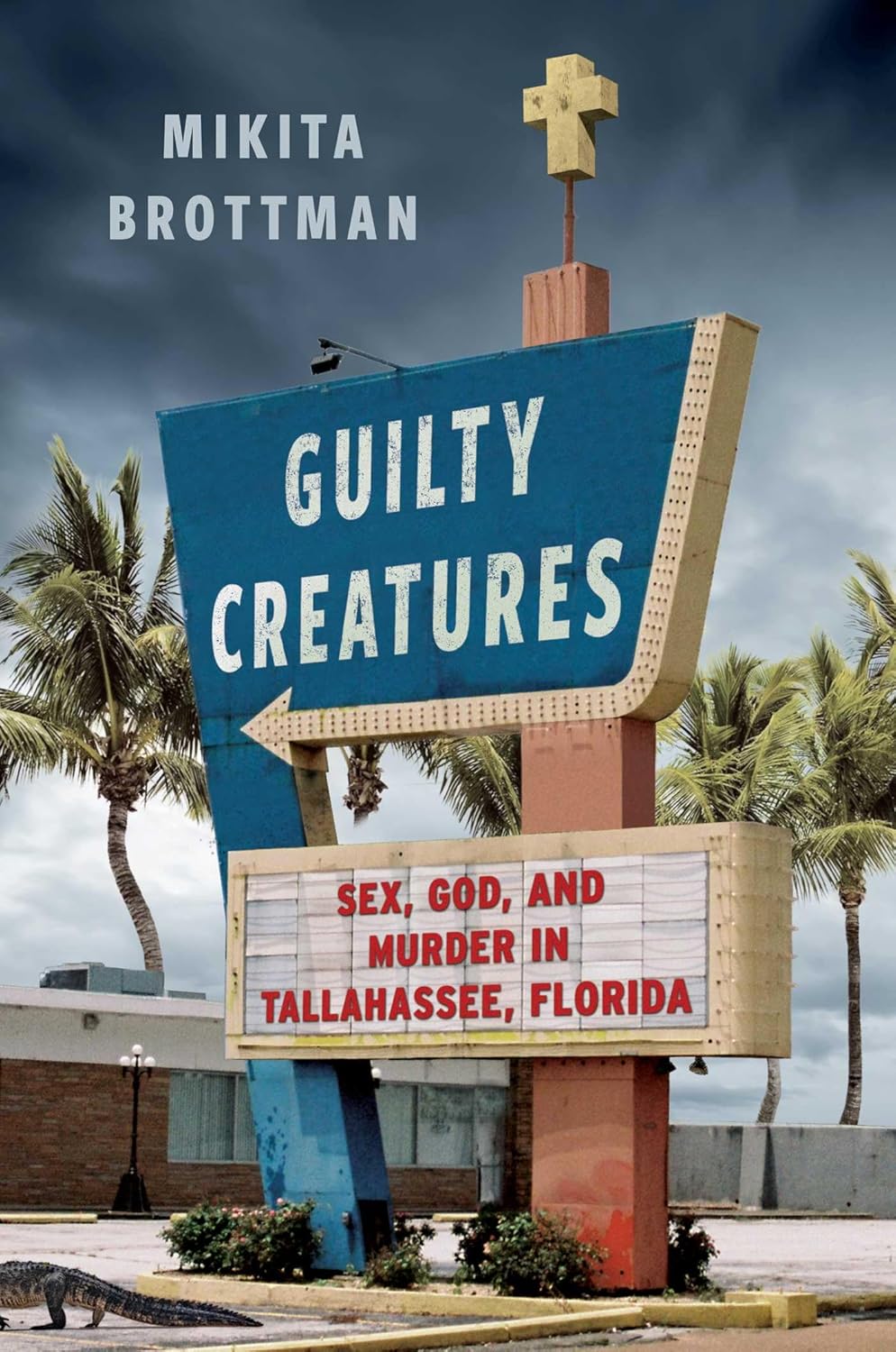
Guilty Creatures: Sex, God, and Murder in Tallahassee, Florida

This is a review of Guilty Creatures: Sex, God, and Murder in Tallahassee, Florida by Mikita Brottman. Please note that this review contains spoilers. The facts of this case are well-known, but the Devil – as they say – is in the details. If you don’t want to know, or don’t want to read about a fairly gruesome murder, read no further.

This book is about two couples who live in a religious community in the suburbs of Tallahassee. Mike – who did not grow up wealthy – spends most of his time working and neglects his wife (Denise), so she starts hanging out with his best friend Brian, who is having his own problems with his wife (Kathy). Brian and Denise start an affair. She doesn’t want to get divorced, so they start talking about devising a ‘test of God’s will.’

This ‘test’ involves Brian luring Mike out to a lake to go duck hunting and then pushing him off the boat. If he sinks, it’s God’s will. Since Brian and Denise believe that a person wearing duck waders will always sink, it’s not much of a test. Mike doesn’t sink, so he passes. Brian shoots him in the head anyway, drags his body into his truck, stuffs his corpse into a dog crate to control the bleeding, and then drives home. After which, he goes to Home Depot to purchase a shovel, tarp, & weights, and buries his best friend’s body in an unmarked grave.

The obvious question is, why didn’t Mike and Denise get divorced? People end relationships all the time and for all sorts of reasons, but mostly it boils down to money and compatibility, or lack thereof. People who aren’t God’s chosen are allowed to drift apart or even dislike each other. Sometime people discover they aren’t compatible, because reasons (insert your own). It’s when you deny those reasons because you are thinking about God’s will or God’s plan that you can run into problems.

Before Mike is murdered, he takes out two life insurance policies. Denise cashes in on both of them, and this is what catches the eyes of the authorities. Brian divorces his wife and marries Denise a few years later. The authorities suspect, people talk, and Mike’s mother won’t give up trying to find her boy. But none of that is the reason they are in prison today.

Brian and Denise get to a point where they can’t stand each other. Yes, there’s that compatibility thing again. When Denise divorces Brian, he kidnaps her at gunpoint and threatens to kill himself. This is a serious crime, especially in Florida. Denise asks the prosecutor for a life sentence, which is when Brian confesses. He gets a lenient sentence of twenty years behind bars. Denise, who was not involved in the actual execution of the murder, gets thirty years. Did she deserve thirty years? I do not know. This is a fairly recent case, which means that most of the people involved – families and friends – are still around, so it wouldn’t be right to speculate.

Ms. Brottman does a good job recounting the source material and getting the known facts of the case correct. She is a therapist, and will sometimes psychoanalyze her characters. Because ultimately that’s what they are, characters she invented. Please note that I am not saying Ms. Brottman made them up. We all have biases and prejudices, so our view of certain people is always going to be fictional to a degree.

For example, Brian is depicted as a jealous manchild with too much money. He doesn’t need to work, and fills the empty holes in his life with porn. There is less information about Denise, which makes her more of a tabula rasa. When a person seems like a blank slate, people will project. Some observers of the trial viewed Denise as an evil mastermind or puppet master. Maybe that’s true, or maybe she just wanted to block the whole thing out. She didn’t share Brian’s desire to confess, that’s for sure, and she’s not a big crier. So what?

I have no idea about ‘tests’ or ‘God’s will.’ To me, this book seems to be about obsession and human frailty. The author quotes the Bible and James M. Cain, the author of Double Indemnity and The Postman Always Rings Twice. Ultimately, this is a story about a pair of lost souls who are drawn to – and ultimately destroy – each other.

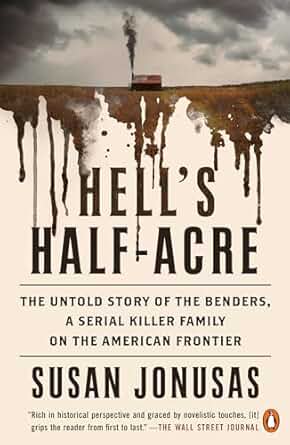
Hell’s Half-Acre: The Untold Story of the Benders, a Serial Killer Family on the American Frontier

This is a review of Hell’s Half-Acre: The Untold Story of the Benders, a Serial Killer Family on the American Frontier, by Susan Jonusas. This review contains spoilers. I am not an expert on the Benders, and this book is my main (only) source of information. Gossip and conjecture aside, we do not know a lot about this family.

We do know that the Benders came to Kansas in 1870, when the new state was flooded with settlers. The family consisted of Ma and Pa Bender, a couple in their fifties who spoke mostly German. Kate Bender and John Gebhardt, in their early 20’s, might have been their children, or they might not have been even related. Eyewitnesses claim they saw ‘physical intimacy’ between them, so perhaps they were husband and wife. Or maybe those eyewitnesses were making things up after the fact.

The Benders lived in a one-room log cabin and sold groceries to travelers. Sometimes they killed those travelers by hitting them over the head with a hammer and slitting their throats. They buried their victims in the apple orchard and took their goods. After eleven murders – including a child, who was buried alive – the Benders fled Kansas and headed west, where they vanished into the frontier. They were never captured.

I do not think the term ‘serial killer’ describes the Benders. I’d call them opportunistic killers who murdered for financial gain. They didn’t have a ‘type,’ and neither I nor anyone else know if they derived psychological or sexual satisfaction from the murders. Yes, their modus operandi was brutal, but it was also efficient and minimized risk to the killers.

The killings spurred a press feeding frenzy, making it hard to separate fact from fantasy. In the aftermath of the murders, every person in Kansas seems to have encountered the Benders. To her credit, the author avoids speculation, although she does attribute thoughts and feelings to her characters, I’m assuming for dramatic effect.

The Benders were not criminal masterminds. They escaped justice by vanishing into the western frontier, which doesn’t exist anymore. Their pursuit was haphazard and disorganized, and that is putting it kindly. There wasn’t much in the way of law enforcement on the frontier, and people were all too willing to take the law into their own hands. One of the more vivid sequences of the book describes the lynching of a group of violent drunks and the attempted lynching of a neighbor of the Benders.

Hell’s Half-Acre is a good book that suffers from a paucity of content. Ms. Jonusas cannot interview eyewitnesses, so she relies on primary sources while avoiding speculation. This works for and against the author. The book reads as historically accurate but is sometimes limited in scope. The description of the discovery of the bodies at the Benders’ cabin is a visceral eye-opener. The same holds for the description of what passed for a manhunt.

After that, the Benders simply vanish and the book loses steam, shifting to the arrest, trial, and eventual acquittal of two women accused of being Ma and Kate Bender, years later. The trial scenes go on too long and belong in another book, but it isn’t the author’s fault that the ending is anticlimactic. Sometimes stories fade out instead of ending with a bang.

The Benders are fascinating in the same way as car crashes – people gawk with their mouths open, but stay safely in their cars. The fate of the central players of this drama remains unresolved, and not knowing adds a certain mystique to what is a sad and gruesome story. In the end, the Benders’ final fate is lost to history.