Marvel Masterworks: Daredevil Volume Eighteen

This is a review of Marvel Masterworks Daredevil Volume Eighteen, written by Denny O’Neil and drawn by various artists. Read my reviews of Volumes One, Two, and Three here, here, and here. Why, you may ask, did I switch from Volume Three to Volume Eighteen? Well, the third volume of Daredevil was so bad I didn’t want to read the fourth.  It happens, especially with 1960’s Marvel comics. For every classic issue of Spider-Man or The Fantastic Four, you have things like Matt’s imaginary twin brother Mike Murdock, evil landlord The Masked Marauder, and Daredevil trapped in a spaceship blasted into outer space by Electro.  Not all old comics are good.

However, these comics are good! Aside from the art – which is inconsistent – this is a very underrated run. The meat of the volume is Daredevil’s archnemesis Bullseye being shanghaied to Japan by disgraced kamikaze Lord Dark Wind, where his broken bones are replaced with metal implants. Ole Hornhead follows the trail to Japan, where he meets Yuriko, daughter of Lord Dark Wind, who helps him out.

Yuriko has a tattoo on her face, mainly because her father is crazy. After the Daredevil arc, she becomes Lady Deathstrike, courtesy of X-Men scribe Chris Claremont. I guess Claremont rescues her from obscurity, but she goes from a fleshed-out character to a psychotic cybernetic killing machine. Maybe aliens reversed her brain, because now she’s the opposite of how Denny O’Neil wrote her. But such is comics – they giveth, and they taketh away.

This volume also contains a bunch of one-shot issues. My favorite storyline is when Daredevil’s ex Heather Glenn gets drunk and reveals his secret identity at a party. Oopsie. Turns out the guy she spills the beans to is both terminally ill and running a murder squad, which happens. The Black Widow reappears in Matt’s life, and we catch a glimpse of Micah Synn, the Kraven the Hunter wannabe who will make his life miserable in the next volume. And I almost forgot about the guest appearance by Wolverine, everyone’s favorite killing machine!

Not many people recall Denny O’Neil’s Daredevil run, mostly because it’s sandwiched between two Frank Miller runs, but this is good stuff. O’Neil edited Miller’s first Daredevil run, which utilizes serialized storylines – multiple issues featuring recurring characters and a vivid setting – and uses the same techniques himself. Think James Robinson’s Starman and Alan Moore’s Swamp Thing. Recommended, especially for Daredevil fans.
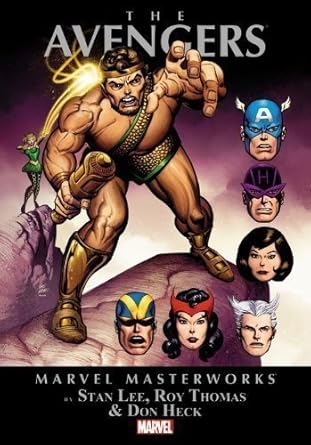
Marvel Masterworks: The Avengers Volume Four

This is a review of Marvel Masterworks: The Avengers Volume Four. See what I thought of the first three volumes here, here, and here. A quick review of the first forty issues of the Avengers –started slow, but got better once the creators started making the team members fight each other more than the villains. Jack Kirby (comic creator) is gone, Stan Lee (writer) is leaving, and Roy Thomas’ (writer) time is upon us.

This volume, the roster expands as Hank Pym – aka Ant Man, aka Goliath, aka Yellowjacket, aka Ultron’s Daddy – and The Wasp rejoin the team. The Greek God Hercules, who at one point we see playing ukulele at a tiki bar, also joins after a mild misunderstanding – Herc tries to kill them all – gets ironed out. Hawkeye wants his girlfriend The Black Widow to join the team, also, and she’d be an interesting addition, but it doesn’t happen because reasons.

The tension between Hawkeye and Captain America is gone, replaced by tension between Goliath and Hawkeye. Goliath is written as a loose cannon. Besides that, he’s sort of a dick. He is also the team’s strong-man, which is weird considering he’s a scientist. What kind of scientist, do you ask? If forced to answer, I would call Pym a physicist, just because the power to grow and shrink seems to be quantum physics. What he has, of course, is a doctorate in handwavium.

The team fights the Sons of the Serpent, a two-issue storyline that today would be an 18 part event. The Living Laser storyline features one of the first realistic depictions of a stalker in comic books I’ve ever seen. There are Ultroids in Bavarian villages and yet another battle with the Sub Mariner, who manages to uncover the Cosmic Cube.

I have a confession to make. Sometimes reading 60’s era Marvel comics (besides Jack Kirby and Steve Ditko) is a real slog, but I look forward to these volumes. After a rough first volume, this series is a must-read. Recommended!

Marvel Masterworks: The Sub-Mariner Volume Two

This is a review of Marvel Masterworks: The Sub-Mariner Volume Two. You can read my review of the first volume, here. Warlord Krang, Namor’s archnemesis from the previous book, only makes a brief appearance. He’s replaced by Daredevil villain The Plunderer, aka Kazar’s Evil Brother, aka The Bad Seed, who wants to conquer the earth by arming his men with VIBRA-GUNS. Namor has a rock dropped on his head and then is buried in an avalanche, while Atlantis is destroyed for the second or third – or maybe the fourth – time. I lost count.

Prince Namor is as gullible and hot-tempered as ever. He has no control over his emotions, declaring war on the surface world in one panel and saving humans from certain death in the next. The meta-story revolves around his never-ending frustration with the surface world. He’s banned from Atlantis because of a stupid misunderstanding, and then leaves his people to fend for themselves after Atlantis is destroyed – when his subjects need him most. This is Namor’s fatal flaw, much like Magneto’s fatal flaw – his narcissism and anger ensure that it will always be about him. Namor must avenge this and wreak vengeance on that, blah blah blah. It’s a very childlike outlook.

The stories are less disjointed, but still way too reliant on coincidence, misunderstandings, and bad luck. The scene where Atlantis is destroyed is worth mentioning. The underwater city is carpet-bombed by a U.S. submarine; earlier, The Plunderer destroys a domed city full of humans. The visuals are striking, and makes me wonder if the creators were influenced by the footage and imagery of the Vietnam War. I don’t know if this is true, btw.

This volume should appeal to Sub-Mariner fans and lovers of obscure characters. Namor is interesting in that he’s a gray character – he’s fought alongside the Fantastic Four as well as Dr. Doom. Another possible draw is Bill Everett – the creator of The Sub-Mariner – doing the pencils and/or inkwork in a few of these issues. All in all, an interesting read about a flawed – but interesting – antihero.

.

Marvel Masterworks: The Mighty Thor Volume Three

Version 1.0.0

This is a review of Marvel Masterworks Thor: Volume 3. Thor keeps getting better, which is a relief, because the first volume was one of the worst graphic novels I’ve ever read. When Jack Kirby took over Thor the second book improved, and now the third volume is hitting its stride courtesy of his great art and clever plotting. Read my reviews of the first two graphic novels here and here.

Jane Foster is in peril a lot in this volume. She’s kidnapped by Loki, menaced by the Grey Gargoyle, and then manhandled by the Executioner and the Enchantress. Don Blake gives the magic beans away by telling Jane he’s Thor, but All-Father Odin conveniently strips him of his powers so he can’t change forms, and she starts thinking he’s soft in the head. All part of Odin’s master plan to cock-block his mighty son!

Thor’s adopted brother, Loki, doesn’t want to mess with Thor’s love-life. He wants to kill him by proxy, using his sorcery to empower Crusher Creel, aka the Absorbing Man. When that fails, he makes a baseless claim against his half-brother. Even though Loki does nothing but lie, and Odin sacrificed an eye for divine wisdom (including the ability to see anything), the All-Father seems strangely clueless in regards to his sons. He sentences them to an ordeal in Skornheim. Loki wins, because he cheats. Loki always cheats, but he shouldn’t bother because Odin already knows he cheated. My theory is that it’s a bizarre sham put on by the All-Father, who must be bored out of his mind. What’s a war god to do in times of peace?

The best part of this volume is when Loki activates The Destroyer, which is more powerful than Thor, and then realizes that if The Destroyer kills Thor, Odin will blast him to atoms. This leads to a sequence where Loki tries in vain to awaken a sleeping Odin and ends up saving Thor’s life. The back-up feature, Tales of Asgard, is great also, heralding the first appearance of the mighty Volstagg, who has served as comic relief for lo these many decades.

Good stuff, especially if you like Jack Kirby and Thor!