Daredevil Omnibus by Frank Miller and Klaus Janson. Part One.

This is a review of Daredevil Omnibus by Frank Miller (artist/writer) and Klaus Janson (artist/inker), which consists of Frank Miller’s legendary run on Daredevil, from issue #158 – 191. This review covers the first half of the omnibus, from 158 – 175. Wow, that’s a lot of exposition! Are these comics any good? Well, yes, they sure are. Mr. Miller made such an imprint on Daredevil that creative teams have tried – and mostly failed – to imitate this run for years.

Frank Miller’s run began when he took over the art duties for writer Roger McKenzie. The highlights of Mr. McKenzie’s run in this omnibus are a three-issue fight with Bullseye, with the final battle set in Coney Island; and an encounter with the Hulk, which is a homage to the Man Without Fear’s fight with the Sub-Mariner way back in Daredevil #7. When Mr. Miller takes over the writing duties, Daredevil makes a seismic leap in quality. He writes the Black Widow out of the comic and introduces Matt’s crazy ex-girlfriend/assassin Elektra, who was created for one reason, which I will not mention here because spoilers. The stories themselves are shorter, punchier (literally!), and have a harder, grittier edge.

Mr. Miller stretches Daredevil to his limits, beefing up his rogue’s gallery by adding crime boss The Kingpin as the big baddie. In their first encounter, Daredevil dances around the Kingpin like a ballet diva, until the Big Man ends the fight with a single punch to Hornhead’s face. Having your villain be stronger and arguably smarter than your hero is something not many creative teams have the guts to do.

The creative team also puts Daredevil through the emotional wringer. When arch-nemesis Bullseye goes crazy because of a brain tumor and embarks on a killing spree, Daredevil beats the crap out of him in the subway. Bullseye lies unconscious on the tracks, directly in the path of an approaching train. Daredevil saves him because he believes in the law, i.e. that nobody is above the law. This ranks as the single biggest mistake of his crimefighting career, because after the doctor removes the tumor Bullseye goes back to killing people. Is Daredevil responsible? You can argue either way. There’s another reason letting Bullseye live was a mistake, but no need to go into that here.

Normally, I am not crazy about testing a character’s values in this way, because the writer holds all the cards. I believe it was writer Dan Slott who was asked who would win a fight between Hulk and Thor. His answer: whoever the writer wants to win. That being said, the way Mr. Miller tests Daredevil’s belief system is organic and believable. Some would say it is inevitable.

I hated these issues when they came out in the early 1980’s, because I thought the art was ugly. It was different from anything I’d read before, and I had trouble processing. Now I will say that the art is dynamic, emphasizing the human form and giving readers Mr. Miller’s wonderful take on New York City (look at all that grit, kids!). This is one of the best superhero runs of all time, period. Recommended for fans of superhero comics; if you are a Daredevil fan, what are you waiting for?
Avengers Forever

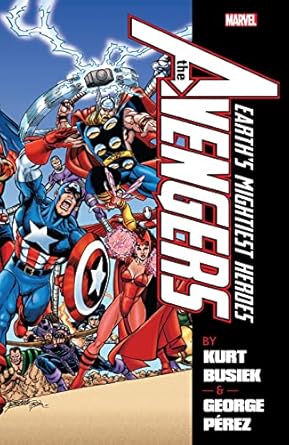
This is a review of Avengers Forever, a 12-issue miniseries by Kurt Busiek (writer) and Carlos Pacheco (artist). This miniseries appears in Avengers Earth’s Mightiest Heroes Omnibus Volume One, which I didn’t finish because it’s over 1,000 pages. Kurt Busiek has the distinction of writing one of the best runs in Avengers history. Years later, all that’s been undone, but these stories stand the test of time. This miniseries came out when Marvel still cared about correcting their continuity goofs and plot flaws.

Speaking of which…this miniseries has a lot of story. Here is the Cliffs note version of the plot. At the behest of his masters the Time Keepers, the time traveling villain Immortus attempts to murder Rick Jones, because Jones is the conduit to a power activated by the Kree Supreme Intelligence. This is the same Supreme Intelligence that destroyed its own race because they reached an evolutionary dead end.

In some timelines, Rick Jones’ power surge leads to the Avengers turning bad and conquering the universe. Note I said, some timelines. The exact number is 42%, which turns to 0% if Rick dies, so the Time Keepers have a valid argument! Fortunately for Rick, the Avengers disagree. So does Kang the Conqueror, who is Immortus’ younger self. So does someone called Libra, and the Kree Supreme Intelligence.

Avengers are plucked from different timelines to deal with the threat. We have mainstays Hawkeye and Captain America, who are still hanging around. There’s also Goliath and the Wasp. This is before Hank Pym ran off with Ultron and Jan Van Dyne died, because Brian Bendis wanted to kill a character (who played a miniscule part in the plot) at the end of Secret Invasion. Someday there will be a discussion of why a person who hated the Avengers ended up writing them, but that’s for another day.

Captain Marvel Jr. and Songbird are part of the team, too. If you aren’t a big comic geek, like yours truly, you might not know them. Yellowjacket is – wait a minute, Yellowjacket? Isn’t he also Goliath? That’s right! Hank Pym has almost as many nom de plumes as nervous breakdowns. In this one, he claims to have killed Hank Pym (bringing self-hatred to new heights!), so he’s not in the best of shape.

The Avengers waste no time figuring out what’s going on. This involves a number of time anomalies, along with Martians, dinosaurs, and a Skrull Richard Nixon. After which, we are treated to two solid issues worth of exposition. If you are interested in seeing how Marvel tried to correct a bunch of their editorial goofs, you might find these issues interesting. This is followed by a rousing climax that wraps up all loose ends.

The only thing that stops this miniseries from being a classic is the aforementioned exposition, and the fact that some of the characters are a tad obscure. It is not the best introduction to Busiek’s Avengers run. That would be the first issue, contained in this selfsame volume. I still recommend this miniseries, but only after you read the first nine issues!

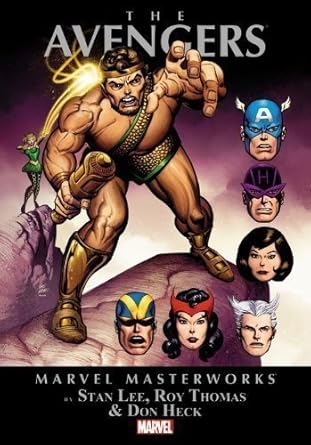
Marvel Masterworks: The Avengers Volume Four

This is a review of Marvel Masterworks: The Avengers Volume Four. See what I thought of the first three volumes here, here, and here. A quick review of the first forty issues of the Avengers –started slow, but got better once the creators started making the team members fight each other more than the villains. Jack Kirby (comic creator) is gone, Stan Lee (writer) is leaving, and Roy Thomas’ (writer) time is upon us.

This volume, the roster expands as Hank Pym – aka Ant Man, aka Goliath, aka Yellowjacket, aka Ultron’s Daddy – and The Wasp rejoin the team. The Greek God Hercules, who at one point we see playing ukulele at a tiki bar, also joins after a mild misunderstanding – Herc tries to kill them all – gets ironed out. Hawkeye wants his girlfriend The Black Widow to join the team, also, and she’d be an interesting addition, but it doesn’t happen because reasons.

The tension between Hawkeye and Captain America is gone, replaced by tension between Goliath and Hawkeye. Goliath is written as a loose cannon. Besides that, he’s sort of a dick. He is also the team’s strong-man, which is weird considering he’s a scientist. What kind of scientist, do you ask? If forced to answer, I would call Pym a physicist, just because the power to grow and shrink seems to be quantum physics. What he has, of course, is a doctorate in handwavium.

The team fights the Sons of the Serpent, a two-issue storyline that today would be an 18 part event. The Living Laser storyline features one of the first realistic depictions of a stalker in comic books I’ve ever seen. There are Ultroids in Bavarian villages and yet another battle with the Sub Mariner, who manages to uncover the Cosmic Cube.

I have a confession to make. Sometimes reading 60’s era Marvel comics (besides Jack Kirby and Steve Ditko) is a real slog, but I look forward to these volumes. After a rough first volume, this series is a must-read. Recommended!

Star Wars: Darth Vader

This is the first part of a review of Star Wars: Darth Vader by Kieron Gillen (writer) and Salvador Larroca (art). The events of this graphic novel take place after the Death Star’s destruction by a young Rebel pilot named Luke Skywalker, i.e. between A New Hope and The Empire Strikes Back.

Darth Vader uncovers a plot to usurp him orchestrated by…the Emperor? Turns out Palpatine isn’t happy with his disciple, and is searching for his replacement(s). Is Vader’s time with the Empire coming to an end? Anyone familiar with the first trilogy knows the answer, but it’s still fun to watch him spar with his doppelgangers in a series of fast-paced issues.

Darth Vader himself is cold, calculating, and methodical. It’s interesting, but in many ways he reminds me of Judge Dredd. In this volume, it’s revealed that he can also be subtle. He has no choice. When the one person more powerful than you is your boss, you need to be sneaky. Many of Vader’s victims get what’s coming to them, but an equal number have done nothing but be unlucky enough to get in his way. If there’s one thing this series drove home for me, it is that Darth Vader is not redeemable.

The first half of the graphic novel climaxes in a close encounter with our favorite band of rebels, Skywalker, Solo, and Leia. The creative team gifts us with grotesque parodies of our lovable heroes and heroines. Triple Zero and BeeTee-One are murder-Droids, Black Krrsantan is a homicidal Wookie, and Dr. Aphra is Han Solo. I read these issues knowing that nobody important would die, but still had a lot of fun.

If Vader is the bad-ass, his counterpart is Dr. Aphra, who throws in her lot with him early and becomes his cat’s paw, despite knowing that her lifespan is limited to her usefulness. Aphra is the most interesting character in this graphic novel. She reminds me of a Han Solo who shoots first and always makes the wrong choice. Despite having the glimmerings of a conscience, she is as bad as Darth Vader.

Interestingly, of the two I find Vader to be the more sympathetic character. If someone is going to kill me, I’d prefer they just get it over with and not mope about it. Accept what you are; maybe even lean into it a little! Final verdict: this is the best Star Wars comic I’ve ever read and as such is highly recommended.

Marvel Masterworks: The Sub-Mariner Volume Two

This is a review of Marvel Masterworks: The Sub-Mariner Volume Two. You can read my review of the first volume, here. Warlord Krang, Namor’s archnemesis from the previous book, only makes a brief appearance. He’s replaced by Daredevil villain The Plunderer, aka Kazar’s Evil Brother, aka The Bad Seed, who wants to conquer the earth by arming his men with VIBRA-GUNS. Namor has a rock dropped on his head and then is buried in an avalanche, while Atlantis is destroyed for the second or third – or maybe the fourth – time. I lost count.

Prince Namor is as gullible and hot-tempered as ever. He has no control over his emotions, declaring war on the surface world in one panel and saving humans from certain death in the next. The meta-story revolves around his never-ending frustration with the surface world. He’s banned from Atlantis because of a stupid misunderstanding, and then leaves his people to fend for themselves after Atlantis is destroyed – when his subjects need him most. This is Namor’s fatal flaw, much like Magneto’s fatal flaw – his narcissism and anger ensure that it will always be about him. Namor must avenge this and wreak vengeance on that, blah blah blah. It’s a very childlike outlook.

The stories are less disjointed, but still way too reliant on coincidence, misunderstandings, and bad luck. The scene where Atlantis is destroyed is worth mentioning. The underwater city is carpet-bombed by a U.S. submarine; earlier, The Plunderer destroys a domed city full of humans. The visuals are striking, and makes me wonder if the creators were influenced by the footage and imagery of the Vietnam War. I don’t know if this is true, btw.

This volume should appeal to Sub-Mariner fans and lovers of obscure characters. Namor is interesting in that he’s a gray character – he’s fought alongside the Fantastic Four as well as Dr. Doom. Another possible draw is Bill Everett – the creator of The Sub-Mariner – doing the pencils and/or inkwork in a few of these issues. All in all, an interesting read about a flawed – but interesting – antihero.

.

Marvel Masterworks: The Mighty Thor Volume Three

Version 1.0.0

This is a review of Marvel Masterworks Thor: Volume 3. Thor keeps getting better, which is a relief, because the first volume was one of the worst graphic novels I’ve ever read. When Jack Kirby took over Thor the second book improved, and now the third volume is hitting its stride courtesy of his great art and clever plotting. Read my reviews of the first two graphic novels here and here.

Jane Foster is in peril a lot in this volume. She’s kidnapped by Loki, menaced by the Grey Gargoyle, and then manhandled by the Executioner and the Enchantress. Don Blake gives the magic beans away by telling Jane he’s Thor, but All-Father Odin conveniently strips him of his powers so he can’t change forms, and she starts thinking he’s soft in the head. All part of Odin’s master plan to cock-block his mighty son!

Thor’s adopted brother, Loki, doesn’t want to mess with Thor’s love-life. He wants to kill him by proxy, using his sorcery to empower Crusher Creel, aka the Absorbing Man. When that fails, he makes a baseless claim against his half-brother. Even though Loki does nothing but lie, and Odin sacrificed an eye for divine wisdom (including the ability to see anything), the All-Father seems strangely clueless in regards to his sons. He sentences them to an ordeal in Skornheim. Loki wins, because he cheats. Loki always cheats, but he shouldn’t bother because Odin already knows he cheated. My theory is that it’s a bizarre sham put on by the All-Father, who must be bored out of his mind. What’s a war god to do in times of peace?

The best part of this volume is when Loki activates The Destroyer, which is more powerful than Thor, and then realizes that if The Destroyer kills Thor, Odin will blast him to atoms. This leads to a sequence where Loki tries in vain to awaken a sleeping Odin and ends up saving Thor’s life. The back-up feature, Tales of Asgard, is great also, heralding the first appearance of the mighty Volstagg, who has served as comic relief for lo these many decades.

Good stuff, especially if you like Jack Kirby and Thor!