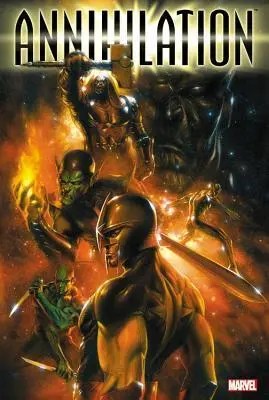
Annihilation Omnibus: Ronan

This is a review of the Ronan miniseries, written by Simon Furman with art by Jorge Lucas, which appears in the Annihilation Omnibus. You can read my reviews of Drax the Destroyer, Nova, The Silver Surfer, and The Super Skrull here, here, here, and here

Short summary: the Marvel universe is being invaded by The Annihilation Wave, a space armada hailing from the Negative Zone led by Annihilus, a beaucoup powerful bug warlord. Will this be the last time I have to post this summary? Stay tuned! 

Ronan the Accuser is a Kree. He’s blue, like a Smurf; unlike a Smurf, he’s built like a pro wrestler and wields an enormous hammer. Ronan is an Accuser, which means he passes summary judgment on, well, just about everybody, but especially the Kree. Think judge, jury, and executioner and you’ll get the idea. 

Ronan has been accused of treason! It’s obvious he’s innocent, because people with binary points of view – besides being scary – don’t sell out their ideals, which are baked in. After a rigged trial, Ronan is exiled from Kree Space. 

Ronan’s new goal in life is to track down the alien who gave false testimony and make her reveal who betrayed him. This leads him to Godthab Omega, a gritty planet held together by dirt, spit, and barbed wire. Besides the settlers, this world is occupied by a band of women named the Graces. They are led by Gamora, the self-proclaimed Deadliest Woman in the Universe. 

But wait, there’s more! A cosmic entity named Glorian manipulates Ronan and Gamora into fighting, and uses the power run-off from their battle to terraform the world into something beautiful. Now Godthab Omega has way more trees, which is so nice! This attracts the attention of the Annihilation Wave, because reasons. 

Wow, lots more plot than I expected! Lots of names to look up, too, but that’s my problem not yours. So is this miniseries any good? There is a lot of material crammed into four issues, but if you like space opera set in gritty worlds this is entertaining. 

There is also a touch of humor, which may or may not be intentional. Gamora, the most dangerous woman in the universe, goes into combat wearing a thong. If it was me, I’d wear battle armor, but I’m not the most dangerous woman in the universe. Maybe it’s a battle thong?

I will give Ronan this. He might be a big blue goon, but he sure isn’t a chauvinist. He pulls no punches when battling Gamora as they joyously pummel the crap out of each other. The miniseries moves the larger Annihilation plot forward while also changing Ronan as a character.* Since the big galoot is a mover & shaker in the Annihilation miniseries, which I will review next week, this is a must-read! 

*Addendum: the next time we see Ronan, he tells a Kree commander he’s relieved of duty right before smashing his skull in with his hammer, so maybe he hasn’t changed all that much.
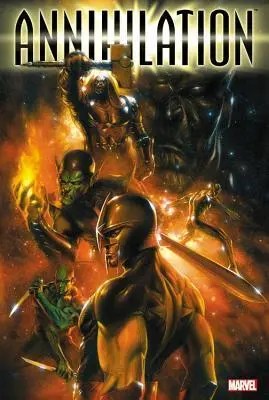
Annihilation Omnibus: Super Skrull

This is a review of the Super Skrull miniseries, written by Javier Grillo-Marxuach with art by Gregory Titus, which appears in the Annihilation Omnibus. You can read my reviews of Drax the Destroyer, Nova, and The Silver Surfer here, here, and here

Short summary: the Marvel universe is being invaded by The Annihilation Wave, a space armada hailing from the Negative Zone led by Annihilus, a beaucoup powerful bug warlord. Will the Marvel universe survive? What do you think? 

First, some background: The Super Skrull, aka Kl’rt, is a Fantastic Four villain who has been around since the 1960’s. I believe he was featured in the 1967 Hanna-Barbera Fantastic Four cartoon! Kl’rt is super strong, can absorb almost limitless amounts of energy, can project invisible force fields, and has a malleable molecular structure. He’s also totally ruthless, can shape change into anything he wants, and has hypnotic abilities to boot. 

If you think it makes no sense that he’d lose to the Fantastic Four 97,654 times, you would be correct. Apparently, the Fantastic Four are stronger because they fight together as a family, which is comic book logic at its finest. Since the Super Skrull is a popular villain, the powers-that-be at Marvel keep on bringing him back. 

In this miniseries, the Super Skrull wants to stop something called The Death Star – er, Harvester of Sorrow, a living world-destroying weapon which is scything through the Skrull Empire like a hot knife through butter. Kl’rt is fanatically loyal to the Skrull Empire, but the Skrull Empire no longer exists. Now it’s just a collection of warlords.

The Super Skrull pleads for aid with one of those warlords, who laughs at him. Because of his past failures, Kl’rt is viewed as a joke by his fellow Skrulls and is openly jeered. This is not smart, as many Skrulls discover moments before they die.

An angry Kl’rt kills scores of his countrymen, but is hopelessly outgunned. He’s rescued from certain death by R’kin, a scrappy Skrull youth who idolizes him. If Kl’rt was a hero, he and young R’kin would bond and perhaps he’d mentor the youth! 

The thing is, Kl’rt isn’t a hero. He is a supervillain who uses any means at his disposal (torture, murder, mutilation, etc.) to get what he wants, leaving behind a trail of broken, twisted, charred – you get the idea. Annihilation as a whole features characters who range from morally gray (reborn Drax) to black (Super Skrull) to mass murderers (old Drax) to genocidal (Silver Surfer).  Nova is the only uninteresting protagonist of the bunch, because he’s a dyed-in-the wool goody-two-shoes. 

Anyway, the Super Skrull and R’kin travel to the Negative Zone. They pick up a hardscrabble army on a prison planet, as well as a virus bioweapon to destroy the Harvester of Sorrow. There’s even a hint of romance between Kl’rt and living robot Praxagora, which is bizarre as they are totally different life forms, but love conquers all boundaries! Alas, they are betrayed. 

Instead of killing the Super Skrull, his enemies haul him into the Harvester of Sorrow. Would you bring someone who can absorb/expel almost limitless amounts of energy into your living bio-weapon? Anyone with a functioning brain knows what happens next.

Super Skrull is my favorite Annihilation miniseries. Partly that’s because it is a self-contained storyline with a beginning and an end. Partly it’s because of the Super Skrull himself, who is a character with a short but very intense shelf life. Sometimes it’s fun to watch a villain romp, but you don’t want him to overstay his welcome, and this miniseries doesn’t do that. Recommended for lovers of space opera comics and obscure Marvel characters.

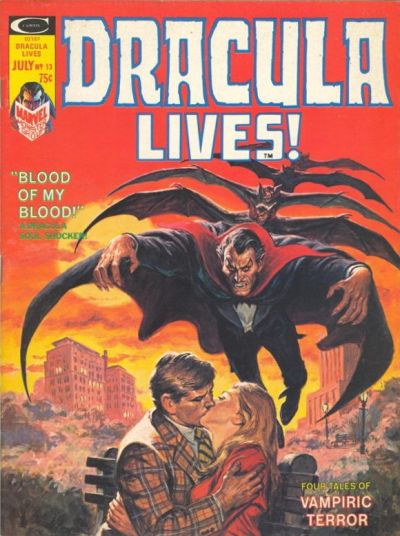
Dracula Lives!

This is a review of Dracula Lives!, a black-and-white horror magazine published by Marvel in the 1970s. These thirteen issues are best viewed as a companion piece to the horror comic, Tomb of Dracula, also produced by Marvel. You can read my reviews of Tomb of Dracula Volumes One and Two here and here

Dracula Lives! is written by comic luminaries such as Roy Thomas, Tony Isabella, Doug Moench, and Steve Gerber. There is a rotating ensemble of illustrators, and in general the art surpasses the writing. The magazine features (mostly) three original Dracula stories per issue, along with trivia and short fiction. We are treated to ‘adult’ content in the form of semi-nudity, most of it female. Dracula himself is naked in a few panels, but we do not see the Vampire Lord’s junk. 

The stories are a mixed bag. Dracula’s origin is recounted. The best part of this tale is the art by the great Neal Adams, with the origin itself being boilerplate villain melodrama. Dracula gains vengeance on his enemies and declares everlasting war on the human race, blah-blah-blah. This story exists because the powers-that-be wanted to give Dracula an origin story, which he doesn’t need.

We have tales featuring a washed-up old horror film actor who believes he’s Dracula, Dracula stalking the halls of the Vatican, and the Count’s ongoing battle with the sorcerer Cagliostro during the French Revolution. Dracula bites a junky in New York City and has to go cold turkey! Dracula encounters a Voodoo Queen in New Orleans! Dracula enjoys the hospitality of Countess Bathory and Marie Antoinette! Dracula vs. The Silver Chastiser, Champion of the Puritans! That last one’s not true, but there is a story with Solomon Kane (a Robert E. Howard character) and werewolves that’s pretty good.

My favorite story is set during the second World War. The Nazis occupy Dracula’s castle and discover that a vampire stalks the halls of the ancient keep. This tale did not go the way I expected, and is the only one of the batch that I found genuinely unsettling. Close second goes to a story written by Gerry Conway about death stalking Dracula. Mr. Conway is a very workmanlike writer, but he can pull a gem out of his hat. 

These stories mostly appear in the first few issues of the magazine. As time goes on, the tie-ins with Tomb of Dracula end, which is both a good thing and a bad thing. No longer having to piece together storylines from multiple titles is a relief, but the magazine loses its identity and becomes a Tales from the Crypt anthology vehicle. Promising storylines are dropped. Dracula vs. Cagliostro goes bye-bye just as it was getting interesting.

In general, the material in later issues is more generic. A New York City street cop encounters Dracula on his last night on the job. A gunslinger stalks Dracula in Europe. A man tries and fails to protect his blind wife from Dracula. A fair bit of the prose in this series is truly purple, which befits a character of Dracula’s stature. In one of the stories, a woman calls Dracula pompous as she sticks a dagger into his belly. When it has no effect, she tells him she didn’t mean it.

Towards the end of Dracula Lives! run, we are treated to two installments of Lilith, Dracula’s Little Girl hanging out in Greenwich Village. Lilith, Mass Murderer is more accurate. After she murdered 75 people on an airplane (in Tomb of Dracula), I have issues taking her seriously as a protagonist. 

Perhaps that’s a Me problem, but I don’t think so. Do you know how much fan mail and how many marriage proposals Ted Bundy got in prison? Lilith may be a mass-murderer, but she sure looks good in those black tights! If you are attractive, you can get away with a lot of shit.

The serialization of Bram Stoker’s Dracula novel, which also takes place in later issues, fares much better. This is a competent retelling of the novel that features great artwork by Dick Giordano. Since Dracula is a melodramatic potboiler, it works very well in graphic format. Too bad they never finished it.  

As far as I know, the issues of Dracula Lives! have never been collected on their own. You can buy the individual issues or purchase them along with the Tomb of Dracula Complete Collection volumes . If you enjoy 1970’s monster magazines and can’t get enough of Dracula, it’s worth the price.

Tomb of Dracula Complete Collection Volume Two

This is a review of Tomb of Dracula Complete Collection Volume Two. You can read my review of the first volume, here. The premise of this graphic novel is simple. The Lord of Vampires awakens in the Swingin’ Seventies and moves to London, where he feasts upon an endless supply of nubile young women.

Dracula is opposed by a group of fearless vampire hunters – Buffy, er Rachel Van Helsing, crossbow wielder; Blade, vampire hunter; Taj Nital, who does not speak; Quincy Harker, mastermind; and last but least, Frank Drake, total loser. Please note that this comic series was released decades before Buffy.

Highlights of this volume include a visit from green-pants-lover Werewolf by Night. After that, Dracula and Rachel Van Helsing embark on the Hike from Hell in the Alps. The WTF Award goes to Rachel, who waits eight hours until nightfall to try and stake Dracula and misses. We also see the Lord of the Vampires being attacked by a psycho mountain goat.

After that, Dracula is captured by Dr. Sun – a pickled brain in a jar –  and must fight the good doctor’s proxy, a vampire biker dude who has all of Dracula’s memories. Dr. Sun is obsessed with vampires, because he needs an unending supply of human blood to survive. Instead of transferring his brain into the Lord of the Vampires, he decides to, uhhh…

…what the hell is Dr. Sun doing, anyway? I read this, and I honestly don’t know. Maybe I should read it again? Hell, no! Once is enough. Whatever he does, it fails. Let’s just say that the Dr. Sun storyline reads more like science fiction than horror and is the weakest storyline thus far, and leave it at that.

Dracula returns to London and a story set in a haunted mansion that reads like a parody of a Gothic novel. We have our Gothic heroine, Shiela (that’s how it’s spelled) Whittier, who is tormented by a poltergeist/father figure/BDSM daddy. She is rescued by Dracula, who is a thousand times worse. Things end badly for her, just as things end badly for most of the human cast of this book. Unlike Dracula, they are not immortal.

This volume also collects the Vampire Lord’s guest appearance in Frankenstein’s Monster. Yes, the Frankenstein Monster had his own comic in the 1970’s! Why doesn’t anyone remember it? Well, it might be because it wasn’t very good.

The Monster is adopted by a Gypsy (this is the term used in the comic, not a slur) woman at the behest of her grandmother, who turns out to be a vampire. She awakens Dracula and kills a villager. The villagers kill the Gypsies. The Monster rumbles into the village and kills villagers. The villagers try to burn the Monster at the stake.

The Monster leaves the village to kill Dracula after telling the villagers they shouldn’t judge people by appearances. The villagers think maybe they were wrong about the Monster, except in the previous issue he killed a bunch of them. The Monster kills Dracula, who turns into a skeleton so that the next rube can pull the stake from his heart.

We also meet Dracula’s Little Girl, Lilith, who is the daughter of the Vampire Lord’s first wife. Dracula claims he hates Lilith because he hated her mother – in a flashback, we see him slapping his first wife. This is untrue. Dracula hates Lilith because she is a woman, and in this comic he is written as a misogynist who views women as either playthings or a food source. That being said, Lilith is vicious. She is not worse than Dracula – that’s impossible – but she gives him a run for the money.

I will be honest, here. Gene Colan’s phantasmagoric art on Tomb of Dracula is incredible. With the exception of the “team-up” between Dracula and Spider-Man that takes place on a cruise ship and is a lot of fun, the writing is depressing. There is a lot of violence against women, much of it casual – women are slapped, punched, gaslighted, and treated as objects. 

To me, Tomb of Dracula gives off the same vibe as The Walking Dead. If I read too many issues at once, I want to rip my eyes out of my sockets. Perhaps I am feeling this way because I DID read too many issues at once. It’s hard for me to tell at this point. If you like vampire stories, Gene Colan’s art, or are a Dracula groupie, this is worth a read.

Annihilation Omnibus: Silver Surfer

This is a review of the Silver Surfer miniseries, written by Keith Giffen with art by Renato Arlem, which appears in the Annihilation Omnibus. You can read my reviews of Drax the Destroyer and Nova here and here

The Annihilation Wave is coming, so lock your doors! On second thought, don’t bother. Since The Annihilation Wave is a space armada hailing from the Negative Zone led by bug warlord Annihilus, it won’t do any good. Annihilus is invading us because our universe is expanding and the Negative Zone is shrinking. This is a crazy reason to declare war on a universe, but you don’t get to be a bug warlord by being sane.

This miniseries features the Silver Surfer, a silver dude who flies around on his cosmic surfboard. I kid you not. He’s also known as Norrin Radd, ex-Herald of Galactus. Who is Galactus, you ask? Why, he’s a big purple and pink dude who travels the universe devouring planets. The Silver Surfer was his original herald, which means he found worlds for Galactus to eat.

In other words, the Surfer is an accessory to genocide, mass murder, Armageddon – whatever you want to call it. He leads Galactus to Earth and then has a change of heart and turns against him. The Purple World Eater doesn’t take this well and gives the Surfer the boot. That’s why he’s an ex-herald.

Whew, that’s a lot of exposition! Anyway, the Surfer is being stalked by Annihilus’ minions, a bunch of big grey hardbody dudes with space-dogs led by Ravenous. Annihilus wants to harness the Power Cosmic, and since Galactus goes through heralds like socks, Ravenous and his boys have been busy. 

After beating up on Ravenous but not killing him, the Surfer once again becomes Galactus’ herald. But not before the Silver One has a crisis of faith. What is the difference between the Annihilation Wave and what Galactus does?

The difference, apparently, is that what Galactus does is part of the Galactic Order. How do we know this? Well, Galactus tells us. I mean, if I was Galactus, I might say the same thing, but I digress. We also see Thanos, who I think starred in some movie, meet up with Annihilus. Afterwards, Thanos has a pow-wow with Tenebrous and Aegis, two beings on par with Galactus. Seems like trouble might be brewing!

The Silver Surfer is an interesting character, quiet, introspective, thoughtful. Perhaps these qualities are what make him a good herald? I dunno. Anyway, this storyline seems mostly about advancing the plot for the upcoming Annihilation miniseries, so it’s not as interesting as the others. But you do need to read it, if you want to read Annihilation, which I think is a good idea. Recommended for lovers of space opera comics and dudes on cosmic surfboards.

Annihilation Omnibus: Nova

This is a review of the Nova miniseries, written by Dan Abnett & Andy Lanning with art by Kev Walker, which appears in the Annihilation Omnibus. Read my review of the first volume, Drax the Destroyer, here. The Annihilation Wave is coming! What’s the Annihilation Wave, you may ask? In the Marvel Universe, there’s a place called The Negative Zone. The king of the Negative Zone is a bug thing named Annihilus, and the Annihilation Omnibus chronicles his invasion of our universe (The Positive Zone?).

This graphic novel features the adventures of Nova, aka Richard Rider, a member of the Nova Corps, which fyi isn’t ANYTHING like the Green Lantern Corps. The Nova Corps meet to discuss the impending threat of the Annihilation Wave, and five minutes later they are gone except for Richard and the Xandarian WorldMind, which uploads itself into his brain. This is good and bad – it boosts Richard’s powers, but he can’t handle all that data and eventually his monkey brain will pop like a zit.

Luckily Richard has Drax – who appeared in the first miniseries – to give him a helping hand. Drax has dropped the Destroyer moniker, but his specialty is still killing things, which is good because in this series there’s a lot of stuff to kill. Together, they escape the remains of Xandar and meet up with cosmic goodie two shoes Quasar, possessor of the coveted quantum bands. Too bad the Annihilation Wave is in hot pursuit.

Will Annihilus conquer the universe? How long can Richard hold out before his brain fries? And will the Xandarian WorldMind ever shut up? I read Annihilation years ago, and didn’t appreciate how much fun it was. That may be because most of the characters are obscure, and today – well, they’re still obscure, but that makes it more interesting. Annihilation was a huge gamble on Marvel’s part, and it paid off. Recommended for lovers of cosmic superheroics and space opera.

Annihilation Omnibus: Drax the Destroyer

This is a review of the Drax the Destroyer miniseries, written by Keith Giffen with art by Mitch Breitweiser, which appears in the Annihilation Omnibus. The Annihilation storyline revitalized Marvel’s cosmic line, leading to the resurrection of titles like Guardians of the Galaxy and the resurgence of characters like Thanos, both of whom appeared in the movies Avengers: Infinity Wars and Avengers: Endgame. I won’t say that this is the miniseries that started it all, but it’s still a fine read.

Drax the Destroyer is Marvel’s cosmic version of The Hulk, big, green, and dumb. Drax survives an exploding spaceship taking him to prison, and ends up in Coot’s Bluff, Alaska, population 2816 – a number that is soon to plunge. I do not know why Drax is bound for prison. I am a comic junkie, and I do not even know Drax’s backstory. If you look up obscure Marvel characters in the dictionary, you will see Drax’s face. His history doesn’t matter, because the purpose of this miniseries is to serve as an introduction to characters appearing in Annihilation.

Besides Drax, there are four other survivors – a Skrull named Paibok, a blue alien named Lunatik, and the Blood Brothers, who are, uh, brothers. This group can be divided into those who are smart, Paibok; those who are smart and evil, Lunatik; and those who are stupid, The Blood Brothers and Drax. The Blood Brothers start a brawl with Drax while Paibok and Lunatik enter Coot’s Bluff, kill a bunch of locals, and organize the survivors into work gangs. They want to salvage the remains of the exploding spaceship and jury rig a ship so they can leave Earth, ASAP.

Paibok kills Drax. It takes him about five seconds. The Skrull is a soldier, and he uses his abilities like a soldier would. But don’t worry! Drax is resurrected, or perhaps he resurrects himself. There are hints Drax is evolving during his scuffle with The Blood Brothers – the longer the fight drags on, the smarter he gets.

Upon Drax’s resurrection, he psychically bonds with Cammie, a local. Cammie falls under the category of smart and evil. She’s ten, but has the world-weariness of a fifty-seven-year old cashier working full-time at McDonalds, which is to say she’s stuck and hates her life. The new Drax isn’t as strong as the dumb Drax, but he’s a thousand times more lethal. He has no qualms about killing and only fights when he needs to.

This reads more like an adventure or survival comic than a superhero story in that it is devoid of any sentimentality and features a sky-high body count. None of the characters – Drax included – act like superheroes. They act according to their self-interests. Drax doesn’t kill Paibok, because he has no reason to do so. In a way, Paibok did Drax a favor – because big, green, and dumb is no way to go through life. Recommended, especially for fans of Keith Giffen and Marvel’s Cosmic Line.

Marvel Masterworks: Daredevil Volume Eighteen

This is a review of Marvel Masterworks Daredevil Volume Eighteen, written by Denny O’Neil and drawn by various artists. Read my reviews of Volumes One, Two, and Three here, here, and here. Why, you may ask, did I switch from Volume Three to Volume Eighteen? Well, the third volume of Daredevil was so bad I didn’t want to read the fourth.  It happens, especially with 1960’s Marvel comics. For every classic issue of Spider-Man or The Fantastic Four, you have things like Matt’s imaginary twin brother Mike Murdock, evil landlord The Masked Marauder, and Daredevil trapped in a spaceship blasted into outer space by Electro.  Not all old comics are good.

However, these comics are good! Aside from the art – which is inconsistent – this is a very underrated run. The meat of the volume is Daredevil’s archnemesis Bullseye being shanghaied to Japan by disgraced kamikaze Lord Dark Wind, where his broken bones are replaced with metal implants. Ole Hornhead follows the trail to Japan, where he meets Yuriko, daughter of Lord Dark Wind, who helps him out.

Yuriko has a tattoo on her face, mainly because her father is crazy. After the Daredevil arc, she becomes Lady Deathstrike, courtesy of X-Men scribe Chris Claremont. I guess Claremont rescues her from obscurity, but she goes from a fleshed-out character to a psychotic cybernetic killing machine. Maybe aliens reversed her brain, because now she’s the opposite of how Denny O’Neil wrote her. But such is comics – they giveth, and they taketh away.

This volume also contains a bunch of one-shot issues. My favorite storyline is when Daredevil’s ex Heather Glenn gets drunk and reveals his secret identity at a party. Oopsie. Turns out the guy she spills the beans to is both terminally ill and running a murder squad, which happens. The Black Widow reappears in Matt’s life, and we catch a glimpse of Micah Synn, the Kraven the Hunter wannabe who will make his life miserable in the next volume. And I almost forgot about the guest appearance by Wolverine, everyone’s favorite killing machine!

Not many people recall Denny O’Neil’s Daredevil run, mostly because it’s sandwiched between two Frank Miller runs, but this is good stuff. O’Neil edited Miller’s first Daredevil run, which utilizes serialized storylines – multiple issues featuring recurring characters and a vivid setting – and uses the same techniques himself. Think James Robinson’s Starman and Alan Moore’s Swamp Thing. Recommended, especially for Daredevil fans.

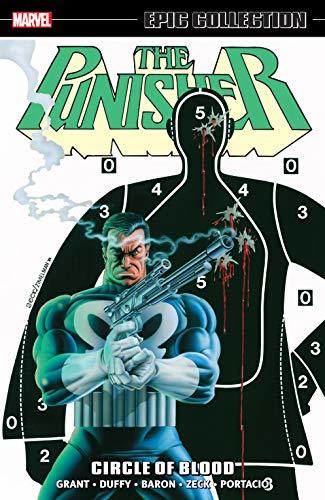
Punisher Epic Collection: Circle of Blood

This is a review of Punisher: Circle of Blood by various writers and artists. This graphic novel is divided into three sections – the first Punisher miniseries, written by Steven Grant with art by Mike Zeck; the first ten issues of the ongoing series, written by Mike Baron with art by Klaus Janson (first few issues); and Punisher: Assassin’s Guild, written by Mary Jo Duffy with art by Jorge Zaffino.

The character of the Punisher is controversial today partly because he’s been made into a symbol of something he is not. Frank Castle (aka The Punisher) is not a cop or an ex-cop, and you can make a case that all of the writers in this graphic novel portray him as mentally ill. The Punisher’s origins stem from Men’s Adventure and Soldier-of-Fortune Magazines, as well as pulp paperbacks featuring characters like The Executioner and maybe Remo Williams, if you scrape away the martial arts weirdness.

The Punisher first appeared in the 1970’s in a Spider-Man comic. He didn’t get his first miniseries, written by Steven Grant and drawn by Mike Zeck, until the 1980’s. In it, The Punisher is released from jail by a shadow organization that supposedly shares his values. This series is way better than it should be. Yes, there are parallels to an 80’s action film, but Frank Castle (The Punisher) is portrayed as being broken in a way that is not fixable. There is a moment when Frank realizes that setting the mobs against each other means lots of innocents getting killed in the crossfire, and you can tell he’s in over his head and has no idea what to do.

The ongoing Punisher series features irredeemable villains and a tight focus on plot. There aren’t many recurring villains, for obvious reasons. The stories are all over the place and have a bizarre energy that one can only admire. In one storyline the Punisher fights insider traders, complete with ninjas and serial killers; in another, he ends up in a compound with the Rev and his sister, ala Jonestown. Frank is shot, beat up, tortured, etc., etc., etc. He survives with a few nicks and scratches, but the same can’t be said for his allies, who all die. The exception is Microchip, a middle-aged guy who doesn’t partake in field operations.

Assassin’s Guild rounds out the trilogy. The Punisher and a guild of assassins confront (i.e. kill) a ring of people who are exploiting children. This graphic novel was not approved by the Comic Code Authority and thus contains what was then considered adult content. Besides the blossoming body count, we witness the Punisher having sex and an obnoxious kid assassin who gets a kick out of offing people. Despite dated ethnic portrayals and a few tropes past their expiration date, Assassin’s Guild is genuinely disturbing and is thus worth a look.

Recommended for fans of The Punisher.

Marvel Masterworks: The Invincible Iron Man Volume Four

This is a review of Marvel Masterworks Invincible Iron Man Volume Four. You can read my reviews of the first three volumes here, here, and here. This volume is written by Stan Lee and drawn by the great Gene Colan, who also drew Tomb of Dracula. Mr. Colan’s Iron Man is dynamic – twisting, contorting, always in action.

Thus far, Iron Man has been an on/off title to read. The main culprit is the writing, which can be kindly described as inconsistent. Nonstop action is great, but the plots need to make sense. The writing has a slapdash quality that I don’t like, such as when Iron Man leaves the widget he needs to defeat the Titanium Man on his coffee table because it slipped his mind. Series regular Happy Hogan retrieves the widget, only to be mortally injured, which leads to Happy’s transformation into a monstrous etc., etc., etc. This is known as plotting on the fly, aka making it up as you go along.

Happily, the writing in this volume is better. When Archie Goodwin takes over scribing duties – which seems like it might be a few issues before he’s credited – the plots get tighter. Yes, dumb cliffhangers still abound, but that is part of the joy of reading superhero comics. The Grey Gargoyle throws a petrified Iron Man off the roof, but lucky for him, there’s a handy truck full of sand nearby to fall on.

The villains in this volume are better. Unlike Mr. Doll (featured in Volume One), they look like real threats. Look at Titanium Man! He’s scary! Look at the Grey Gargoyle! He’s mean! There’s also Whiplash, who has a, uh, steel whip. Let’s not forget ultra-secret organizations Maggia and AIM, bent on world domination. Also: Madame Masque, minus the mask.

Series regulars Happy (chauffer) and Pepper (secretary) get written out of the book for reasons I don’t understand. I think it might have to do with Happy knowing that Tony is Iron Man. Instead of fridging him, the writers allow him to elope with Pepper. They are replaced by SHIELD agent Jasper Sitwell, the most annoying man in the universe. Sitwell debuts by trying to blow Tony Stark’s head off his shoulders, although that’s not how he frames it. Overall, this volume shows a lot of improvement from the last. Recommended for Iron Man fans and lovers of superhero comics!