B.P.R.D.: The Black Flame

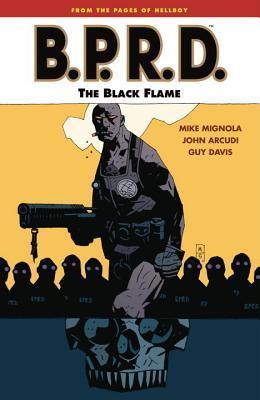
This is a review of B.P.R.D.: The Black Flame, the fifth volume of this series. Read my reviews of the first, second, third, and fourth volumes to catch up. B.P.R.D. stands for Bureau of Paranormal Research and Defense, and its members consist of Liz (firestarter), Roger (golem incubated in horse manure), Johann (friendly ghost), Abe (fishman), and Ben (dead man walking).

In this volume, the war on frogs continues. By frogs, I mean enormous frogmen. Roger the golem has become a tough guy, just like his idol Captain Ben Daimio. Both have heads hard as rocks, so they have a lot in common. Liz meets a mysterious figure in her dreams who stuffs cryptic warning notes down her throat, which she spits out upon awakening. Abe Sapien mopes about his undead wife, and then rejoins the team. Not a lot happens with Johann in this volume, but his time is coming. Oh, and a team member dies.

However, the star of this volume has to be Landis Pope, a corporate CEO who dons a cape and tights – a fantasy of corporate CEOs everywhere, although it’s unclear if they’d be superheroes or villains – and starts referring to himself as The Black Flame. He trains a pair of captured frogmen to talk and releases them into the frogs’ lair in the hopes that they will worship him.

Or something like that. Mr. Pope is out of his mind, so it’s tough to tell what he wants. Why would any sane human being want to wipe out humanity and rule over a bunch of frogmen? The Black Flame’s plan works, sort of. The frogs tell their frog friends, who use him to summon a creature that looks like it’s out of Pink Floyd’s The Wall movie (art courtesy of the great Guy Davis). Afterwards, the Frog Men keep the Black Flame alive as their prisoner, just in case the monster he’s just summoned wants lunch.

I suppose there’s a lesson to be learned from this, but I’m unsure what it is. Frogmen are smarter than you think, maybe? Anyway, another great entry in a great series, and as such highly recommended.

Best/Worst Graphic Novels Read in 2024

Ahh, end of the year lists. Everybody’s doing them, so why not me? Here’s the five best and five worst graphic novels I’ve read in 2024. The rules are simple: 1. I read the graphic novel in 2024. 2. This is my first read of the graphic novel.

Batman: Dark Victory is great and would make this list, but I already read it. Graphic novels that are part of a larger series that I have not read count, even if I’ve read the earlier volumes. Example: Love & Rockets, which is on this list.

BEST (in alphabetical order):

Conan: Birth of a Legend, by Kurt Busiek and Cary Nord. This is the best take I’ve ever seen on Conan, made more impressive by the fact that it covers his lost childhood and manages not to be boring.

Daredevil Ultimate Collection: Volume Two, by Brian Michael Bendis and Alex Maleev. I view this as a noir comic rather than a superhero comic, especially since the superhero in question is written as a narcissistic donkey.

Human Diastrophism: Love & Rockets, by Gilbert Hernandez. The characters here age, change, and even die. In this volume, Luba leaves Palomar and we meet aged hitman Gorgo.

Incal: Black Incal, by Alejandro Jodorowsky and Moebius. Hallucinatory science fiction that has spawned countless imitators.

Kamandi: The Last Boy on Earth, by Jack Kirby. Inspired by Planet of the Apes, this postapocalyptic comic by Jack Kirby moves at a breakneck pace.

WORST (in alphabetical order):

I, Vampire. This series might’ve had promise, but the creators left after a few issues, and the second creative team jumped the shark, and by the time the third creative team found its footing the series ended.

Justice League of American: The Marriage of the Atom and Jean Loring. If you are interested in Brad Meltzer’s Identity Crisis, you might enjoy this . Most will find it a slog to read, with too many characters, confusing storylines, and no meta-plot.

Marvel Masterworks Daredevil: Volume Three, by Stan Lee & Gene Colan. Mike Murdock, Matt’s identical twin who is also blind and who none of Matt’s friends have ever met, takes center stage as the creators see how high they can fly before their feathers melt and they plunge into the ocean.

Marvel Masterworks Sub-Mariner: Volume Two, by Roy Thomas & Bill Everett. This is a step-up from the first volume, with some eye-opening imagery and also art by Golden Age artist Bill Everett, but it won’t be of interest to anyone but the biggest Sub-Mariner fans.

World’s Finest Silver Age Volume Two. If you want to see Indian chief Superman and a crackpot inventor with a salad colander on his head torment the Dynamic Trio, then look no further.

The Human Target

This is a review of The Human Target by Tom King (writer) and Greg Smallwood (artist). Technically, this is a twelve-issue miniseries in two volumes, and my review covers both volumes. SPOILER WARNING. I reveal the killer’s identity, so if you don’t want to know whodunit, read no further.

Let’s get this out of the way. I can see how this book would upset people. A big part of what Mr. King does is give new spins on older, more obscure characters. Other comic writers who do this are Brian Michael Bendis and, of course, Alan Moore. If you are the nostalgic type who has a stake in the JLI (Justice League International) and its characters, I would not read this. You won’t like it.

Why not? There was a show I watched as a kid called The Brady Bunch, which was a dumb kid’s show. That’s fine, because I was a dumb kid. After The Brady Bunch ended, they did a spinoff called The Brady Brides that dealt with all sorts of adult themes that never lasted longer than an episode. Marcia would have a drinking problem, and then it’s never referred to again. I loved The Brady Bunch. I think I watched a single issue of The Brady Brides, and hated it so much I never watched another.

People have nostalgia for the characters of the JLI. I read the first few years of the run, 30+ years ago. It featured a group of obscure, often goofy, characters. We have Guy Gardner, the Rambo Green Lantern; Booster Gold, who comes from the future; Fire and Ice, who hail from Brazil and Norway; Rocket Red, a Russian hero; Blue Beetle, best known for BWAH HAH HAH. No, seriously. That’s what he’s known for.

Turns out, the characters of the DC Universe harbor deep, dark secrets and untold trauma. If you’ve read Brad Meltzer’s Identity Crisis, where Ralph Dibny’s wife Sue is raped and then murdered, you’ll know what I mean. Why would people read that? I read it back in the day, but at that point I’d been reading superhero comics for decades. Basically, it’s adding a degree of noir – not realism – to your comics. If it’s done well, think Watchmen. If it’s not done well, we have ASSHOLE BATMAN and The Blue Beetle being shot in the head.

Would I read it today? Well, I read the first volume of this graphic novel, skimmed the second, and then called it quits. Skimming means I read the issues quickly, a skill perfected from years of waiting in line at the comic book store. Did I hate this graphic novel that much? No, I thought it was depressing. At its heart, The Human Target is all about watching an emotionally stunted man die.

The plot: Christopher Chance, who goes by the moniker the Human Target, impersonates Lex Luthor. That is Mr. Chance’s job, taking the bullet for his client. In this instance, it’s literal. Chance is shot impersonating Luthor, but that’s what saves his life. He spits out the poisoned coffee he drank earlier, but the poison is still in his system, which means he has twelve days to live. One of the interesting things about this graphic novel is that Luthor is one of the few characters who is what he appears to be.

Okay, then. Besides everyone, who’d want to kill Luthor? Hold on, there’s a clue. The poison has trace radiation from a certain dimension, blah blah blah. Turns out a member of the JLI poisoned the coffee, and Chance has twelve days to find the culprit. Lo and behold, the culprit turns out to be Ice, the last person you’d expect. Why? I read the book, and I don’t know why. Yes, she died (and then got better), and it was sort of Luthor’s fault, but who in the DC Universe hasn’t died? Maybe she’s unstable because she killed her father and grandfather as a child and then made up a dumb story about being raised by a lost tribe? Most superhero origins are traumatic, so what does that prove?

Ice is an enigma. In noir terms, she’s the femme fatale. Whether or not she fits into that mold, or whether she’s jammed into it, I leave to the reader. There are two ways to read Ice – the first is that she feels awful about accidentally, you know, killing Chance; the second is that she does everything she can to derail Chance’s investigation. Either interpretation seems valid to me. Or it could be both, because two things can be true at the same time. It’s hard to tell, because a lot of what she does and says is performative. The creators wouldn’t have Chance fall for the woman who kills him, right? BWAH HAH HAH!

The technical term for Chance is an alphahole. What’s that? Well, combine an alpha male with an asshole and – well, you get the idea. The alphahole is a staple in romance novels, where he has attractive qualities and is always redeemable (after he grovels). Chance is a realistic alphahole in that he has no friends, family, or lovers. No, that’s not true. Chance has one friend, who has the worst cover identity in the universe. The guy owns a pizza parlor, doesn’t know a word of Italian, and microwaves his pizza. Since Chance has killed many people and will also serve your prison sentence for you, he isn’t a nice guy. He is absolutely positively no doubt terrified of any hint of intimacy.

The Human Target is an uneasy fusion of superhero comics and noir. Plot-wise, it’s tight; character-wise, it’s all over the place. Let me be clear: I have no particular love or nostalgia for these characters. The reinterpretations didn’t work for me, and I thought Chance was an extremely depressing character. Maybe this graphic novel will work for you, but that’s my take. Anyway, next week I will have a best/worst of 2024 list for the New Year.  

The Incal: The Black Incal

This is a review of The Incal: The Black Incal, by Alexandro Jodorowsky and Moebius. This is a science fiction comic put out by Humanoids, an European publisher. I haven’t read many Humanoids comics. My first impression was Heavy Metal coupled with Eurotrash, a heady whiff, but that’s not true. They are having a huge Humble Bundle sale, here.

A private eye named John DiFool is hired to escort a beautiful young aristocrat to a brothel, where she mates with a man with a wolf’s head. At midnight she transforms into an old woman. Fleeing an angry WolfHead, DiFool takes refuge in futuristic sewers where he meets an alien with a knife in his back. The dying alien gives him the Incal, which at first glance resembles a glowing cigarette lighter.

With me so far? In American comics, we’d be three issues in, but this graphic novel is just getting started. DiFool escapes getting thrown into an acid lake and then retrieves his bird, who is acting like the Messiah, preaching and healing people (DiFool jammed the Incal down the bird’s throat), before witnessing the clonage of His Supreme Highness and then traveling to a huge necropolis, where robots are made from human parts. And that’s before we meet the Black Incal.

Whew, that’s a lot of plot. Also: great art by Moebius. This is a futuristic dystopia with a healthy dose of anarchy/satire. There’s also some nudity and sex scenes, which aren’t too graphic. I did not know this came out in 1980. If you read it, you’ll see its influence in the aesthetic of movies like Total Recall, The Fifth Element, and Blade Runner. In comics, think of Cynosure in John Ostrander’s Grimjack, Warren Ellis’ Transmetropolitan, Judge Dredd.

John DiFool is an EveryMan. Well, given his name I guess he’s stupider than that. I don’t know what the Incal is, but it is sentient and can talk. There isn’t much of a plot yet, just lots of spectacle and great art. Everyone wants the MacGuffin – er, I mean the Incal. This is a great science fiction comic and is thus highly recommended!

The Flash by Mark Waid, Book Two

This is a review of The Flash by Mark Waid, Book Two. You can read what I thought of the first volume, here. This review requires a bit of Flash-edification to makes sense. The original Flash is Jay Garrick (alive), Barry Allen (dead) is his successor, and Wally West (Barry’s nephew) is the current Flash (very alive). This graphic novel starts innocently enough with a team-up between Wally West and Green Lantern Hal Jordan, where they face off against villains Hector Hammond and Gorilla Grodd. Rex the Wonder Dog guest stars!

After an encounter with a new Doctor Alchemy and a schmaltzy Christmas story, we witness the return of Barry Allen, the original Flash. Barry died in the first Crisis, back in the 1980’s. His return would not be unprecedented as superheroes die, are replaced by newer models, and return from the dead all the time. And this CERTAINLY IS Barry Allen. It must be, because he knows everything about Barry’s life. It’s not like he traveled from the future – the 25th century, maybe? – and read the authorized biography of Barry Allen. Of course not.

Anyway, Uncle Barry starts acting strangely, and it’s not long before he ZOOMs off on a rampage. The crime: the city failed to honor his memory when he was dead. Jay Garrick, the original Flash, rallies the troops – oldsters Johnny Quick and Max Mercury. Except this Flash – whoever he may be – is faster than any of them.

This is one of my favorite Flash storylines, period. Mr. Waid’s writing is a fusion of Silver Age ideals (optimistic, fun to read, good vs. evil) and the emotional depth (some would say nihilism) of the Modern Age. Wally is rejected by his hero, which devastates him, and that’s only the start. When Barry goes on a rampage, Wally gets thrashed because he isn’t as fast. Let’s face it – in most cases, The Flash is the most powerful guy in the room, but here Wally is a distant #2. Can he overcome his own self-doubt and fear to finally fill his mentor’s shoes?

Highly recommended!

Marvel Masterworks: The Sub-Mariner Volume Two

This is a review of Marvel Masterworks: The Sub-Mariner Volume Two. You can read my review of the first volume, here. Warlord Krang, Namor’s archnemesis from the previous book, only makes a brief appearance. He’s replaced by Daredevil villain The Plunderer, aka Kazar’s Evil Brother, aka The Bad Seed, who wants to conquer the earth by arming his men with VIBRA-GUNS. Namor has a rock dropped on his head and then is buried in an avalanche, while Atlantis is destroyed for the second or third – or maybe the fourth – time. I lost count.

Prince Namor is as gullible and hot-tempered as ever. He has no control over his emotions, declaring war on the surface world in one panel and saving humans from certain death in the next. The meta-story revolves around his never-ending frustration with the surface world. He’s banned from Atlantis because of a stupid misunderstanding, and then leaves his people to fend for themselves after Atlantis is destroyed – when his subjects need him most. This is Namor’s fatal flaw, much like Magneto’s fatal flaw – his narcissism and anger ensure that it will always be about him. Namor must avenge this and wreak vengeance on that, blah blah blah. It’s a very childlike outlook.

The stories are less disjointed, but still way too reliant on coincidence, misunderstandings, and bad luck. The scene where Atlantis is destroyed is worth mentioning. The underwater city is carpet-bombed by a U.S. submarine; earlier, The Plunderer destroys a domed city full of humans. The visuals are striking, and makes me wonder if the creators were influenced by the footage and imagery of the Vietnam War. I don’t know if this is true, btw.

This volume should appeal to Sub-Mariner fans and lovers of obscure characters. Namor is interesting in that he’s a gray character – he’s fought alongside the Fantastic Four as well as Dr. Doom. Another possible draw is Bill Everett – the creator of The Sub-Mariner – doing the pencils and/or inkwork in a few of these issues. All in all, an interesting read about a flawed – but interesting – antihero.

.

B.P.R.D.: The Dead

This is a review of B.P.R.D.: The Dead. A short recap: this is the fourth volume of the series. You can read my reviews of the first three volumes here, here, and here. B.P.R.D. stands for Bureau of Paranormal Research and Defense, whose members number Liz Sherman (Firestarter), Roger the Golem, Johann (medium), and Abe Sapien (fishman).

In this volume, the B.P.R.D. gets a new member! Ben Daimio has a simple origin story – he wakes up in a body bag. Daimio’s dislikes include being dead, people with triple-digit IQs, and Liz Sherman. To be fair, in Liz’s case the feeling is mutual. Daimio’s face is mutilated, which might give horror fans a clue as to his real origins.

The B.P.R.D. are trying to contain the frog monsters from the previous volume, who are spreading like wildfire. Since the froggies are heading west, so does the team. They move to a base in Colorado, only to discover it’s occupied by more than stray critters and mice. Gunter is a German scientist who says he’s been trapped in the base since it closed in the 1950’s. Of course he’s lying; Gunter has seen Raiders of the Lost Ark and knows all the cool holy relics are stored in military compounds.

Missing from the action is Abe Sapien, who stays behind in Rhode Island, where he meets his wife – or maybe it’s his ex-wife. It’s complicated. Anyway, she’s dead now, but unlike most of the monsters in this volume, she doesn’t want to bring about Ragnarok. She just wants her husband (that’s Abe, sort of) to stay with her.

Back in Colorado, Johann starts acting strangely as the citadel’s ghosts – all German scientists – awaken. Gunter has a plan that involves the Spear of Destiny and opening a gateway to Heaven. Unfortunately, Gunter didn’t watch the part of Raiders when they tried to use to ark. His plan works, sort of. He creates a Gunter angel, and his flapping skin forms the creature’s wings.

Great work from Mike Mignola (story), John Arcudi (story), and Guy Davis (art). A special shout-out goes to Guy Davis’ wonderfully creepy monster designs. Recommended for fans of Hellboy, horror comics, and the X-Files.

Scalped: Book One

This is a review of Scalped: Book One by Jason Aaron and P.M. Guera. Dashiell Bad Horse is an undercover FBI agent. His mission: take down Lincoln Red Crow, who runs the reservation where he was born. Dash gets into it with Red Crow’s thugs; this is an audition of sorts, and it works. Red Crow is impressed, and takes Dash into his employment. First, he tells Bad Horse about what it was like having sex with his mother. I couldn’t figure out why he’d say something like that, and then realized that this is Red Crow’s way of making small talk. It’s also his way of saying, ‘I own your ass.’

Soon Bad Horse is a cop, busting meth houses, spying on his ex-girlfriend and beating up her boyfriends (she call them fuck buddies, but never mind), and providing security for the soon-to-be opened casino. His single encounter with his mother, who is an activist, does not go well. Conditions at the reservation are depicted as being awful. I do not know how accurate this depiction is. I will say that this book contains multiple triggers – blood, swearing, racial epithets, blood, partial nudity, drug use, blood, gunfights, fistfights, sex, murder, lots and lots of blood. If this offends you, do not read this. I guarantee you will get upset.

Scalped is a well-done graphic novel that reads like an action movie and blends two genres – noir and Westerns. P.M. Guera’s gritty art captures the spirit of the book. Mr. Aaron’s approach is blunt, but there’s lots of stuff going on beneath the surface. Everyone has an agenda, and nobody is exactly who they seem to be.

One can debate whether this is the creators’ story to tell. In this case, I am not the person to ask, but I do feel like I have something to contribute to the discussion. I have genuine OCD. I’m not ‘a little OCD,’ I am diagnosed and it’s really messed with my life. When I see fiction about OCD, my first thought is whether the author has OCD. if the author does have OCD, more power to them! If not, things become murky.

My own viewpoint – I’m speaking for myself here, as I am no gatekeeper – is that if you are writing about OCD and you don’t have it, do your homework and get it right. Otherwise, you will be misrepresenting a devastating mental illness, and perhaps indirectly hurting the people who have it. In fact, there are folks who will get mad even if you do your homework and get it right. That’s because you are profiting off something that has made many lives miserable.

If you are shocked that people might feel this way, whether it be about OCD or daily life on an Indian reservation, think of it this way. What if someone you didn’t know made a movie using the details of your life without your permission, made a million dollars, got some of the details wrong, and then told you they were doing you a favor by raising the public’s awareness of you?

Would you thank them, or sue them?

Marvel Masterworks: The Mighty Thor Volume Three

Version 1.0.0

This is a review of Marvel Masterworks Thor: Volume 3. Thor keeps getting better, which is a relief, because the first volume was one of the worst graphic novels I’ve ever read. When Jack Kirby took over Thor the second book improved, and now the third volume is hitting its stride courtesy of his great art and clever plotting. Read my reviews of the first two graphic novels here and here.

Jane Foster is in peril a lot in this volume. She’s kidnapped by Loki, menaced by the Grey Gargoyle, and then manhandled by the Executioner and the Enchantress. Don Blake gives the magic beans away by telling Jane he’s Thor, but All-Father Odin conveniently strips him of his powers so he can’t change forms, and she starts thinking he’s soft in the head. All part of Odin’s master plan to cock-block his mighty son!

Thor’s adopted brother, Loki, doesn’t want to mess with Thor’s love-life. He wants to kill him by proxy, using his sorcery to empower Crusher Creel, aka the Absorbing Man. When that fails, he makes a baseless claim against his half-brother. Even though Loki does nothing but lie, and Odin sacrificed an eye for divine wisdom (including the ability to see anything), the All-Father seems strangely clueless in regards to his sons. He sentences them to an ordeal in Skornheim. Loki wins, because he cheats. Loki always cheats, but he shouldn’t bother because Odin already knows he cheated. My theory is that it’s a bizarre sham put on by the All-Father, who must be bored out of his mind. What’s a war god to do in times of peace?

The best part of this volume is when Loki activates The Destroyer, which is more powerful than Thor, and then realizes that if The Destroyer kills Thor, Odin will blast him to atoms. This leads to a sequence where Loki tries in vain to awaken a sleeping Odin and ends up saving Thor’s life. The back-up feature, Tales of Asgard, is great also, heralding the first appearance of the mighty Volstagg, who has served as comic relief for lo these many decades.

Good stuff, especially if you like Jack Kirby and Thor!

Superman Golden Age Volume Three

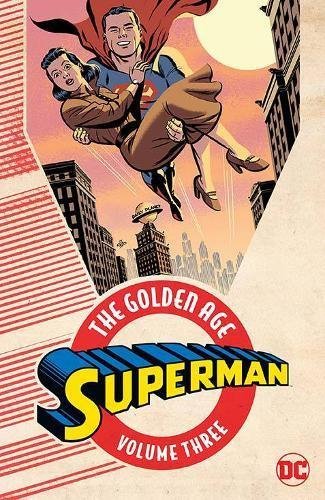
This is a review of Golden Age Superman Volume 3. Read my reviews of the first two graphic novels, here and here. I purchased five of these volumes when they were on sale; just be aware that reading one volume is enough, because they’re all the same. Here we have more of Superman as Big Brother, solving the world’s problems. Supes fights thugs using thug tactics, so arguably he’s the biggest thug of all, but at least he has a personality. Modern day Superman is pretty vanilla, and it’s difficult to explain why a fellow with godlike powers isn’t running things.

The Superman of yesteryear was even more powerful than the modern version, in that he has no qualms about playing God. Luckily, he doesn’t want to be bothered ruling the world. He also has superpowers that have either gone by the wayside, or he no longer uses. Yes, Superman is a master of hypnosis! The makers of the movie Superman Two also read this volume, apparently.

There are three standout stories here. In the first, a mad scientist uses science to make men giants. Superman is buried under an avalanche, which slows him down. The best part of this story is when the mad scientist threatens to make Lois a giantess! The Macrophiliacs in my audience will be disappointed to know he doesn’t succeed.

The second story involves giants, also. Enormous animals are overrunning the suburbs, and Lois and Clark go to investigate! I figured this one out halfway, but it has a clever twist. The third tale involves Superman trying to reform a spoiled heiress. He’s hired by the heiress’ father, the man who spoiled his daughter, but why quibble details? The unbelievable climax requires a deus ex machina in the form of a bursting dam.

I’d be remiss if I didn’t mention Lois Lane. Superman follows Lois around like a lost puppy, or perhaps a stalker, but I’ve lost count of how many times he’s saved her life. Is Lois really that stupid? Well, yes and no. Lois is a plot device, representing Superman’s vulnerability. Since Supes himself is invulnerable, we have Lois held hostage/tied up/transformed into a giantess/thrown off a cliff-building-airplane-etc. in almost every issue.

Recommended for comic history buffs and Superman fanatics!