Daredevil Omnibus by Frank Miller and Klaus Janson. Part One.

This is a review of Daredevil Omnibus by Frank Miller (artist/writer) and Klaus Janson (artist/inker), which consists of Frank Miller’s legendary run on Daredevil, from issue #158 – 191. This review covers the first half of the omnibus, from 158 – 175. Wow, that’s a lot of exposition! Are these comics any good? Well, yes, they sure are. Mr. Miller made such an imprint on Daredevil that creative teams have tried – and mostly failed – to imitate this run for years.

Frank Miller’s run began when he took over the art duties for writer Roger McKenzie. The highlights of Mr. McKenzie’s run in this omnibus are a three-issue fight with Bullseye, with the final battle set in Coney Island; and an encounter with the Hulk, which is a homage to the Man Without Fear’s fight with the Sub-Mariner way back in Daredevil #7. When Mr. Miller takes over the writing duties, Daredevil makes a seismic leap in quality. He writes the Black Widow out of the comic and introduces Matt’s crazy ex-girlfriend/assassin Elektra, who was created for one reason, which I will not mention here because spoilers. The stories themselves are shorter, punchier (literally!), and have a harder, grittier edge.

Mr. Miller stretches Daredevil to his limits, beefing up his rogue’s gallery by adding crime boss The Kingpin as the big baddie. In their first encounter, Daredevil dances around the Kingpin like a ballet diva, until the Big Man ends the fight with a single punch to Hornhead’s face. Having your villain be stronger and arguably smarter than your hero is something not many creative teams have the guts to do.

The creative team also puts Daredevil through the emotional wringer. When arch-nemesis Bullseye goes crazy because of a brain tumor and embarks on a killing spree, Daredevil beats the crap out of him in the subway. Bullseye lies unconscious on the tracks, directly in the path of an approaching train. Daredevil saves him because he believes in the law, i.e. that nobody is above the law. This ranks as the single biggest mistake of his crimefighting career, because after the doctor removes the tumor Bullseye goes back to killing people. Is Daredevil responsible? You can argue either way. There’s another reason letting Bullseye live was a mistake, but no need to go into that here.

Normally, I am not crazy about testing a character’s values in this way, because the writer holds all the cards. I believe it was writer Dan Slott who was asked who would win a fight between Hulk and Thor. His answer: whoever the writer wants to win. That being said, the way Mr. Miller tests Daredevil’s belief system is organic and believable. Some would say it is inevitable.

I hated these issues when they came out in the early 1980’s, because I thought the art was ugly. It was different from anything I’d read before, and I had trouble processing. Now I will say that the art is dynamic, emphasizing the human form and giving readers Mr. Miller’s wonderful take on New York City (look at all that grit, kids!). This is one of the best superhero runs of all time, period. Recommended for fans of superhero comics; if you are a Daredevil fan, what are you waiting for?

The Flash Silver Age Volume Three

This is a review of The Flash Silver Age Volume Three, written by John Broome and drawn by Carmine Infantino. Read my reviews of Volumes One and Two here and here. The Flash is of course the Fastest Man on Earth. Mild-mannered police scientist Barry Allen is struck by lightning, which grants him super speed. He can outrun bullets, time travel, and control every atom in his body! He has a fiancée, hen reporter (not a typo, Google it!)  Iris Allen; a young protégé, Kid Flash; a weird friend, The Elongated Man; PLUS a bow-tie, and he’s ready to go!

Know that this volume contains many erudite rogues, the type of blue-collar supervillain who will haul beer crates during the day and invent a perpetual motion machine during lunch break. Instead of selling their inventions and living the rest of their lives in luxury, they use their inventions to rob jewelry stores. They’re all the same character in that they are doing it for the kicks and not the money. We have an episode with the Mirror Master – I think it was the Mirror Master – breaking out of jail because his rogue rating went down in the prison newspaper, which I’m guessing is put out by his fellow cons. His rogue rating goes up and then tanks when the Flash flattens him.

There are also a few science fiction stories. I respect the fact that Mr. Broome always invents an explanation for his ridiculous Silver Age stories. In one story, the Flash time travels to the future to videotape the end of the earth for his girlfriend. He touches something, which is stupid, and ends up with Hands of Death ™. Everything he touches withers and dies. How to cure this? Just eat grain and oats, which I guess is immune to aging but will absorb the toxins in his hands and thus create an antidote when consumed. Simple!

The Flash’s supporting cast continues to expand. We meet Iris Allen’s brilliant professor father, who I’m sure wanders around asking people what day of the week it is, but almost deduces Flash’s secret identity using Einstein’s Theory of Relativity. When Barry uses super speed, time slows down around him, and his watch slows down. That’s why he’s always late. He’s not a lazy bum after all! And we have The Reverse Flash, who hails from the 25th century and is destined to become the Flash’s greatest foe.

These comics were written in the 1960s for children and young teens, and now they are being made into TV shows and movies that make millions of dollars. How influential are these comics? Well, if the creative team wasn’t doing work-for-hire, they would’ve been millionaires before they died. The lesson: own your own intellectual property! If you are a fan of the Flash and Silver Age comics you will enjoy this.

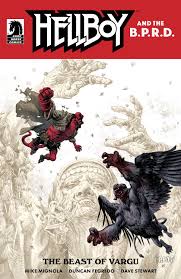
Hellboy and the B.P.R.D: The Beast of Vargu and Her Fatal Hour

This is a review of Hellboy and the B.P.R.D.: The Beast of Vargu and its sequel, Hellboy and the B.P.R.D.: Her Fatal Hour, both written by Mike Mignola. For the past six months I’ve been reviewing B.P.R.D. (aka Bureau of Paranormal Research and Defense) titles – you can read the last one here – and while I enjoy them, I like changing things up.

Please note that these tales take place in 1962 and 1979, so none of the current members of the B.P.R.D. are present. These are stories of Hellboy when he was a member of the B.P.R.D. He quit because they put a bomb in the brain of Roger, his golem buddy, in a graphic novel I haven’t reviewed yet.

In The Beast of Vargu, Hellboy travels to Romania to meet the Wolf Man – er, the Beast of Vargu, a creature that looks like an enormous wolf with wings. The Beast kicks Hellboy in the teeth, which is strange, because normally Hellboy is the one who does all the teeth-kicking. Background, for the unwary/uninitiated: Hellboy may or may not be the Anti-Christ – he periodically snaps off his horns, which regrow – but part of his gimmick is that he’s the monster that monsters are scared of.

Not this time. A bruised and bloodied Hellboy is found by a young Roma woman. She takes him to her cigarette-smoking mother, who treats Hellboy to a puppet show wherein a puppet Hellboy and a puppet Beast of Vargu fight, but this time Hellboy kills it. Do you think the Beast is really dead? That’s a rhetorical question; of course it’s dead!

Next we have the sequel, Her Fatal Hour, when the no-longer young Roma woman summons Hellboy to help out with her psychotic suitor, aka Satan, who comes crawling down the chimney at midnight to claim her soul. Hey, it happens. Hellboy pummels the Evil One wearing his host’s pink, flowered bathrobe. We also learn that Hellboy has a High Noon poster in his bedroom, which totally fits.

I enjoy the shorter Hellboy stories, which all follow the same template: Hellboy beats the crap out of an exotic monster. Sometimes nice and simple is best. Recommended for those who like horror, the occult, the Hellboy universe, and Devils who come crawling down chimneys.

The Girl from HOPPERS: A Love & Rockets Book

This is a review of the Girl from HOPPERS: A Love & Rockets Book, drawn and written by Jaime Hernandez. Read my review of Human Diastrophism, drawn and written by his brother Gilbert, here. Love and Rockets is an indie comic that came out in the 1980’s. Jaime writes about Hoppers, a fictional working-class Mexican-American neighborhood in California, while many of Gilbert’s stories are set in Palomar, a mythical town in Latin America.

The characters in this graphic novel all grew up in the 1970’s and 80’s, just like me. I myself came of age thousands of miles away in a suburb, but my experiences were pretty similar. Boredom. Restlessness. The urge to escape. It’s lost youth, except some of these characters are in their twenties and thirties. Being a rebel is great as a kid, but when you’re thirty years old and bagging groceries at the supermarket or a perpetual couch surfer who spends time at the homeless shelter, it loses its luster.

There are two standout stories in this volume. The first is the Death of Speedy, who has a thing for Maggie but ends up having sex with her sister, which upsets the gangbanger she’s dating. Anyway, Speedy dies, which isn’t a spoiler because that’s the title of the story. At first I thought I was missing something, but there’s nothing to miss. In the volume I read, he isn’t mentioned again. This is a bold storytelling choice because it’s so realistic. Life goes on, and so do we. We are all Speedy, R.I.P.

The second story involves Izzy, Speedy’s sister. Izzy travels to Mexico, meets a guy with a young son, almost marries him, and then her guilt arrives in the form of Satan and she checks out. I think it’s because she had an abortion, but it’s not clear. Mr. Hernandez makes the editorial choice to leave things murky, which doesn’t bother me but may drive others crazy. I will give Izzy this; she allows herself the space to process her feelings, as awful as those feelings may be. Most of the characters in this graphic novel are too busy anesthetizing or even killing themselves to bother.

To say The Girl from HOPPERS has an ensemble cast is to understate things. Characters wander in and out of the story, just like in real life! I haven’t even mentioned the through story, which involves Maggie getting mad when she misses going on Hopey’s band’s tour because she overslept, and then Hopey vanishes for two years, which makes Maggie so angry she dumps her current boyfriend Ray as soon as Hopey returns. Ray seems like a decent guy but Maggie doesn’t want decent. She’s drawn to Hopey, who never met an impulse she didn’t act on.

This graphic novel is comic storytelling at its finest, but it’s not for everyone. There are a LOT of characters, the timeline jumps back and forth, and sometimes motives and even plot points are left intentionally ambiguous. But if you like your comics unsanitized, with realistic (read: flawed) characters who don’t always do the right thing, and who don’t always get the happy ending, you will love this series. Highly recommended!

Avengers Forever

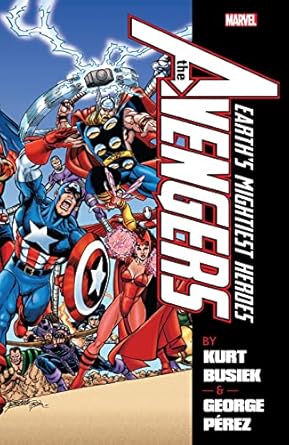
This is a review of Avengers Forever, a 12-issue miniseries by Kurt Busiek (writer) and Carlos Pacheco (artist). This miniseries appears in Avengers Earth’s Mightiest Heroes Omnibus Volume One, which I didn’t finish because it’s over 1,000 pages. Kurt Busiek has the distinction of writing one of the best runs in Avengers history. Years later, all that’s been undone, but these stories stand the test of time. This miniseries came out when Marvel still cared about correcting their continuity goofs and plot flaws.

Speaking of which…this miniseries has a lot of story. Here is the Cliffs note version of the plot. At the behest of his masters the Time Keepers, the time traveling villain Immortus attempts to murder Rick Jones, because Jones is the conduit to a power activated by the Kree Supreme Intelligence. This is the same Supreme Intelligence that destroyed its own race because they reached an evolutionary dead end.

In some timelines, Rick Jones’ power surge leads to the Avengers turning bad and conquering the universe. Note I said, some timelines. The exact number is 42%, which turns to 0% if Rick dies, so the Time Keepers have a valid argument! Fortunately for Rick, the Avengers disagree. So does Kang the Conqueror, who is Immortus’ younger self. So does someone called Libra, and the Kree Supreme Intelligence.

Avengers are plucked from different timelines to deal with the threat. We have mainstays Hawkeye and Captain America, who are still hanging around. There’s also Goliath and the Wasp. This is before Hank Pym ran off with Ultron and Jan Van Dyne died, because Brian Bendis wanted to kill a character (who played a miniscule part in the plot) at the end of Secret Invasion. Someday there will be a discussion of why a person who hated the Avengers ended up writing them, but that’s for another day.

Captain Marvel Jr. and Songbird are part of the team, too. If you aren’t a big comic geek, like yours truly, you might not know them. Yellowjacket is – wait a minute, Yellowjacket? Isn’t he also Goliath? That’s right! Hank Pym has almost as many nom de plumes as nervous breakdowns. In this one, he claims to have killed Hank Pym (bringing self-hatred to new heights!), so he’s not in the best of shape.

The Avengers waste no time figuring out what’s going on. This involves a number of time anomalies, along with Martians, dinosaurs, and a Skrull Richard Nixon. After which, we are treated to two solid issues worth of exposition. If you are interested in seeing how Marvel tried to correct a bunch of their editorial goofs, you might find these issues interesting. This is followed by a rousing climax that wraps up all loose ends.

The only thing that stops this miniseries from being a classic is the aforementioned exposition, and the fact that some of the characters are a tad obscure. It is not the best introduction to Busiek’s Avengers run. That would be the first issue, contained in this selfsame volume. I still recommend this miniseries, but only after you read the first nine issues!

Marvel Masterworks: The Avengers Volume Four

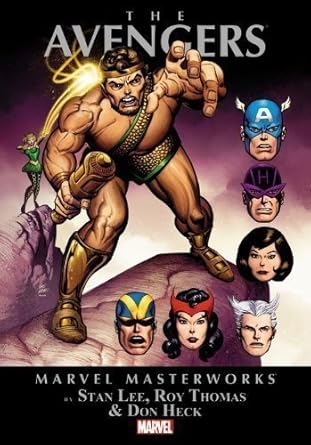
This is a review of Marvel Masterworks: The Avengers Volume Four. See what I thought of the first three volumes here, here, and here. A quick review of the first forty issues of the Avengers –started slow, but got better once the creators started making the team members fight each other more than the villains. Jack Kirby (comic creator) is gone, Stan Lee (writer) is leaving, and Roy Thomas’ (writer) time is upon us.

This volume, the roster expands as Hank Pym – aka Ant Man, aka Goliath, aka Yellowjacket, aka Ultron’s Daddy – and The Wasp rejoin the team. The Greek God Hercules, who at one point we see playing ukulele at a tiki bar, also joins after a mild misunderstanding – Herc tries to kill them all – gets ironed out. Hawkeye wants his girlfriend The Black Widow to join the team, also, and she’d be an interesting addition, but it doesn’t happen because reasons.

The tension between Hawkeye and Captain America is gone, replaced by tension between Goliath and Hawkeye. Goliath is written as a loose cannon. Besides that, he’s sort of a dick. He is also the team’s strong-man, which is weird considering he’s a scientist. What kind of scientist, do you ask? If forced to answer, I would call Pym a physicist, just because the power to grow and shrink seems to be quantum physics. What he has, of course, is a doctorate in handwavium.

The team fights the Sons of the Serpent, a two-issue storyline that today would be an 18 part event. The Living Laser storyline features one of the first realistic depictions of a stalker in comic books I’ve ever seen. There are Ultroids in Bavarian villages and yet another battle with the Sub Mariner, who manages to uncover the Cosmic Cube.

I have a confession to make. Sometimes reading 60’s era Marvel comics (besides Jack Kirby and Steve Ditko) is a real slog, but I look forward to these volumes. After a rough first volume, this series is a must-read. Recommended!

B.P.R.D.: The Universal Machine

This is a review of B.P.R.D.: The Universal Machine. Read my reviews of the first, second, third, fourth, and fifth volumes. The Bureau of Paranormal Research and Defense consists of Abe Sapien, fish-man; Ben Daimio, dead man walking; Johan Kraus, ghost in the machine; Liz Sherman, fire starter; Roger, homunculus stewed in horse manure (R.I.P.). We also have Dr. Kate Corrigan, academic, who in this volume takes center stage.

The death of Roger the Golem continues to have repercussions. Dr. Corrigan travels to Ableben, a charming small town in France to meet a collector, who may have the obscure book needed to bring Roger back. The collector is an odd fellow, as collectors often are. He shows off his collection, including a stuffed baboon that people in the Middle Ages thought a werewolf, along with the replica of a magic ring that rests upon his finger. True to B.P.R.D. form, the town is full of actual werewolves.

While Kate travels to France, the remaining members of the B.P.R.D. do their version of sitting around a campfire telling ghost stories. Daimio’s story is the standout, a tale of blood and murder as he and his team are slaughtered in Bolivia by the minions of a jaguar god. Not to be undone, Krauss tells us how he fell in love with a female ghost, and used her grieving husband to keep seeing her. Interestingly, Daimio is the only one who correctly calls the story pathetic.

Meanwhile, Kate is stuck in the collector’s shop, which is bigger on the inside than the outside and which seems to have faded from our reality, leaving her companion stranded in a phone booth surrounded by werewolves. A dwarf and a group of aristocrat vampires join the party. The collector gets pushy, as collectors often do when arguing over prices. Kate cuts off negotiations – as well as the finger with the magic ring – and feeds it to the dwarf, who transforms into a demon, and that’s when the shit hits the fan.

Recommended for fans of occult comics, Hellboy, and the X-Files!

Superman’s Pal, Jimmy Olsen

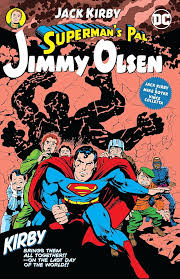
This is a review of Superman’s Pal, Jimmy Olsen written and drawn by Jack Kirby. When people discuss Mr. Kirby’s DC work, they will usually talk about Kamandi or The Demon, reviewed here and here. I’ve never heard a word about this graphic novel, which is a shame. This book, which showcases Superman alongside an ensemble cast, is first-rate science fiction.

What about that ensemble cast, anyway? We have Clark Kent, the Newsboy Legion, the Golden Guardian, who is a clone – no, not of Captain America – as well as that freckled young cub reporter, Jimmy Olsen himself. The Newsboy Legion features five kids who have a vehicle called the Whiz Wagon, based on the Fantasti-Car, that can fly and is also amphibious. The kids are interchangeable, except for the one who dresses in scuba gear all the time, which won’t bode well after he hits puberty.

The plot revolves around The Hairies, a secret group of super-intelligent vat grown humans who live inside a mountain and drive around in a missile carrier disguised as a monster. They’re guarded by a biker gang and are doing top secret experiments on the human genome, backed by the U.S. government and Superman. In the 1970’s, that wasn’t considered unethical; today, there would be collective apoplexy.

Jimmy Olsen and the annoying – I mean youthful – members of the Newsboy Legion investigate. They tangle with the biker gang, and Jimmy automatically becomes head honcho when he punches out their leader. Jimmy Olsen, Biker, is only one of the many startling transformations in store for the reader. We also have Rampaging Jimmy Olsen, transformed by science into a mean green killing machine that doesn’t resemble the Incredible Hulk – NO, NOT AT ALL – and Neanderthal Jimmy Olsen.

Sound weird? Wait until the scene where everyone drops acid, including Superman, that Head Square Himself. Oh, Kirby gives us some nonsense about a solar phone, but this is his version of an acid trip. Anyway, Olsen and company discover that The Hairies are fiddling with human DNA, making all matters of chimera, including tiny Jimmy Olsens! At one point we look through a microscope to see the tiny Olsens, each wearing a pair of tighty whities.

Darkseid, rightfully deciding the world isn’t ready for that much Jimmy Olsen, sends the most incompetent cat’s paw in the DC Universe to destroy the Hairies. Media mogul Morgan Edge spends all his time trying to kill Jimmy Olsen and the Newsboy Legion. While they are annoying, he could just fire them instead, but I guess I’m missing something.

Other stories include a villain who lives in a volcano, a Scottish Lake Monster, and a miniature planet full of Count Dracula lookalikes that makes TOTAL SENSE when explained. We also have a story starring Don Rickles and his twin, which may have been funny when it was released, but somehow I doubt it.

Nobody in this graphic novel has anything resembling a personality, but that’s my only quibble. Mr. Kirby was a genius, and is allowed a misstep here and there. Highly recommended!

Star Wars: Darth Vader

This is the first part of a review of Star Wars: Darth Vader by Kieron Gillen (writer) and Salvador Larroca (art). The events of this graphic novel take place after the Death Star’s destruction by a young Rebel pilot named Luke Skywalker, i.e. between A New Hope and The Empire Strikes Back.

Darth Vader uncovers a plot to usurp him orchestrated by…the Emperor? Turns out Palpatine isn’t happy with his disciple, and is searching for his replacement(s). Is Vader’s time with the Empire coming to an end? Anyone familiar with the first trilogy knows the answer, but it’s still fun to watch him spar with his doppelgangers in a series of fast-paced issues.

Darth Vader himself is cold, calculating, and methodical. It’s interesting, but in many ways he reminds me of Judge Dredd. In this volume, it’s revealed that he can also be subtle. He has no choice. When the one person more powerful than you is your boss, you need to be sneaky. Many of Vader’s victims get what’s coming to them, but an equal number have done nothing but be unlucky enough to get in his way. If there’s one thing this series drove home for me, it is that Darth Vader is not redeemable.

The first half of the graphic novel climaxes in a close encounter with our favorite band of rebels, Skywalker, Solo, and Leia. The creative team gifts us with grotesque parodies of our lovable heroes and heroines. Triple Zero and BeeTee-One are murder-Droids, Black Krrsantan is a homicidal Wookie, and Dr. Aphra is Han Solo. I read these issues knowing that nobody important would die, but still had a lot of fun.

If Vader is the bad-ass, his counterpart is Dr. Aphra, who throws in her lot with him early and becomes his cat’s paw, despite knowing that her lifespan is limited to her usefulness. Aphra is the most interesting character in this graphic novel. She reminds me of a Han Solo who shoots first and always makes the wrong choice. Despite having the glimmerings of a conscience, she is as bad as Darth Vader.

Interestingly, of the two I find Vader to be the more sympathetic character. If someone is going to kill me, I’d prefer they just get it over with and not mope about it. Accept what you are; maybe even lean into it a little! Final verdict: this is the best Star Wars comic I’ve ever read and as such is highly recommended.

Promethea 20th Anniversary Deluxe Edition Volume One

This is a review of Promethea 20th Anniversary Deluxe Edition Volume One by Alan Moore (writer) and J.H. Williams III (art). Content warning: there is a consensual sex scene between two adults in this volume that people may find upsetting because of the gap in their ages. The setting is gritty near-future New York City, but this is fantasy and not science fiction – unless you consider magic to be science.

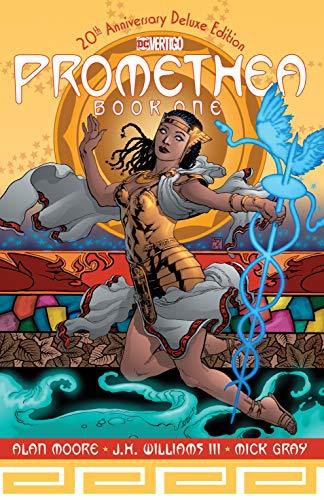
Promethea is a living story who flies and wields a glowing blue caduceus composed of a pair of talking snakes. Her alter ego, a college student named Sophie Bangs, is writing a term paper about Promethea and unwittingly becomes her new host after meeting Barbara Shelley (the old host). They encounter a Smee, which Promethea destroys, but this is just a warning shot. Sophie needs to learn magic, fast, before Hell’s legions come calling. Throughout the ages, there have been other Promethea hosts. Sophie travels to the Immateria to meet them, but still needs a teacher in the material world.

There is a lot of exposition about magic here, so be prepared. An entire issue is spent on the topic.  Unfortunately, after reading this I still do not understand magic, but I will say it seems very complex. Promethea spends most of her time flying around blasting people with her magic caduceus, and I’m unsure what is so complex about that, but I’m no wizard.

Sophie approaches Jack Faust, who is a wizard. He agrees to teach her magic on one condition. He wants sex…with Promethea. Keep in mind that we’ve seen the tragic fate of people who dare to love Promethea, and it’s not pretty. Neither is Jack Faust, who is portrayed as old, unattractive, and creepy, complete with a gross apartment. They have sex, which takes up an entire issue (20+ pages for non-comic readers).

I will be honest here. If I knew about the sex scene, I wouldn’t have reviewed this graphic novel. I am not defending or condemning, except to say that this scene has an ick factor through the roof and will upset people. I am sure Mr. Moore knew this. Since Jack Faust is a magician, Moore could have portrayed him as young and handsome (Faust even mentions using a glamour), but he makes the choice not to. Unfortunately, the sex scene is what most people will recall after reading this and will thus dominate the discussion, making it difficult to talk about the graphic novel’s other virtues and flaws.

Yes, what about those virtues and flaws? As I stated, there’s too much exposition about magic. The storytelling is great, because plotting has always been a strength of Mr. Moore’s. The art is phantasmagoric; too bad I can’t post visuals. I read this graphic novel virtually, but if it seems like something you might enjoy, I suggest that you buy the actual physical book.  

And that’s my review.