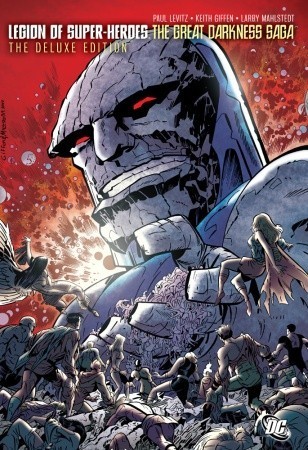
Legion of Super Heroes: The Great Darkness Saga

This is a review of the Legion of Super-Heroes: The Great Darkness Saga, written by Paul Levitz with art by Keith Giffen. You can read my review of Superboy and the Legion of Super Heroes Volume One here

The Legion of Super Heroes are a group of 30th century youngsters with superpowers who have teamed up to defend the universe. Back in the Silver Age they were all teenagers. Thus, the monikers Cosmic Boy, Saturn Girl, Light Lass, etc. The stories in this volume, written in the late 1980s, treat them more as New Adults (early twenties). Think space opera combined with superpowers and dopey melodrama.

By dopey melodrama I’m talking romance, because let’s face it, everyone loves romance!!! How about an example? Light Lass convinces her beau Timber Wolf – who has a face that could scare a block of concrete – to undergo cosmetic surgery. 

Soon afterwards Timber Wolf is shanghaied into a disastrous intel mission on the Khund (not-nice aliens) homeworld. They are rescued in the nick of time by a team led by Saturn Girl, which crashes on an asteroid. By the way, Saturn Girl is Light Lass’ sister-in-law. 

Hey, why doesn’t Light Lass lead the rescue party? Wonder what’s up with that? Our hapless heroes are rescued by another search party led by Light Lass, who sees Saturn Girl and Timber Wolf hugging. Light Lass quits the Legion, giving Timber Wolf an ultimatum – stay or go with her. What will he do? 

In the meantime, Princess Projectra and Karate Kid return to her homeland and are almost burned at the stake. Brainiac Five accidentally resurrects an old Legion foe, Computo, which marks his one billionth screw-up since he joined the team. Everyone forgives him, because they’re used to it. And someone stirs in a deserted old planet in backwater space.

The Legion receives a much-needed shot in the arm when Keith Giffen comes onto the title as artist and co-plotter. We have new Legionnaires – Blok, who is a living rock; Invisible Kid, whose little sister is host to genocidal computer Computo; and The White Witch, a sorceress. 

This volume features the Great Darkness Saga, a five issue storyline that involves the awakening of cosmic menace Darkseid in the 30th century. I am not giving anything away because the cover of this volume shows us Darkseid, who terraforms an entire planet into his effigy. 

Darkseid sends out degraded versions of cloned heroes as his emissaries – to collect items of power, and then people. The Legion is overmatched, especially when Darkseid learns of the existence of the planet Daxam, which orbits a red sun. He warps the planet under a yellow sun, which means billions of super-powered Daxamites under his control! Can the universe survive? Well, yeah, but it’s a big story.  

Nowadays, the Great Darkness Saga would be a special event with multiple issues in twelve different titles. Instead it’s just there – the best Legion of Super Heroes storyline ever created, one of the top superhero comic storylines of the 20th century, and a high point of both of the creators’ careers. If you like superhero comics combined with space opera it doesn’t get any better than this.

Marvel Masterworks: The Invincible Iron Man Volume Four

This is a review of Marvel Masterworks Invincible Iron Man Volume Four. You can read my reviews of the first three volumes here, here, and here. This volume is written by Stan Lee and drawn by the great Gene Colan, who also drew Tomb of Dracula. Mr. Colan’s Iron Man is dynamic – twisting, contorting, always in action.

Thus far, Iron Man has been an on/off title to read. The main culprit is the writing, which can be kindly described as inconsistent. Nonstop action is great, but the plots need to make sense. The writing has a slapdash quality that I don’t like, such as when Iron Man leaves the widget he needs to defeat the Titanium Man on his coffee table because it slipped his mind. Series regular Happy Hogan retrieves the widget, only to be mortally injured, which leads to Happy’s transformation into a monstrous etc., etc., etc. This is known as plotting on the fly, aka making it up as you go along.

Happily, the writing in this volume is better. When Archie Goodwin takes over scribing duties – which seems like it might be a few issues before he’s credited – the plots get tighter. Yes, dumb cliffhangers still abound, but that is part of the joy of reading superhero comics. The Grey Gargoyle throws a petrified Iron Man off the roof, but lucky for him, there’s a handy truck full of sand nearby to fall on.

The villains in this volume are better. Unlike Mr. Doll (featured in Volume One), they look like real threats. Look at Titanium Man! He’s scary! Look at the Grey Gargoyle! He’s mean! There’s also Whiplash, who has a, uh, steel whip. Let’s not forget ultra-secret organizations Maggia and AIM, bent on world domination. Also: Madame Masque, minus the mask.

Series regulars Happy (chauffer) and Pepper (secretary) get written out of the book for reasons I don’t understand. I think it might have to do with Happy knowing that Tony is Iron Man. Instead of fridging him, the writers allow him to elope with Pepper. They are replaced by SHIELD agent Jasper Sitwell, the most annoying man in the universe. Sitwell debuts by trying to blow Tony Stark’s head off his shoulders, although that’s not how he frames it. Overall, this volume shows a lot of improvement from the last. Recommended for Iron Man fans and lovers of superhero comics!

Superboy and the Legion of Super Heroes Volume One

This is a review of Superboy and the Legion of Super Heroes Volume One, written by Paul Levitz and featuring art from a number of artists, including Mike Grell. The Legion of Super Heroes is a Silver Age invention, with an ensemble cast of 30th century teenaged superheroes and superheroines, including Superboy (who flies in from the 20th century).

This volume features three interesting storylines. The first is the wedding of Saturn Girl and Lightning Lad, whose nuptials are disturbed by the Time Trapper. The Trapper alters history but nobody knows it except Superboy, who travels to the 30th century from a time period BEFORE history was changed. The second story features Grimbor the Chainsman, whose goal in life is tying up members of the Legion. Surprisingly, good ole’ Grimbor hasn’t been used all that much lately.

The third is a storyline about the framing of Ultra Boy, a character who possesses Superboy’s abilities but can only use one of his powers at a time. Ultra Boy visits former lover, An Ryd. Yes, that’s her name. Ultra Boy seems confused as to why she would choose a cheap motel room for their meeting. Unfortunately for him, An Ryd has no interests but self-interests and sells him out. I have no idea if she’s an objectivist, but this story makes it clear that Ultra Boy is really stupid. Poor An Ryd is murdered and Ultra Boy wakes, framed for her murder.

When his Legion buddies ask him to explain, Ultra Boy of course acts like a criminal and runs away. Left on his own, there is little doubt Ultra Boy would be in solitary for a hundred years, but luckily there exist Legion members with three-digit IQs. The culprit – not the murderer – is revealed, and Ultra Boy is vindicated!

There are a bunch of interesting things about this storyline, chief among them being that Ultra Boy cannot decipher social cues, especially sexual social cues. His girlfriend, Phantom Girl, looks very wholesome and even wears her hair in ponytails. There’s also the heavily muscled older male science officer who seems to take Ultra Boy’s betrayal personally. All stuff I would have missed back in my teens.

Anyway, did I mention that Saturn Girl and Lightning Lad get hitched? They have to quit the team because the Legion’s charter forbids married members. One of the reasons I enjoyed these issues so much is that nobody ever asks the obvious question, such as ‘why not change the charter then?’ The members themselves act more like new adults than teenagers, but there’s still a lot of posturing, chest-beating, and stupid drama.

 Paul Levitz is the gold standard for the Legion of Super Heroes, and these stories are better than most of the comics being published around that time period (late 70’s, early 80’s). Recommended for Legion of Super Heroes fans and also fans of space opera, because a few of these stories (Time Trapper) feature interesting science fiction concepts.

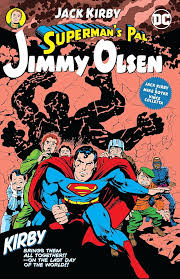
Superman’s Pal, Jimmy Olsen

This is a review of Superman’s Pal, Jimmy Olsen written and drawn by Jack Kirby. When people discuss Mr. Kirby’s DC work, they will usually talk about Kamandi or The Demon, reviewed here and here. I’ve never heard a word about this graphic novel, which is a shame. This book, which showcases Superman alongside an ensemble cast, is first-rate science fiction.

What about that ensemble cast, anyway? We have Clark Kent, the Newsboy Legion, the Golden Guardian, who is a clone – no, not of Captain America – as well as that freckled young cub reporter, Jimmy Olsen himself. The Newsboy Legion features five kids who have a vehicle called the Whiz Wagon, based on the Fantasti-Car, that can fly and is also amphibious. The kids are interchangeable, except for the one who dresses in scuba gear all the time, which won’t bode well after he hits puberty.

The plot revolves around The Hairies, a secret group of super-intelligent vat grown humans who live inside a mountain and drive around in a missile carrier disguised as a monster. They’re guarded by a biker gang and are doing top secret experiments on the human genome, backed by the U.S. government and Superman. In the 1970’s, that wasn’t considered unethical; today, there would be collective apoplexy.

Jimmy Olsen and the annoying – I mean youthful – members of the Newsboy Legion investigate. They tangle with the biker gang, and Jimmy automatically becomes head honcho when he punches out their leader. Jimmy Olsen, Biker, is only one of the many startling transformations in store for the reader. We also have Rampaging Jimmy Olsen, transformed by science into a mean green killing machine that doesn’t resemble the Incredible Hulk – NO, NOT AT ALL – and Neanderthal Jimmy Olsen.

Sound weird? Wait until the scene where everyone drops acid, including Superman, that Head Square Himself. Oh, Kirby gives us some nonsense about a solar phone, but this is his version of an acid trip. Anyway, Olsen and company discover that The Hairies are fiddling with human DNA, making all matters of chimera, including tiny Jimmy Olsens! At one point we look through a microscope to see the tiny Olsens, each wearing a pair of tighty whities.

Darkseid, rightfully deciding the world isn’t ready for that much Jimmy Olsen, sends the most incompetent cat’s paw in the DC Universe to destroy the Hairies. Media mogul Morgan Edge spends all his time trying to kill Jimmy Olsen and the Newsboy Legion. While they are annoying, he could just fire them instead, but I guess I’m missing something.

Other stories include a villain who lives in a volcano, a Scottish Lake Monster, and a miniature planet full of Count Dracula lookalikes that makes TOTAL SENSE when explained. We also have a story starring Don Rickles and his twin, which may have been funny when it was released, but somehow I doubt it.

Nobody in this graphic novel has anything resembling a personality, but that’s my only quibble. Mr. Kirby was a genius, and is allowed a misstep here and there. Highly recommended!

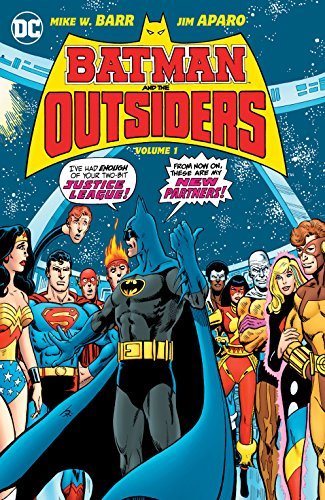
Batman and the Outsiders, Volume One

This is a review of Batman and the Outsiders Volume One. This book scores huge nostalgia points for me. I recall reading the first issue at my local drugstore whilst drinking a Cherry Coke at the counter, and that’s your slice of life for today. Interestingly, many of the pleasant memories of my youth involve comic books.

Hot off art duties for the Brave & the Bold, artist Jim Aparo and writer Mike W. Barr create a new superhero team. The plot: when his friend/employee Lucius Fox is trapped in the imaginary Eastern European country of Markovia, Batman quits the JLA (who won’t help) and goes it alone. The team comes together when he and Black Lightning, who loses his lightning powers for a grand total of one issue, travel to Markovia to rescue Lucius.

There they find Metamorpho, the goofy elemental, along with three new characters – Katana, Halo, and Geo Force. Katana is a samurai who wields a cursed sword possessed by the spirit of her dead husband. Halo can fly, possesses powers derived from light, and is a tabula rasa. Geo Force possesses earth-based elemental powers and is the brother of Tara, aka Terra, a character known to anyone who read New Teen Titans in the early 1980’s.

Anyway: after a few speed bumps, the Outsiders are formed. They’re led by Batman. I mean, who wouldn’t want their own super team, especially if you get to make the rules? The Outsiders are powerful, but not very experienced. This is done to make the villains seem like real threats. Most of the storylines are two issues and move along at a nice clip. The interplay between the characters is enjoyable.

My favorite part of this graphic novel is the Halo solo story. Halo joins the high school marching band, and is about to participate in a high stakes Battle of the Bands competition – no, seriously – when their leader/drum major is kidnapped by a gang of dudebros from the opposing school. Halo flies to the rescue, and even manages to hook her best friend up with the drum major, which is nice. I do enjoy comics that don’t take themselves so seriously.

The first volume of this is a fun, entertaining read. None of the other iterations of the Outsiders have ever really stuck, but DC keeps on trying! Unfortunately, these volumes are expensive, so keep that in mind. Recommended.