Batman in the Fifties

This is a review of Batman in the Fifties. I will be honest here and say that I did not expect to enjoy this graphic novel, which was purchased in a buying frenzy a few years back. DC’s Silver Age might have laid the foundations for decades to come, but it also produced a lot of dreck. When you come down to it, Batman is a crime comic and the character doesn’t do well in science fiction stories. I can prove this, having read two volumes of The World’s Finest – which features Batman & Superman teaming up against aliens, crackpot inventors with salad colanders on their heads, and traveling back in time to become the Three Musketeers.

Imagine my shock when I found myself liking the stories in this volume. This is a curated collection, which means all the content has been hand-picked. My favorite story features The Bat Ape, with Ace the Bat Hound coming in a close second. The Bat Ape lives in a circus. When his trainer is framed for stealing the box office take for the day, the Bat Ape springs into action. He follows the Dynamic Duo to the Bat-Cave, where he dons a Batman outfit and aids Batman & Robin in corralling the real criminals! Ace the Bat Hound follows the same formula.

We also meet Batwoman, aka heiress Kathy Kane, who doesn’t quite mesh with the Dynamic Duo, but paved the way for Batgirl’s arrival in the 1960’s. We witness the origins of Mr. Freeze and the mighty Killer Moth, and learn more about the Joker’s origins (he was the Red Hood). Kudos to the creative team, Bill Finger and Bob Kane, who spent well over a decade working on the same comic, and still managed to make it entertaining.

Recommended for Batman fans!
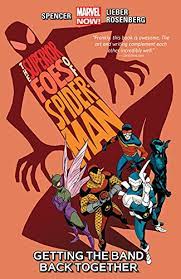
Superior Foes of Spider-Man Volume 1: Getting the Band Back Together

This is a review of Superior Foes of Spider-Man Vol. 1: Getting the Band Back Together. There’s a scene in this graphic novel where a kid tells Speed Demon, who used to call himself the Whizzer, that he’s stupid. Speed Demon tells the kid she might have a point, and then steals her dog.

Yes, that’s right. The Superior Foes of Spider-Man are villains. I won’t say super-villains, because there’s nothing super about them. They’re all too stupid. Boomerang, who throws boomerangs and has jets on his ankles, is stupid. Speed Demon, aka Whizzer, is stupid. Overdrive, the ultimate getaway driver, and the Beetle, the only girl in the group, are stupid. The Shocker differs from the others in that he’s really stupid.

The plot is too complex to explain. It involves the long-lost head of crime-boss Silvermane and a portrait of Dr. Doom. The plot doesn’t matter, though. The fun of this graphic novel lies in watching the characters double-and-triple cross each other. It’s a funny comic. Boomerang goes to a support group for super-villains. Speed Demon asks if objects get lighter when you move faster. Collective IQs fall fifty points when the Shocker enters a room.

This graphic novel reminds me more of a Dortmunder caper than a superhero comic. For those who don’t know, Dortmunder was the unluckiest criminal mastermind in the universe. Once he stole the same jewel five times. Recommended for people who like crime in their superhero comics.

Human Diastrophism: A Love and Rockets Book

This is a review of Human Diastrophism: A Love and Rockets Book, the second Palomar volume written & drawn by Gilbert Hernandez. If you are new to Love & Rockets, start with Heartbreak Soup, which features the same characters and comes first chronologically. The Brothers Hernandez – Gilbert and Jaime and Mario – have been making great comics for over forty years. Personally, I like Gilbert’s material a little better than Jaime’s, but both are wonderful.

The chronicles of Palomar combine magic realism with an ensemble cast. The setting is Palomar, a village in Latin America cut off from the rest of the world. To clarify: the people of Palomar know the rest of the world exists, they just don’t have much contact with it. The plot is hard to describe, as there are a lot of them. Most of the storylines have to do with people arriving and leaving Palomar – a serial killer, a fashion designer, a woman who sets herself on fire, an aged hitman (?!?!) named Gorgo.

The Love and Rockets series features realistic body sizes and types. There is a frankness about sex, nudity, and bodily functions that might shock a few people. The characters have real problems, and don’t always make the ‘correct’ choices. Parts of this graphic novel are set around the late 1980’s, when everyone thought there’d be thermonuclear war. If you weren’t around then, you didn’t miss much; you can listen to Sting’s song Russians to catch up.

Anyway, highly recommended!  

Justice League of America: The Marriage of the Atom and Jean Loring

This is a review of Justice League of America: The Wedding of the Atom and Jean Loring. The JLA is a simple concept – seven of the most popular characters in the DC Universe team up – that should be a license to print money. This volume isn’t flying off anyone’s shelf, unfortunately. Most of the stories are written by Gerry Conway, who is a prolific writer. If you read superhero comics in the 1970’s and 1980’s, you’ve read him. I speak as a fan of his work when I say he’s done better work elsewhere.

The first four issues feature Jean Loring, aka the Atom’s fiancée, being abducted by aliens. This leads to her having a nervous breakdown, which is realistic. Jean randomly teleports throughout the universe, bringing natural disasters in her wake, which isn’t realistic but whatever. This storyline first appeared in the Secret Society of Super Villains, and each issue features the Atom teaming up with random heroines/heroes in his search.

After the Atom rescues his fiancée, we turn to the Justice League of America where writer Steve Englehart does a storyline featuring Star-Tsar, who may or may not be disgraced JLA mascot Snapper Carr. Snapper is like a former child celebrity gone to seed – rightly or wrongly, he blames the JLA. We also have a two-issue team-up between the JLA, the JSA (the JLA from Earth One), and the Legion of Super Heroes (far future teen heroes). If you don’t get what I’m saying, don’t worry about it. I am familiar with comics, and I had problems understanding the plot and keeping track of all the characters.

Writer Gerry Conway takes up writing duties soon afterwards, and does serviceable work. There’s no meta story to speak of, but the volume does culminate in the marriage of The Atom and Jean Loring. In between, we get a few classic JLA villains (T.O. Morrow, Doctor Destiny, etc.), Green Arrow annoying everyone, and Red Tornado – who is a robot – moping about what it means to be human. The issues are mostly a slog to read, although the writing gets better. Part of it might be the fact that the stories are 30 + pages and thus do not sync with me personally.

To me, the main point of these issues – because let’s be honest, sometimes comics are obscure for a reason – is to give us Jean Loring’s backstory for Brad Meltzer’s Identity Crisis miniseries (out in 2004!), in which she plays a role. Say what you will about Mr. Meltzer as a comic book writer, but nobody can accuse him of not doing his homework!

Recommended for JLA fans only.

Hitman Volume Two: 10,000 Bullets

This is a review of Hitman Volume Two: 10,000 Bullets. You can read my review of the first volume, here. There’s a scene in this volume where Natt the Hat – Tommy Monaghan’s hitman friend from Detroit – stomps on a ninja’s crotch to get information. This isn’t unusual. The hero displaying his manhood by beating the crap out of a guy who can’t fight back is a staple of action movies, especially buddy cop movies. The person getting beaten up is always a bad guy, which in action movie logic makes it okay. The problem is, what if the person doing the beating is also a bad guy?

Because Natt the Hat is a bad guy, just like Tommy Monaghan is a bad guy. This isn’t an insult. They kill people for a living, and they know the score. Garth Ennis (the writer) makes them likable. He gives Monaghan an imaginary code, i.e. don’t kill the good guys. Except Tommy is the person who determines who’s a good guy. None of that changes the fact that normal people view him with revulsion, fear, and hatred.

To wit: after getting shot, Tommy and Natt hole up in his girlfriend Wendy’s apartment. Wendy doesn’t know Tommy’s a hired killer, and is shocked when he shows up on her doorway half-dead. She lets him bleed on her couch until he’s well enough to leave, and then tells him to get out. She isn’t nice about it, either. And just like that Wendy is Tommy’s ex-girlfriend.

Natt the Hat – who serves as a sort of a Hitman Everyman – asks Tommy what he was thinking. Because he knows that a girl like Wendy is way out of Monaghan’s league. Natt knows it, the reader knows it. The only person who doesn’t is Tommy, who has an adolescent streak a mile long when it comes to women. AWWW SHUCKS LOOK AT ME I’M DATING A GURL!!!!!!!!!

Natt might not be able to read minds, but he can read people better than Tommy (who can read minds). When Tommy introduces Natt as his new best friend at Noonan’s (dive bar), his old best friend Pat gets upset. Natt sees this, but Tommy doesn’t. Tommy didn’t even mean anything bad by it – maybe. When Hacken (another hitman) punches Pat and calls him a coward, Monaghan breaks it up but later tells Natt that he thinks Hacken is right. It’s a lack of respect, which pays off big time. When Pat is later tortured for information, Tommy’s words are what keeps him from blabbing. Monaghan’s reaction to all this is to go on a killing spree, but the self-hatred isn’t hard to see.

Anyway, I liked this graphic novel a lot. Be warned: this is a very violent comic (there’s a 20+ page shootout that’s awesome), but it is comic book violence and thus not realistic. Still: if violence upsets you, you might not want to read this. There are also a few slurs that people used in the 1990’s that are (rightfully) taboo today.   

Marvel Masterworks: The Avengers Volume Three

This is a review of Marvel Masterworks Avengers Volume Three. If you read my reviews of the first two volumes, here and here, you will see that the Avengers got off to a rocky start and found its legs only after the powers-that-be revamped the team, getting rid of the heavy hitters in favor of Captain America and three ex-criminals. The Scarlet Witch and Quicksilver are former members of Magneto’s Brotherhood of Evil, and Hawkeye has tangled with Iron Man.

These stories have a formula: the Avengers bicker. The source of the tension is almost always Hawkeye, who has a king-sized chip on his shoulder. Quicksilver and the Scarlet Witch are mutants, Homo Superior, and possess wondrous powers. Captain America has his shield and the super soldier serum. Hawkeye is an ex-carny with a quiver full of trick arrows, so it’s natural that he might overcompensate.

Anyway, after bickering one of the Avengers quits or stalks off. The rest go on a mission, which goes badly until they are rejoined by the wayward Avenger. Rinse and repeat. The other thing that helps this book is that most of the stories are now two-parters, which adds a little depth.

This graphic novel doesn’t have great writing, or great art. What it does have is attitude and lots of action. My favorite storyline: the Avengers bicker. Hawkeye stalks off to hit the nightclubs and go dancing. The Avengers – alerted by guest star the Wasp – fight underwater warlord Attuma, who is a cross between the Sub-Mariner and Conan the Barbarian. Attuma wants to flood the surface world with his tidal wave machine.

The Avengers get their heads handed to them. Hawkeye returns to Avengers HQ, but can’t recall the password to access their comm-link system. Maybe he’s hungover? In case you haven’t figured it out, Hawkeye is an idiot. But it works.

In the meantime, Attuma decides to defeat the Avengers a second time, just to show how tough he is. Quicksilver gets flushed out of the torpedo bay but is rescued by a returning Hawkeye, who has managed to recall the password, and together the reunited Avengers destroy Attuma’s tidal wave machine. Etc., etc., etc.

It’s not rocket science, but it’s fun.

Marvel Masterworks: The Fantastic Four Volume Three

Version 1.0.0

This is a review of Marvel Masterworks: The Fantastic Four Volume Three. After reading Jack Kirby’s Kamandi, this volume felt like a letdown. Mr. Kirby’s art looks rushed in places here, there’s no meta story, and the issues have a ‘villain of the month’ quality. We have a single science fiction tale about a young godling, but the rest is mostly battles with the team’s growing rogue’s gallery – Doctor Doom, The Mole Man, The Red Ghost and his Super Apes, etc, etc., etc.

The highlight of this volume is the Thing’s battle with the Hulk. The not-so-jolly-green-giant invades Manhattan, because reasons. Most of the Fantastic Four is either sick or injured by the Hulk, so it falls to the Thing to fight the jade giant. And fight him he does, in a great battle sequence that lasts nearly an entire issue and ends with the Thing getting knocked on his ass. Never fear, the rest of the Fantastic Four and the Avengers join the fray in the next issue. It’s a great two-parter.

Other developments worth mentioning: the creators give Sue Storm the ability to cast invisible force fields, which gives them more to do with her character. Prince Namor arrives to propose to Sue, except his idea of proposing involves kidnapping and imprisoning her in an enormous bubble until she agrees to marry him. Reed Richards, feeling his manhood threatened, rushes to fight the Sub-Mariner, which is interesting because he’s usually written as a pretty mild guy. Afterwards, Sue puts Namor in the Friend Zone – actually he should be in the Don’t-Come-Within-Two-Hundred-Feet of my House Zone, but whatever.

This volume is a slight step back from the first two books, but the Hulk two-parter is a classic and worth the price of admission. Recommended.

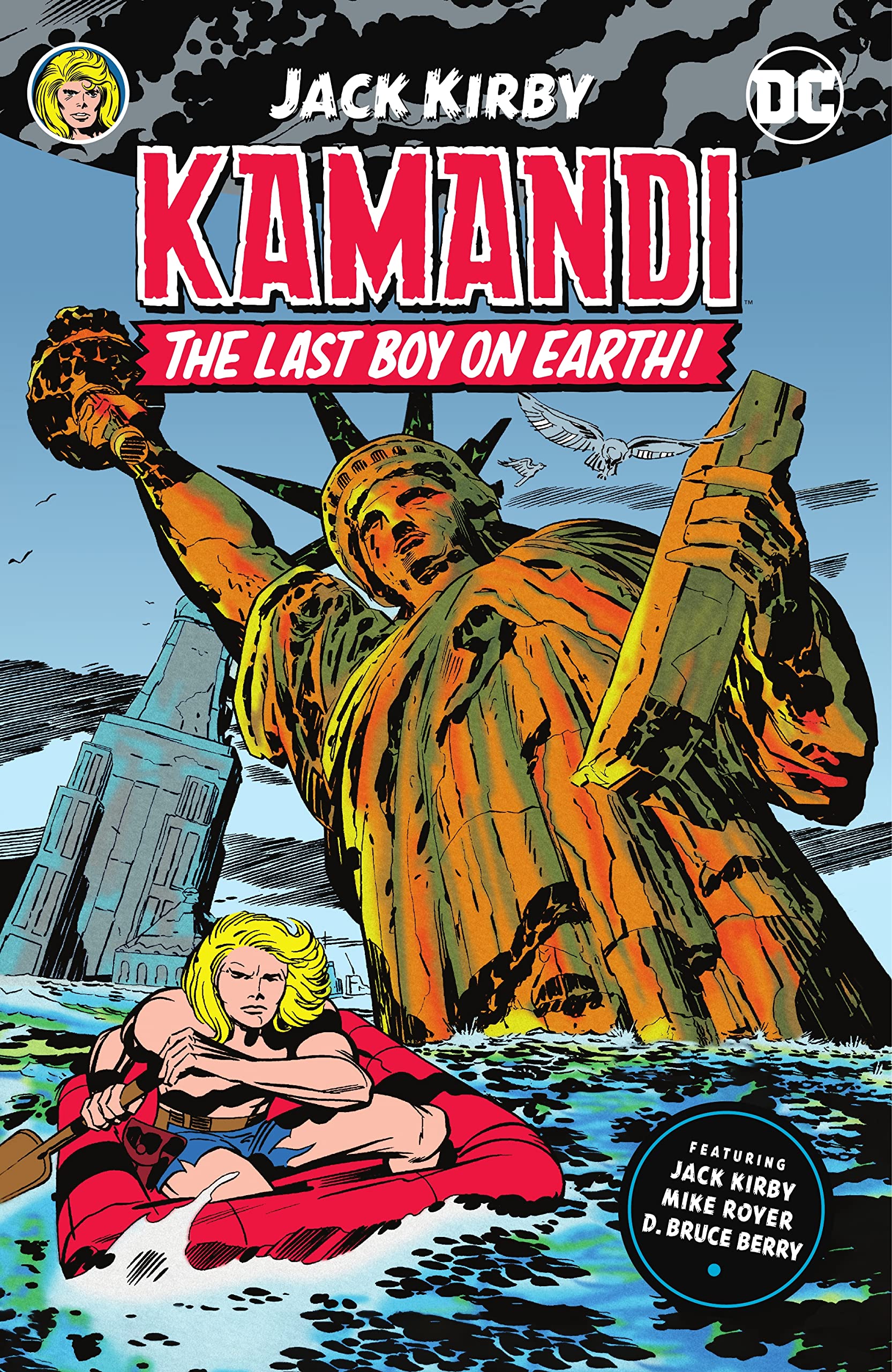
Kamandi: The Last Boy on Earth Volume One

This is a review of Kamandi: The Last Boy on Earth Volume One. Jack Kirby (the creator of Kamandi) wrote a lot of material for DC. Thus far I’ve read The Demon and OMAC, but this graphic novel blows them out of the water. Kamandi is a riff on the original Planet of the Apes movie that came out in the late 1960’s, but Mr. Kirby runs with it. In Kamandi, there are super-intelligent lions, tigers, cheetahs, groundhogs, bats, etc. Humans are now on the low end of the totem pole, and are treated like animals or even exotic pets. Some enterprising animals have even taught humans how to talk!

Kamandi, who owns a single pair of blue cargo shorts, lives in a bunker (Command 1 – get it?) with his grandfather. One day he leaves the shelter to see how earth fares after being ravaged by an unnamed natural disaster. He finds out that things are much, much worse than he thought. Thus begins a bizarre road trip.

This is not superhero comic. Kamandi has no special powers, and gets the crap kicked out of him on a regular basis. Indeed, there’s a scene where he goes berserk because he realizes that he’s stuck in this world with no way out. He’s rescued by one of his friends – Kamandi makes lots of friends, both animal and human, but the friendships never last long. He’s always wandering away, being captured by rampaging gorillas, or falling out of the hot-air balloon he’s using to escape.

This graphic novel moves quickly, has a rotating cast, and in many ways reads like a war comic. It’s really a post-apocalyptic comic. Substitute zombies for the different animals, and you’ll see what I mean. My favorite storyline in this volume is when a group of conservationist lions put Kamandi and his female companion, Flower, into their version of a nature preserve. Unfortunately, there are cougar poachers who want a piece of him. This issue is the best single comic I’ve read in years.

Highly recommended!

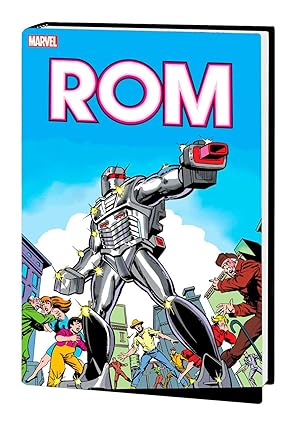
Rom: The Original Marvel Years Omnibus Volume One (Part Two)

 This is part two of my review of Rom: The Original Marvel Years Omnibus Volume One. You can read my review of the first part here. I have most of the original issues of Rom stored in an attic somewhere, but one of the advantages of aging gracefully is the fact that I don’t recall what I ate for breakfast two days ago.

The upshot: I don’t remember most of this series, although I do recall enjoying it. First off, this is a horror comic disguised as a superhero comic. Rom has a meta-story that lasts 70+ issues, albeit with a number of side stories. Unlike superhero comics, it has a beginning and a definite end. The monsters, the sense of paranoia that permeates this book, and the weird conspiracy theories remind me of The X-Files, but unlike the X-Files Rom hasn’t jumped the shark…yet.

The other reason this is a horror comic is the body count. The creators (Mantlo & Buscema) use a cast of mostly new characters. There are cameos by Marvel heroes – in this volume we get the Torpedo, the X-Men, Power Man & Iron Fist, Nova, and the Fantastic Four – but they make sense in the context of the larger storyline, which is earth’s invasion by the Dire Wraiths. Bottom line: many of the characters are new, and the creative team has no qualms about killing them. This can be unsettling, because cast changes in superhero comics tend to remain static. In practical terms, this means that nobody is safe.

The highlights of this volume are Rom’s battle with Hybrid, the offspring of a human mother and a Dire Wraith father. Hybrid – who is also a mutant, and whose character design is totally grotesque – wastes no time killing his parents. His battle with Rom is interrupted by the arrival of the X-Men, searching for the new mutant. A number of misunderstandings ensue, which leads to the X-Men attacking Rom.

The second highlight is Rom’s return to his home planet of Galador, which leads to an encounter with Galactus, who wants to eat the planet. Rom strikes a deal with the planet-eater and leads Galactus to the Dark Nebula (the Dire Wraiths’ home planet), but who will consume who?

Mention should also be made of the arrival of The Torpedo, the Grade Z hero Rom chooses to protect his adopted home town of Clairton, WV from the Wraiths. So far, his record is 0-1, as Clairton is overwhelmed by a mystical fog in Rom’s absence. The Torpedo seems like a nice guy, and he does his best, but sometimes that’s not enough…

Highly recommended!

Tales of the Batman: Len Wein

This is a review of Tales of the Batman: Len Wein. The comics in this volume are amongst the first Batman material I ever read, over forty years ago. I enjoyed the five-part Ra’s Al Ghul story in a mass market paperback before there was such a thing as graphic novels. The Joker’s Birthday Bash story is the first Batman comic I ever bought. For some reason, I thought the writer was Gerry Conway but it’s Len Wein.

Anyway, this is a hefty volume. Over thirty issues of 70’s Batman goodness, which if you like the Dark Knight turns out to be pretty good deal. I’d suggest waiting until Comixology has another sale, though, as these volumes are pricey.

The stories are mostly one-shots, and feature Batman’s rogue gallery as well as villains from other titles. Hawkman villain the Gentleman Ghost makes an appearance here, as well as Captain Boomerang (a Flash foe). Two-Face, The Joker, Kite Man, Calendar Man, Firebug, Signal Man, etc., etc., etc. also make appearances. Selina Kyle, aka Catwoman, is present, but this time it’s mostly as Bruce Wayne’s love interest.

Selina and Bruce manage to have sex, off-screen, a fact I missed because I was twelve years old. This leads into a two-part story where it turns out Selina is dying of some rare unnamed disease she caught as Catwoman, which okay. The only cure is an urn full of even rarer Egyptian herbs, because the ancient Egyptians knew so much more about medicine than us. When the herbs are stolen from the museum, Selina becomes suspect #1. You know, the usual nonsense.

I like Mr. Wein’s portrayal of Batman. Instead of being portrayed as a sociopathic asshole, the Dark Knight manages to achieve balance in both sides of his busy life. His powers of detection are highlighted, as well as his escape artist skills. There are a number of instances where Batman is knocked out and put into a death trap, which he always manages to escape. I’m assuming the villains who choose to tie him up instead of just putting a bullet through his head either have a bondage fetish or watched too many episodes of the 60’s TV show.

Recommended for Batman fans!