Marvel Masterworks: Captain America Volume Two

This is a review of Marvel Masterworks: Captain America Volume Two. Back in the 1960’s, Captain America and Iron Man shared the same magazine – Tales of Suspense – for awhile. The difference being, Captain America had Jack Kirby and Iron Man didn’t. The characters might have been in the same magazine, but the stories are in different stratospheres.

I am sure you will all be fascinated to know that I rate all the graphic novels I read. The only thing preventing this from being a four-star book was the absence of Kirby in two storylines. The fill-in artists (one of whom was Gil Kane) did a fine job with the art, but the stories read as sloppy, unfocused, and rushed. Kirby was a craftsman. More than that, he cared. When you read his product you can tell he cared about what he was putting on the page.

Most of the storylines in this volume follow a template: a villain returns with an apocalypse device. When Cap teams with Agent Thirteen and The Black Panther (Kirby story), it’s a satellite that focuses solar energy into death rays. Okay, that’s scary. In Kirby’s absence, it’s a device that can enclose anything in indestructible bubbles. Which is stupid, especially when the villain ditches his bubble machine for a nuclear submarine. Anyway: Cap kicks the shit out of the villain so that he can go back to being depressed. What, you say Captain America’s depressed? If you were frozen in an iceberg for twenty years and then thawed out, you’d be depressed too!

There are two storylines I’d like to mention. The first involves the Super Adaptoid, a creation of A.I.M. (Advanced Idea Mechanics). The Adaptoid gets the jump on Cap and duplicates him exactly, and then proceeds to get his head handed to him by a Z-grade villain called The Tumbler. Although the Adaptoid has all of Cap’s physical prowess and skills, he doesn’t know how to fight. The Adaptoid goes down, and the real Cap recovers in time to beat the tar out of the confused Tumbler. This is a story built around an idea.

The second storyline is when Cap proposes to Agent Thirteen, the SHIELD agent he’s in love with (even though he doesn’t know her name). Agent Thirteen turns down his proposal to be Mrs. Captain America because she has a sense of duty – and she doesn’t want to quit her job, although she doesn’t say that. Unfortunately for them, it’s the mid-60’s so they can’t just shack up. Cap, depressed, publicly unmasks and quits so that he can have a life. This has real repercussions, in that a number of Captain America impersonators run amok in the city and the Syndicate starts trying to kill them all.

Recommended!

Marvel Masterworks: The Invincible Iron Man Volume Three

This is a review of Marvel Masterworks: The Invincible Iron Man Vol. 3. Note: this volume contains Iron Man and Captain America stories, but I only read the Iron Man material. You can peruse my reviews of the first two volumes here and here.

Iron Man is Tony Stark, multi-millionaire. Tony makes weapons for SHIELD and the U.S. Defense Department. Since he hails from the Marvel Universe, there’s a catch. Stark’s heart was damaged in Vietnam, and now he’s living on borrowed time. The only thing keeping him alive is the plate welded onto his chest, which he must charge whenever there’s an emergency or a supervillain appears.

The art – mostly by Don Heck and Gene Colan – is good. The stories are – well, they’re a mixed bag. No more Mr. Doll, which is a shame. Instead we have The Titanium Man, a big burly Russian who builds a big burly green suit of armor. TM challenges Iron Man to a battle royale, mano a mano, East vs. West – just like that exciting Rocky movie, which I’ve never seen! (Confession: I’ve never seen any of the Rocky movies).

Iron Man triumphs, but only after his chauffer Happy Hogan is almost killed bringing Shell-Head the MacGuffin, an object so integral to Tony’s battle with Titanium Man that he left it behind on his coffee table. Luckily, Happy is saved by the Enervator, which has the unfortunate side-effect of transforming him into an enormous hulking freak of nature. Hey, it happens.

After that, warlord and racist caricature The Mandarin stops by to test his enormous android, Ultimo, against Iron Man. And then the Sub-Mariner attacks! Lots of action, no let up. The problem being, the stories all start to blend together. There are a few points during the Sub-Mariner storyline where the creators forget their own plot points and contradict themselves, but I’d have trouble remembering it all also.

Iron Man started out as a propaganda war comic, and this volume possesses some of these elements. Stark’s main antagonist is Senator Byrd, a dedicated public servant who manages to shut down Stark Enterprises, because reasons. Actually, Byrd’s reasons aren’t bad – Mark Millar’s Civil War, penned decades later, riffs off this.

Nowadays, Iron Man is viewed as a semi-problematic character, depending on who writes him. He’s a millionaire. When you look up ‘capitalist’ in the dictionary there’s a picture of him next to the Monopoly guy. He’s good looking and assumedly gets all the sex he wants. He’s had substance abuse issues with alcohol and he’s the main villain in the first Civil War.

If you’re an Iron Man fan or completist, you might like this.

Tales of the Batman: Archie Goodwin

This is a review of Tales of the Batman: Archie Goodwin. Mr. Goodwin was a prolific writer and editor. This volume collects his Batman stories, with a bonus being his entire Manhunter run (reviewed last week, here). What impressed me most about these tales is how Mr. Goodwin had a vision of Batman and stuck to it. Batman’s origins are grounded in the pulp tradition, and these stories reflect that, hearkening back to Batman’s early adventures when he fought crooked politicians, mobsters, and fifth columnists.

None of the members of Batman’s rogue gallery make appearances here. His foes are evil men and women, period. Batman himself doesn’t get tied up and put into a deathtrap once. This reflects the truism that most criminals will go for the tried & true – a bullet to the head, knife to the heart, etc. – when killing an enemy. Paraphilias aside, killing a person by tying them to a conveyer belt is stupid on multiple levels.

All the stories in this volume are great, but the standout is the final tale, which deals with child abuse. There’s a serial killer in Gotham who is killing parents who abuse their kids. The killer dresses up in a mask, just like Batman The difference being that Batman doesn’t kill criminals, he just beats the snot out of them.

Commissioner Gordon almost hits his own son, Jimmy – who grows up to become a serial killer. Batman himself is obviously mentally ill, because that’s what you call people who dress up as enormous bats and send people into intensive care. Mr. Goodwin puts the elements out there, but leaves it to the reader to connect the dots. Or not, as the case may be. This issue takes a fairly blunt look at child abuse and the trauma it causes, without offering any answers, so please be warned.

There’s also a storyline involving the Yakuza, and another that hearkens back to the days of Bruce Wayne’s grandfather. Silver St. Cloud makes an appearance that feels gratuitous and almost gets fridged, which is really the only low point of this volume.

Recommended for Batman fans, only because of the volume’s high price. Bat-fans should know that Comixology’s Batman sale ends today (8/12).

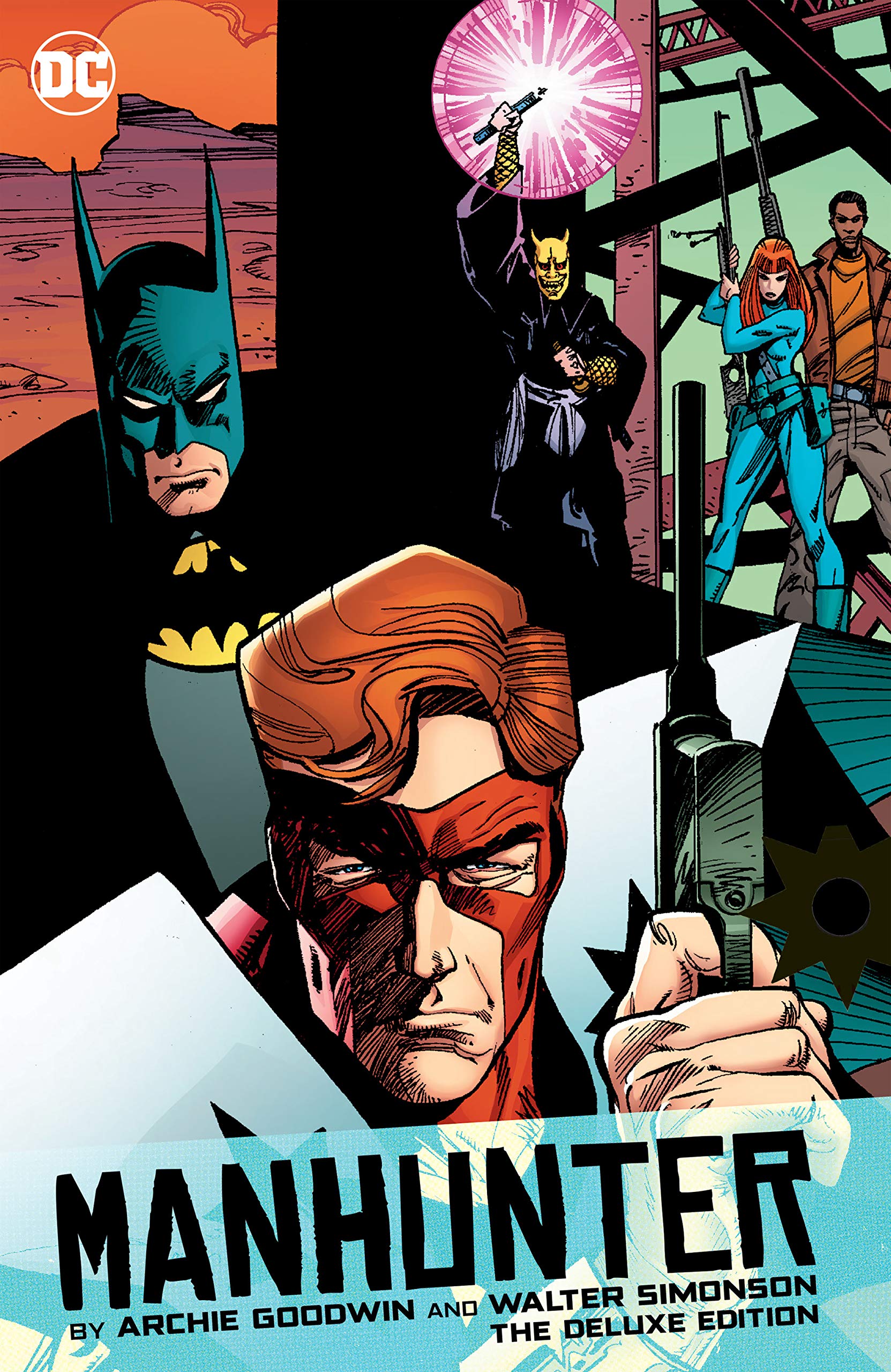
Manhunter Deluxe Edition

This is a review of Manhunter Deluxe Edition by Archie Goodwin (writer) and Walter Simonson (art). When I read Howard the Duck last month, the person who wrote the introduction made the case that the second half of that volume was the world’s first graphic novel. Since graphic novels are a format and not a genre, I disagree.

I think what he meant is that it’s the world’s first stand-alone story in comics, which I also disagree with. Howard having a nervous breakdown is a storyline contained in a larger storyline, whereas Manhunter is a stand-alone story with a beginning and end told in the course of seven back-up issues, climaxing in a full-sized issue guest-starring Batman. There is also a postscript issue that takes place decades later. The entire story – minus postscript – is less than 100 pages.

Anyhow: Manhunter is Paul Kirk, big-game hunter, who dies and is resurrected by a secret society. The Council wants Paul to be their hitman, but he soon discovers they have less than pure intentions and rebels. Here’s the twist: the Council cloned Paul, so he has multiple copies of himself running around. He’s fighting himself, literally.

Manhunter is short, but insanely influential. Paul has a healing factor that lets him recover from most of his wounds – does that sound familiar? Unlike Batman, he has no problem killing people. The postscript issue has no words at all, because Mr. Goodwin unfortunately passed away, but I was impressed by how I didn’t need words to understand the story perfectly. This is action-espionage comics done right. Recommended!

New X-Men Modern Era Epic Collection: E is for Extinction

This is a review of New X-Men Modern Era Epic Collection: E is for Extinction. I read this groundbreaking X-Men run, written by Grant Morrison with art by Frank Quitely (with fill-ins), back in 2001-2002. Mutants are thriving, humanity will be extinct in five generations, and the X-Men now wear leather outfits.

At the moment, those X-Men consist of Cyclops, Marvel Girl, Wolverine, Beast, and the White Queen. Secondary mutations are commonplace. The Beast is mutating into an enormous cat, Emma Frost (The White Queen) can make her skin hard as a diamond, and Jean Grey’s (Marvel Girl) telekinetic abilities have returned. Charles Xavier’s School for Gifted Youngsters is thriving. We even meet Xorn, a new X-Men who has a sun in his brain. What could go wrong?

Enter Cassandra Nova, who makes an entrance with a literal bang, commandeering a Master Mold Sentinel which destroys the mutant city of Genosha. Sixteen million mutants die, but Cassandra is just getting started. In the meantime, the U-Men arrive. The U-Men are human beings who want to be mutants, and their solution to this dilemma is to chop actual mutants into bits and graft the pieces onto their own bodies.

Grant Morrison does some amazing work here, reimagining the X-franchise. His run only lasted four years, but boy oh boy was it influential. After Morrison left, Marvel did House of M and attempted to reset the X-Men back to the 1960’s, and it has taken the franchise two decades to recover from that faux pas. A must-read for any X-Men fan.

Saga of the Swamp Thing Book Four

This is a review of Saga of the Swamp Thing Book Four. This is the conclusion of Swamp Thing’s vision quest across the dark side of America  courtesy of John Constantine. The volume ends with the penultimate issue. Good and evil duke it out, and Swamp Thing’s in the thick of it! This issue guest stars Deadman, Dr. Fate, The Phantom Stranger, The Spectre, The Demon Etrigan, Baron Winters, Zatanna, Zatara, Sargon the Sorcerer, Cain, Abel, Dr. Occult, and maybe a few others I’ve forgotten. The Kitchen Sink doesn’t make an appearance, but that’s about it.

In the meantime, Swamp Thing’s partner Abigail Arcane is arrested as a sex offender after illicit photographs surface of the two of them making love. IMO, this is the scariest scene in the graphic novel.

I mean, there’s not much else to say about this volume. The art, mostly by John Totleben and Stephen Bissette, is wonderful. Writer Alan Moore was way ahead of his time. Honestly, I prefer his Swamp Thing run to his later works (Watchmen and Killing Joke), but that’s just me.

Highly recommended!

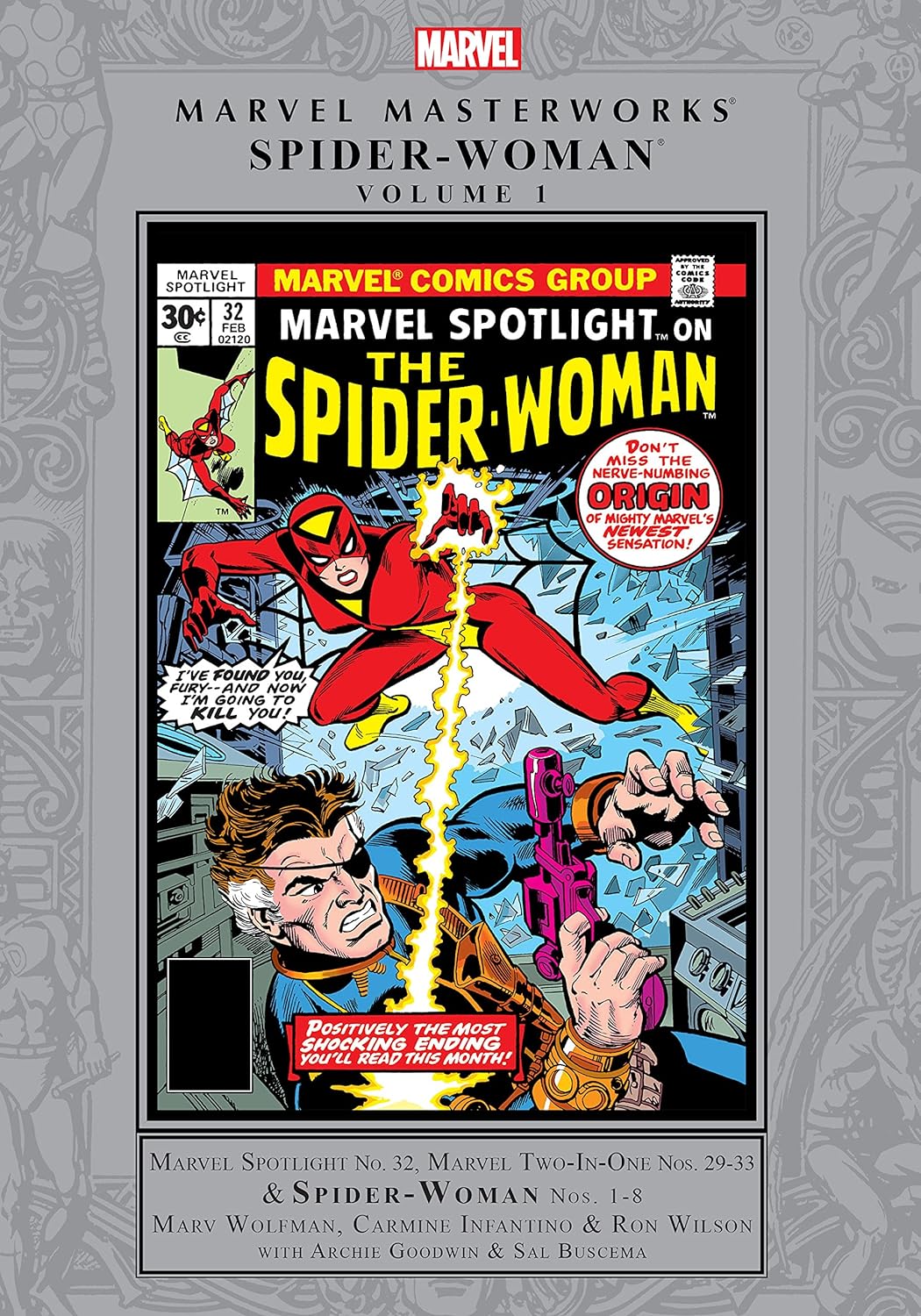
Marvel Masterworks: Spider-Woman Volume One

This is a review of Marvel Masterworks: Spider-Woman Volume One. Spider-Woman came into existence because of a copyright issue. Learning that another company was about to create a character named Spider-Woman, Marvel sprang into action and beat them to the punch! The result: a one-shot issue written by Archie Goodwin that is a marvel of efficiency. Spider-Woman, evolved from a spider by the High Evolutionary and then brainwashed by the terrorist organization Hydra, is sent to kill Nick Fury (the director of SHIELD). At the issue’s end, she throws off her brainwashing.

Spider-Woman’s next appearance is in Marvel-Two-In-One, a comic series which featured characters from the Marvel Universe teaming up with The Thing (of the Fantastic Four). This five-issue storyline, in which Alicia Masters (The Thing’s girlfriend) is transformed into an enormous psychotic spider/human hybrid that wrecks London, pretty much jumps the shark on every level. Spider-Woman’s origins become further muddled when Mordred the Mystic joins the party.

Next we have the Spider-Woman series, written by Marv Wolfman and illustrated by Carmine Infantino. Mr. Wolfman is a legendary comic writer who wrote Tomb of Dracula, Crisis on Infinite Earths, and the New Teen Titans, and under his guidance Spider-Woman becomes an uneasy hodgepodge – it has horror elements, it has superhero elements, it has elements of a fetish comic.

Wait, what? Yes, it’s true. In Issue #4 we have The Hangman, a villain who could double as a Rope Daddy. Spider-Woman finds herself in a jam, let’s put it like that, which makes no sense because she has super strength. It’s a scene that goes on for a number of pages, immortalized by Mr. Infantino’s skill at drawing Japanese rope bondage. Honestly, I have no idea how this issue made it past the Comics Code Authority.

If you read enough superhero comics, you know that this is hardly the only time a female character gets tied up. Still, as the most overt example of shibari bondage in mainstream comics I’ve ever seen, it’s worth a mention. When I read the mass market paperback 40+ years ago as a kid, this scene was the only thing I recalled decades later. Frederic Wertham was right, comics really do influence young minds!

Anyway, this is a weird graphic novel. If you ignore the Marvel Two-In-One storyline, it contains some pretty good comics.

Tales of the Batman: Gerry Conway Vol. One

This is a review of Tales of the Batman: Gerry Conway Vol. 1, which consists of comics penned by famed comic writer Gerry Conway in the late 70’s/early 80’s. Unfortunately, the most impressive thing about this volume is the price tag, so wait until Comixology has one of their periodic Bat-sales to purchase.

Anyway, this graphic novel is the proverbial mixed bag. Mr. Conway writes Batman as a detective/escape artist, which means the trope of him getting bashed in the Bat-skull and then tied up in a Bat-Death Trap persists. It’s a strange thing, perhaps a call-back to the Bat-TV show. We have storylines involving Solomon Grundy – I mean Blockbuster, a Z-grade Batman villain – and another evildoer named The Black Spider, a vigilante who kills drug dealers just like the Punisher (whom Conway co-created).

The highlight of this volume is the two-issue storyline about Alfred’s (Batman’s butler) days in the French Resistance during World War Two. This story is affecting and features a proper ending; when I read a few of the older comics in this volume, it felt like I was getting the cliffs note version of the story.

I also enjoyed the stories from The Brave and The Bold, one of the first series I cut my comics-reading teeth on. The Brave and The Bold features team-ups, and in this volume Batman joins forces with Adam Strange, Wonder Woman, Firestorm, and the Guardians of the Universe. I enjoy the art of Jim Aparo, who did many of the Brave and Bold team-ups and draws a great Batman.

It’s tough to judge Mr. Conway’s work here, as he’s mostly writing fill-ins, single issues, and one-shots, but if such things are of interest, you can trace his growth as a writer within the pages of this volume. If you are a Batman fanatic or completist, go for it, otherwise you can skip this graphic novel.

Marvel Masterworks: Howard the Duck Volume One

This is a review of Marvel Masterworks: Howard the Duck Volume One. Howard is a walking, talking, cigar-smoking duck. He came to earth from another dimension in the pages of Man-Thing, reviewed here. The first six or so issues are send-ups of different genres – fantasy, quack-fu, gothic. This changes when Howard runs for president and loses because of a doctored photograph. He has a mental breakdown, is committed to an insane asylum in Cleveland because of a traffic incident, and ends up being possessed by Damian Hellstrom’s evil second soul. Alas, Howard’s career as Devil Duck is cut sadly short, just like this comic.

The highlight of this graphic novel is when Howard runs for President, because reasons, but the establishment doesn’t want him because he’s a duck. He loses because of a fake photograph of him in the bathtub with Beverly Switzler. Beverly is human, Howard is a duck. Neither Howard nor Beverly nor the creators of the comic itself deny that Howard and Beverly have a relationship…but the photo is fake because Beverly doesn’t like wet feathers.

Howard the Duck is satire, but it’s done well. Marvel in the 1970’s tended to be the place where messages were bludgeoned home with a hammer, but Howard the Duck isn’t overtly political. Man Thing is Steve Gerber’s (the writer’s) political strip, featuring a brain-dead monstrosity that thrashes about mindlessly and destroys things with a touch of its burning fingers. Howard the Duck is about isolation. As a duck living in a world of humans, Howard is the ultimate outsider. He has a single friend, Beverly Switzler, who has a thing for outsiders: her past two boyfriends were a security guard possessed by a cosmic turnip and a guy who commits crime dressed in a diaper. There’s also the magnificent Hell Cow and Howard’s greatest enemy, The Kidney Lady.

This is Marvel’s version of an underground comic. It’s PG-rated, and the writer is perhaps a little self-absorbed, but the journey itself is loads of fun. Recommended!

Conan Omnibus Volume One: Birth of the Legend

This is a review of Conan Omnibus Vol. 1: Birth of the Legend. I’ve read a fair amount of Conan comics in my youth. Back then Marvel Comics had the license, and a typical Conan story went like this. Conan kills the Monster of the Week, summoned by the Warlock of the Week to threaten the Damsel of the Week. Afterwards, he ends up with treasure and probably gets laid, although they don’t show that very last part. Conan is usually drawn looking like a ‘roided-up pro wrestler by John Buscema, one of my favorite comic artists. Most of the issues are one-shots and are enjoyable but forgettable. I recall one story where Conan is hired to escort a baby across a river to its mother or father (I forget which), and the baby turns out to be a baby monster.

This is a different Conan indeed. The opening scene of this graphic novel shows a woman, nine months pregnant, shoving a spear through the back of the warrior about to kill her husband. Conan comes into this world moments afterwards, born on the battlefield. I don’t want to get too specific, for fear of spoiling things for the reader. Suffice it to say that this graphic novel has three storylines – the first depicting Conan’s childhood, the second set in the city of Hyperborea, and the third involving Conan’s first encounter with sorcerer Thoth-Amon. Sorcerers seem to be a recurring theme with Conan, as in he doesn’t like them. And the feeling is mutual.

Unlike the comics of my youth, Conan is not written as an invincible, unstoppable juggernaut. In one scene, he comes face-to-face with a lion pride and runs away. He makes a ton of mistakes, and pays for each and every one of them. His actions – whether intentional or not – hurt other people. He has prominent strengths and weaknesses, although many of the mistakes he makes are from inexperience. But he’s a fast learner.

This is the best Conan I’ve ever read. Highly recommended.