Short Story Review: Richard Matheson’s The Funeral

Best of Richard Matheson

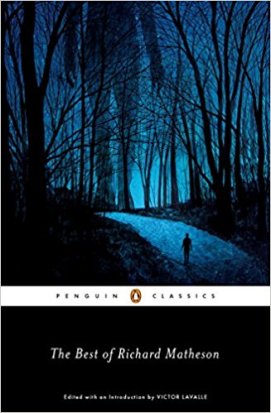
Please note that this review contains SPOILERS. Also: if anyone is interested in reading more of Richard Matheson’s fiction, a short story collection called The Best of Richard Matheson (pictured above) came out a few months ago.

Richard Matheson’s short story The Funeral tells the tale of a greedy funeral director who receives a visit from a man who wants to hold a funeral – for himself. This man hates mirrors and can transform into a bat. His friends include a hunchback, a witch, a group of pointy-toothed gentlemen and a man with hairy palms, er, hands. Mayhem ensues.

I don’t have a lot to say about this short story, a 2,499-word horror/humor mash-up that hasn’t aged well. However, in the interests of thoroughness and five hundred words here is my take. I found The Funeral’s humor to be dated, its use of alliteration distracting and its word choices irritating. I am sure the elevated vocabulary is intentional, a way to poke fun at the pomposity of the funeral business, but making your reader refer to a dictionary while perusing a story is never a good idea. I didn’t know the meaning of two of the words in the first sentence, but can take comfort in the fact that Ygor and old Jenny of Boston had trouble understanding what the hell people in this story were talking about, also. They are salt of the earth types, just like me.

The Funeral is interesting in that it is a horror/humor hybrid, which brings up the question of influences. Matheson is by no means the first person to combine horror and humor. I can think of two possible contemporary influences. The first is Abbott & Costello Meet Frankenstein, which I loved as a kid. Indeed, The Funeral’s slapstick humor reminded me of this movie.

The second influence is EC Comics, publisher of fine horror comics in the late 40’s and early 50’s. The title I am thinking of is Tales from the Crypt, immortalized by the HBO series. I was struck by the fact that The Funeral could be an episode of Tales from the Crypt, except it wouldn’t be a very good episode. If this was an EC comic the funeral director wouldn’t know they were all vampires until the end, when they turned around and ate him, and then he would rise from the grave and cater exclusively to the undead. Matheson’s twist has the deceased recommending the funeral director’s business to all his monster friends.

Final point: cats don’t sit on people’s shoulders. I suppose it’s possible to train a cat to do so, but it would take serious bribes and I’d suggest wearing shoulder pads and a hockey mask. Ask any cat owner if you don’t believe me. Okay…that final point is a total nitpick, but I didn’t like this story.

Humor is subjective, and my review came down to whether or not this short story tickled my funny bone. As it happens, it did not. The biggest reason I didn’t like The Funeral is that I didn’t think it was very funny. To me, the veneer of sophistication shellacked onto this short story backfires, big-time, and The Funeral reads as phony and forced as the funeral business it is mocking.

Book Review: Richard Matheson’s I Am Legend

Legend

Please note that this review contains SPOILERS.

Richard Matheson’s I Am Legend is a groundbreaking novel for its time (1954). It is the granddaddy of at least three different popular fiction (sub-) genres, zombie, post-apocalyptic and medical/science thriller. Mr. Matheson’s description of the ‘vampire bacillus’ echoes modern thinking on the complex behavior of parasites, as illustrated in books such as Carl Zimmer’s Parasite Rex (2000). The scientific explanation of vampirism means that I Am Legend can be read as science fiction, and such a reading would be perfectly legitimate. What makes this book horror is the protagonist’s utter helplessness, self-loathing and psychic ennui.

Mr. Matheson does many things well in I Am Legend, which is a fast read. I have mixed feelings about his writing style. He uses a lot of action verbs but is a bit sparse on description for my personal tastes. This book had more than enough material to engage me, but I recall reading his novel Stir of Echoes (1958) in about a half-hour and thinking it was written for a sixth grader.

I am assuming leaving brand names off everything was a conscious choice on the author’s part, since the action takes place in the far-flung year of 1978. This was a good choice, since one of the things that makes old science fiction so dated is its use of awful futuristic jargon (the vidscreen!). Mr. Matheson does make a reference to Oliver Hardy, a comedian many people today have probably never heard of.

The other thing Matheson does well as a writer is anticipate questions that might arise in his reader’s mind and ask them. Such as: why doesn’t Robert kill himself? Why are Robert’s ‘experiments’ always on women? Why don’t the vampires burn his house down? Note that Matheson never answers these questions, but in a way raising them is enough to satisfy the reader. It’s a great writers’ trick.

The other trick Matheson pulls off involves his protagonist. Robert Neville is not a likable man. Robert Neville is an unpleasant man. It’s a good thing I Am Legend is a short novel, because it would be tough spending a long novel in Mr. Neville’s company. Yes, he’s been through hell. Yes, the trauma of his wife rising from the dead might have unhinged him.

Still: I was struck by the fact that everything Robert touches dies, his wife (twice), his daughter, the dog. He has violent, misogynistic thoughts and impulses towards women which he acts out, at one point dragging a woman around by her hair. Many of his actions make no sense. He kills an infected woman by leaving her in the sun, and then decides to get his car and go back for her to see if she reanimates, seemingly unaware that he can replicate his experiment at any time without risking the sun setting.

Most tellingly, Mr. Neville is a murderer. Many of the vampires he kills are still alive. They are infected, but they are still living beings. Mr. Neville knows but he doesn’t care. He doesn’t wonder how they can still be alive, because he goes through life in a state of ignorance. Yes, he discovers the source of the vampire plague – which anyone with access to a microscope could do – but he doesn’t come close to discovering a cure. The society that arises post-humanity is brutal, but it is a society that he helped create. Mr. Neville did it unknowingly, but since he spends the entire book unaware of the consequences of his own actions that comes as no surprise. The fact that I read and enjoyed a book with such an unlikable protagonist is testimony to Mr. Matheson’s skills as a writer.

You may ask, could I do any better in Robert Neville’s situation? I would have killed myself, and to me the question as to why the protagonist doesn’t end his own life is one of the biggest mysteries of I Am Legend. Mr. Neville has nothing left to live for, clinging to alcohol, ancient records and his enmity with Ben Cortman, whom he seems to view as an old friend by the book’s end.

Did I enjoy Richard Matheson’s I Am Legend? Yes, I admired this book, but must confess to enjoying the author’s short stories more than his novels. To me, Mr. Matheson’s style seems better suited to short fiction. Still, while reading I Am Legend I saw echoes of Richard Matheson in genre greats Stephen King, Michael Crichton and George Romero. He is legend, indeed!


Horror Story

Horror Story is the first Bollywood horror movie I’ve ever seen. It’s nice to learn that the tropes of the horror genre are universal, even when the movie itself isn’t so great. Don’t get me wrong. Horror Story is entertaining and has a few good jump scares, including one that made me shriek so loud it startled my cat. But the story is – well, you’ll see.

Seven attractive young people are busy getting drunk at a bar because one of them is going to America. They decide to spend the night in a hotel that’s supposed to be haunted. That’s pretty much your plot, right there, which is one of the movie’s problems. Nobody has any agency or even much of a personality. The Final Girl doesn’t drink, which good for her!

Once at the hotel, our hapless youngsters immediately start breaking the tropes. Nobody has sex but they split up all the time, even after one of them observes that the evil spirit only kills stragglers so maybe they should all stick together. Eventually our heroes discover that the hotel used to be a mental institution that was the final residence of Maya the Witch, who calls the petrified youths on her cell phone to let them know she wants to kill them all.

Maya doesn’t quite measure up to my favorite evil witch of all time, Bathsheba of The Conjuring, but she really hustles. There are seven youths, so it takes her awhile to whittle the crowd down to a manageable size. Luckily, these young people are really dumb, which helps. Eventually the survivors discover a way to banish Maya, which is good, and then decide to split up, because that makes no sense at all. I try not to root for people to die in horror movies, but Horror Story strained my resolve.

I enjoyed Horror Story. It’s a movie with plot elements but no real plot, but who cares? It looks good; there’s nothing I hate more than a gritty, grainy movie where you can’t see shit. Bottom line: there are worse ways to kill 85 minutes.

WNUF Halloween Special

I grew up during the 1980’s, a very special decade. We had Ronald Reagan, big hair, Satanic Panic, video arcades, Bruce Springsteen, heavy metal, Freddy Krueger, petting zoos, VHS tapes, monster truck tournaments, Beautiful Mount Airy Lodge, help-a-child foundations (all that’s needed is a desire to help and a clean criminal record!) and cheesy commercials for hot dog joints, to name just a few.

The WNUF Halloween Special starts with a news broadcast, where we hear all the local news – dirty attack ads in governor races, a local dentist giving money for Halloween candy, a Christian group claiming that Halloween is evil. The Halloween Special itself, which takes place in a supposedly haunted house where a young man killed his family and claimed the Devil made him do it, doesn’t start until about twenty minutes into the movie.

As is fitting, the WNUF Halloween Special comes complete with commercials for carpet joints, local dentists, bad TV shows and petting zoos. I watched a lot of TV in the 80’s, and can tell you the commercials are spot-on. As the night progresses and the kiddies go to bed, the commercials get weirder and more risqué. The special has been recorded on VCR, and the watcher fast-forwards through the duplicates.

The actors and actresses of this movie look like real people, not airbrushed gods and goddesses. Frank Stewart, the narrator of the Halloween Special, has messy hair and the sleazy appeal of a used car salesman. His guests include a pair of fake psychics and their pet cat, along with a priest who becomes increasingly terrified as the night goes on. They have a call-in séance where a caller tells us that Iron Maiden rules and White Lion sucks. It’s amateur hour, but Frank soldiers on, even though it becomes obvious that something’s in the house.

I wouldn’t call the WNUF Halloween Special found-footage because technically the footage isn’t found. But it has links to that genre; other influences include The Amityville Horror and the BBC mockumentary Ghostwatch, which I reviewed last year. The commercials get a bit annoying, but this is a movie worth seeing, if only because it takes us back to the 80’s, that magical decade!

Four Flies in Grey Velvet

Quattro_mosche

Say you’re a drummer in a rock ‘n roll band. You have a stalker, a mysterious older man who follows you everywhere. Instead of going to the police or arming yourself with a weapon, you confront your tormenter in an empty movie theatre. The man pulls a knife, and before you know it he falls to the ground, seemingly dead. But, wait: a second stalker takes pictures of the entire incident! Do you: a) go to the police; b) suspect someone is setting you up; c) go home and try to forget it ever happened?

Roberto – the main character of Four Flies in Grey Velvet – is the biggest damsel in distress I’ve ever seen in my life. He is utterly without agency. When it turns out that the second stalker is a homicidal maniac who wants to ruin his life and then kill him, he does nothing. Roberto refuses to talk to the police, but tells no less than three people –he doesn’t even know one of them! – his sad tale. After hiring a private eye who hasn’t cracked a case in years, Roberto tries to get on with his life, even after someone breaks into his home (too many times to count), threatens to strangle him, leaves murder photos at his dinner parties and kidnaps his cat.

Soon Roberto’s wife Nina can’t stand anymore and leaves. Nina’s cousin Dalia stays, and pretty soon Roberto – whose philosophy seems to be this – is in the bathtub playing footsie with her. In the meantime his pet homicidal maniac is having a grand ole’ time, going on a murder spree.

Four Flies in Grey Velvet is mediocre Argento, which means it’s still better than 90% of the horror movies out there. The plot is sketchy, throwing in some silly pseudoscience, and I found Roberto to be an unlikable hero. There’s a point at the end when the killer is happily chewing the scenery, and the dubbing ends and I didn’t understand half the monologue. That’s okay, because – spoiler alert! – the killer is crazy, which is all you need to know. I’ve noticed that Argento recycles plot elements in his giallo, so parts of this movie were familiar. However, Four Flies in Grey Velvet is stylishly shot and the movie itself is quite entertaining. The final scene in particular is great. Early Dario Argento is always worth a watch.

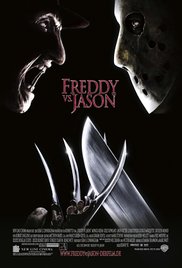
Freddy vs. Jason

Freddy vs Jason

When I was in high school, A Nightmare on Elm Street was the biggest horror movie franchise around. Evil Dead 2 and Return of the Living Dead were great, but they kept on pumping the Freddy movies out. I saw the first five Nightmares in the theatre. The only horror franchise that rivalled it was Friday the 13th, and I saw a bunch of those flicks in the theatre also.

The first Nightmare was a great movie, but after that they all blended. There are exceptions. I recall The Dream Warriors because of the hit Dokken song and because one of the kid’s dream power was that he became a wizard because he played D&D. I recall the Friday the 13th movie where Jason fought the girl with telekinetic powers. And of course, there’s the famous Where’s the Fuckin’ Bourbon (Google it!) scene.

Freddy’s mad because all his kids at Elm Street have forgotten about him. He reanimates Jason by pretending to be his mother. Jason shambles over to Elm Street, where a bunch of teens are having a beer party. Do kids even do that today? Anyway, Jason kills one of them. Freddy gets blamed, which gives him power. He’s back, baby!

Meanwhile, the Final Girl’s boyfriend escapes from the psychiatric institute he’s being held at. All the kids from the last Elm Street massacre are being held against their wills, being force-fed a drug that stops them from dreaming. Apparently constitutional rights don’t mean anything where Freddy’s concerned!

Anyway, Jason kills a bunch of teenagers at a rave in the cornfield. Freddy realizes that Jason’s not going to stop chopping up his kids, so he decides to take matters into his own, er, claws. So it’s machete vs. claw, winner take all. Game on, baby!

I never saw Freddy vs. Jason, because at a certain point I lost interest in both franchises. It just seemed like a dumb idea to me. Luckily I was wrong. The writing isn’t half-bad, and this movie is much gorier than I expected. Alas, nowadays the day of the indestructible slasher is done, replaced by found footage and zombie flicks. Those were good times, but they’re gone forever. I liked Freddy vs. Jason, perhaps because of nostalgia. This is the movie that marked the end of an era, the slasher movie’s last hurrah, and it’s only fitting that it ended with lots of blood.

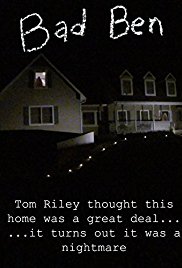
Bad Ben

Bad Ben

Why are there so many found footage movies out there, and why are most of them so awful? The answer to the first question is money; they’re cheap to make. Of course, the plot usually consists of four or five bad actors walking around the abandoned hospital/lunatic asylum/haunted house in Technicolor GoatGreen light, waiting for the evil spirits/demons/ghosts to kill them all. I’ve reviewed a number of movies like this in the past year, and most of them are bad. Grave Encounters is the exception to the rule, but much to my surprise Bad Ben – contradicting its own title – is pretty good also.

Made with security cameras and an iPhone, Bad Ben cost $300 to make (according to IMDB). Compared to most low budget found-footage, this is a masterpiece. The main character has agency and does more than wander around the abandoned house/hospital/mental institution for an hour and twenty minutes. There is actual suspense, thanks to a few jump scares.

Tom Riley buys a house cheap at a sheriff’s auction. His plan to resell it and make tons of money hits a speedbump when it turns out the house is haunted. Doors open and close, furniture moves around and a shadowy figure stalks the grounds. Using the security cameras installed in every room of the house, Tom tries and fails to catch the culprits in the act. Undeterred by the locked room in the basement, the satanic altar in the attic and the creepy kid’s drawings in the living room Tom soldiers on, deadpan, a middle-aged guy with a habit of filming himself in his boxer shorts.

Tom has a dilemma. As he tells us, he can’t leave because he’s sunk every penny into buying the house. So he tries to deal with the escalating craziness, with mixed results. Nothing works but luckily not much seems to phase Tom, who apparently has aspirations to be a vlogger. Why else record yourself? Tom – the only person to appear in Bad Ben – talks to the camera as if it’s another person (‘why are the lights off? I left them on.’) and generally underreacts when most people would run screaming for the door.

If you like found-footage movies, give Bad Ben a try. It’s better than 90% of the found footage movies out there, a number I just made up. Bad Ben’s success (???) spawned a prequel and a sequel, neither of which I’ve seen. Warning: if you want to see Bad Ben, don’t watch the trailer.

I Am The Pretty Thing That Lives In The House

If you enjoy horror movies that rely on atmosphere and the slow buildup of suspense, you will like I Am the Pretty Thing That Lives in the House. If you are the type who likes action-oriented horror, you will be bored to tears. I Am the Pretty Thing That Lives in the House is an effective ghost story, although the writing is sketchy in parts. Translation: if you think too much about this movie it falls apart.

Lily is a young hospice nurse who is taking care of Iris Blum, a horror novelist. Ms. Blum, who isn’t quite right in her head and insists on calling Lily Polly, lives in a spooky old house in the middle of nowhere. The house is dark and creaky, making all the sounds an old house makes. There’s a tiny little television and a corded phone and black mold on the walls – by the way, did you know that if black mold is toxic it can cause hallucinations?

The house also contains Polly, the subject of Ms. Blum’s most famous potboiler, The Lady in the Walls. It’s not clear if Polly is real or a figment of Ms. Blum’s imagination, but pretty soon Lily starts seeing her also. Polly walks forward, with her back turned towards you. I have no idea what that means, but it’s a spooky image.

Indeed, the atmosphere of I Am the Pretty Thing That Lives in the House is very spooky. At the start of this movie I thought the chair nailed to the wall in the kitchen was floating in mid-air and couldn’t figure out why Lily didn’t react to it. There is a lot of imagery like that here, and much of the spoken dialogue is almost poetic. I believe Lily is sometimes quoting from Ms. Blum’s books, but am not sure.

I thought I Am The Pretty Thing That Lives in the House was a sad movie. Lily is a timid woman, living in a secluded house with only a woman with dementia for company. She might as well be alone. We learn that Lily almost married, but her partner called it off. So now she sits alone in the house, slowly rotting.

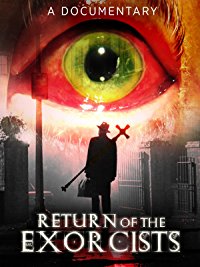
Return of the Exorcists

Return of the Exorcists

There are a few telling scenes in The Return of the Exorcists, a documentary about the resurgence of popularity of the practice of exorcism in Italy. But they aren’t what you might expect.

The first: a busy priest sits in front of a computer, clicking away on the mouse. He’s discussing the case of a person who might be possessed by Satan on the phone. When he hangs up we see the computer screen, which is broken. The exorcist was clicking on an empty screen.

The second scene takes place in a church whose leaders and parishioners are part of the Charismatic Movement. At this particular church you have to take a number to get an exorcism – it’s like being at a deli, but instead of getting roast beef or low-salt ham, you get exorcised.

I suppose you can tell what I think of Return of the Exorcists. I am not Catholic; I was brought up Lutheran. I am now agnostic. This documentary is not really for horror fans unless you are super-interested in exorcism. Even then, the documentary doesn’t go into much detail and at points outright contradicts itself.

We learn that possessed people go into trances. A priest tells us about the possessed woman who almost levitated. Of course, there isn’t any film of this. We do see footage of a number of disturbed people who may or may not be possessed. The filmmakers talk to a woman who has been going to an exorcist for years and now only cooks with olive oil and salt blessed by an exorcist.

The Return of the Exorcists isn’t interested in these people. The focus is on the men who perform the exorcisms, who are the real stars of the show. Or – depending on your point of view – the sideshow.

If you need your exorcism fix, watch The Exorcist again.

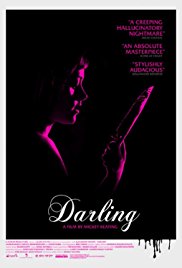
Darling

Darling

Darling is creepy as shit. I jumped a lot watching this movie. There’s a great scene where Darling (the only name the main character goes by) is having a drink at a bar with her new male friend; she excuses herself, walks into the restroom and starts shrieking and crying. There’s another, quieter scene where she sits at a diner, holding a coffee cup in mid-air for about thirty seconds.

Set in New York City in the Upper West Side, Darling starts when Madame (Sean Young) meets the young woman who is the new caretaker of her house. The older woman tells Darling that the former caretaker threw herself off the roof. Soon afterwards, Darling starts hearing weird things during her midnight jaunts around the house. She finds an upside-down cross in a cabinet and a door that won’t open.

Of course, there are the usual rumors about the house being haunted. There are also hints that something’s wrong with Darling; these hints get less and less subtle as this movie progresses. I don’t want to give away too much, and would advise against watching the trailer. Let’s just say Darling has some intense imagery. For the first half-hour I thought this was going to be the type of movie that relies on rising suspense instead of action, but some pretty horrific shit happens.

Darling is shot in black-and-white. The cinematography is great and many of the scenes are direct homages to The Shining. Lauren Ashley Carter is great as Darling. The plot is threadbare and doesn’t explain a lot, but who cares? I think this movie is scarier if you remove the supernatural element, which brings me to Darling’s other influence: Fatal Attraction. Be careful who you go home with, because they might be out of their fucking minds. It happens.

Darling is available on Netflix Streaming, if you want to watch it. And you should.