The Adventures of Red Sonja

This is a review of The Adventures of Red Sonja Volume 1-3, written by Clair Noto, Roy Thomas, and Bruce Jones with pencils by Frank Thorne and others. These comics were released in the 1970’s from Marvel, and are an offshoot of the Conan universe. This review will focus on the Clair Noto/Roy Thomas material, as I did not care for Mr. Jones’s interpretation of the character.

Does Red Sonja have a character? Yes, she does! She also has a metal bikini, which Mr. Thomas takes credit – or blame – for, depending on your viewpoint. She is a wandering mercenary. She’s depicted as a thief in an issue written by Mr. Jones, but seems mostly to make her living as a sellsword. In one issue, she takes a traveler’s cloak with the promise to return it at the tavern, which a thief wouldn’t do.

Red Sonja is depicted as fearless, competent with a sword, and smarter than your average mercenary. She wins a duel by leaping atop the carcass of a great mammoth. When her heavier foe follows, he sinks into the mammoth like a stone. 

The writers mention in passing that Red Sonja has vowed never to sleep with a man, but don’t go into details. She has two potential love interests. Both are heirs to thrones, and both want to make her their queen. She leaves them without looking back. My impression is that she is a born wanderer.

Red Sonja has a code. She’s not an unstoppable killing machine – which would be boring– but she takes no shit. She doesn’t want to kill you, but if you provoke her she will. Case in point: she becomes a wanderer when a king tries to make her his concubine and ends up with a knife in his throat. In another story, she kills three men who best her in a bar brawl – which she does not start – and steal her money.

Red Sonja is a sword & sorcery comic that alternates between one-shots and multi-part storylines. These issues contain loads of fantasy elements, many of which veer into surrealism. In one story, Sonja is tossed into an enormous clam, and fights her way out armed only with a handful of diamonds. Nothing bizarre about that, right?

In another, she fights a man wearing a mask made of poppies, which lull his victims to sleep. Poppy Man serves a trio of vampires who have transformed his father into an enormous carnivorous plant. We also have insect queens, rocs hatching from tiny eggs crafted by centaurs, and unicorns with regenerating horns. 

The multi-part storylines can be dense plot-wise, with lots of characters coming and going. Plot twists are thrust upon the reader without warning, but that’s part of the fun of reading these comics. Recommended, especially for lovers of fantasy and sword & sorcery comics.
The Boys: Get Some

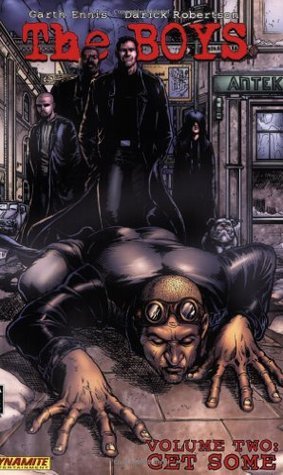
This is a review of The Boys: Get Some by Garth Ennis (writer) and Darick Robertson (artist). You can read my review of the first volume, here. Please be aware that this volume contains challenging material that may trigger readers. I would provide a detailed content warning, but this review is only around 500 words. The point of The Boys is to push boundaries, or to say that there are no boundaries. If you do not agree, my advice is to not engage. Also: SPOILER ALERT.

The Boys are CIA sponsored team led by the Butcher that consists of Wee Hughie, Mother’s Milk, The Woman, and The Frenchman. They exist to combat the growing superhuman problem. What’s the problem with superhumans? Well, they are written as real people with superhuman powers. Anyone older than ten can figure out why that would be a problem.

The first storyline, Get Some, opens with Butcher and Wee Hughie investigating the death of a young gay man who fell off a roof. They visit a gay bar, where the bartender tells them that the person in question had a crush on SwingWing, a superhero who embraces social justice issues and whom everyone assumes is gay.

Three-and-a-half issues later, SwingWing – who is not gay and who despises gay people – confesses, and Butcher tells him that he will let him go if SwingWing becomes his snitch. Except Butcher is lying. He removes a screw from SwingWing’s jetpack, which malfunctions a few days later, causing him to plummet to his death in a scene that is not even shown. Nobody knows what happened but Butcher and the reader, and readers not paying attention might miss it.

The second storyline, Glorious Five Year Plan, is set in Russia and introduces Love Sausage. The plot involves 150 rogue superhumans, exploding heads, and a coup backed by the Russian mob and an American corporation. Except it’s not a coup, it’s more like an elaborate sales pitch that fails when Butcher finds the remote (read: kill switch) and blows 150 superhuman heads off.

The most interesting thing about The Boys is trying to figure out what makes Butcher tick. Why does he kill SwingWing the way he does, instead of sending him to jail or just outright killing him? I don’t know. Butcher is hard to read. On the surface, Garth Ennis might not seem like a very subtle writer, but appearances can be deceiving. I had to read most of these issues twice to see what was really happening.

Do I enjoy reading The Boys? Yes, I do. I’ve been reading comics for a long time and I get the comic insider jokes, which there are lots of. I don’t endorse Ennis’ use of racist/sexist/homophobic language, although his message that a person’s actions should count more than their words comes through loud and clear. People who read this after seeing the Amazon Prime series might be in for a shock, but if you like Garth Ennis without an editor, this is the series for you.

Superman Golden Age Volume Four

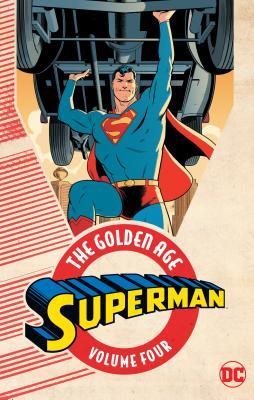
This is a review of Superman Golden Age Volume 4. Read my reviews of the first three volumes here, here, and here. One of the things that becomes clearer as I plow through these volumes is that Golden Age Superman is an odd duck. Exhibit A: Clark Kent and Lois Lane interview a fisherman who claims to have seen a mermaid. Since the fisherman is the type who thinks that aliens from Dimension X have reversed his brain, Lois doesn’t believe him. But Superman does. Why would he? Because Superman is the same type of weirdo as the fisherman. It all makes sense now!

Later in the same story, Superman crushes an undersea invasion of the surface world, which leads to massive casualties. At the time, there was a war going on in Europe. Reading this raises the question of what’s to stop Superman from flying into Germany and ending the war before lunch? Stories like this one are a case of hewing too close to reality. Speaking of which: a tale in this volume features an unscrupulous businessman stealing the rights from an inventor so that he gets rich and the creator doesn’t get a dime. Hey, did you know another multimillion dollar Superman movie came out?

Superman foe Lex Luthor is in four of these stories – five, if you count the Lightning Master tale. The Lightning Master sure looks like Luthor, but since the story ends with Superman executing him – Golden Age Superman does whatever he wants and faces no consequences – I assume the creators decided not to kill him. Good choice, since Luthor is the only villain who can make Superman break a sweat. Other standout villains in this volume include a hypnotist violinist and a big game hunter with a walk-in freezer who sure resembles a serial killer.

The creators have fun, which is great to see. They are writing the same three or four stories under insane deadlines, so why not? Many of the panels are funny or contain in-jokes. In one panel, Superman reads an issue of Action Comics. In another, Lois Lane – who switches from red to a canary yellow dress – is tied to a chair. Lois tips the chair over reaching a phone, where she screams at Clark Kent, who thinks she’s putting him on.

Superman’s cast continues to expand. This volume introduces Jimmy Olsen, cub reporter! Zach Snyder notwithstanding, Jimmy is still around today. Unlike Lois Lane, Jimmy has impulse control and doesn’t blindly barge into situations. On the other hand, he doesn’t have a godlike alien watching his every move. Lois steps on his back to enter a window, which says a lot about his place in the pecking order.

Credit goes to the creators for producing a wish-fulfillment comic for kids that still manages to be entertaining. I have enjoyed every one of these volumes. Recommended if you like Superman and Golden Age comics.

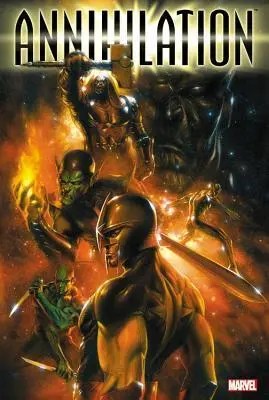
Annihilation Omnibus: Nova

This is a review of the Nova miniseries, written by Dan Abnett & Andy Lanning with art by Kev Walker, which appears in the Annihilation Omnibus. Read my review of the first volume, Drax the Destroyer, here. The Annihilation Wave is coming! What’s the Annihilation Wave, you may ask? In the Marvel Universe, there’s a place called The Negative Zone. The king of the Negative Zone is a bug thing named Annihilus, and the Annihilation Omnibus chronicles his invasion of our universe (The Positive Zone?).

This graphic novel features the adventures of Nova, aka Richard Rider, a member of the Nova Corps, which fyi isn’t ANYTHING like the Green Lantern Corps. The Nova Corps meet to discuss the impending threat of the Annihilation Wave, and five minutes later they are gone except for Richard and the Xandarian WorldMind, which uploads itself into his brain. This is good and bad – it boosts Richard’s powers, but he can’t handle all that data and eventually his monkey brain will pop like a zit.

Luckily Richard has Drax – who appeared in the first miniseries – to give him a helping hand. Drax has dropped the Destroyer moniker, but his specialty is still killing things, which is good because in this series there’s a lot of stuff to kill. Together, they escape the remains of Xandar and meet up with cosmic goodie two shoes Quasar, possessor of the coveted quantum bands. Too bad the Annihilation Wave is in hot pursuit.

Will Annihilus conquer the universe? How long can Richard hold out before his brain fries? And will the Xandarian WorldMind ever shut up? I read Annihilation years ago, and didn’t appreciate how much fun it was. That may be because most of the characters are obscure, and today – well, they’re still obscure, but that makes it more interesting. Annihilation was a huge gamble on Marvel’s part, and it paid off. Recommended for lovers of cosmic superheroics and space opera.