
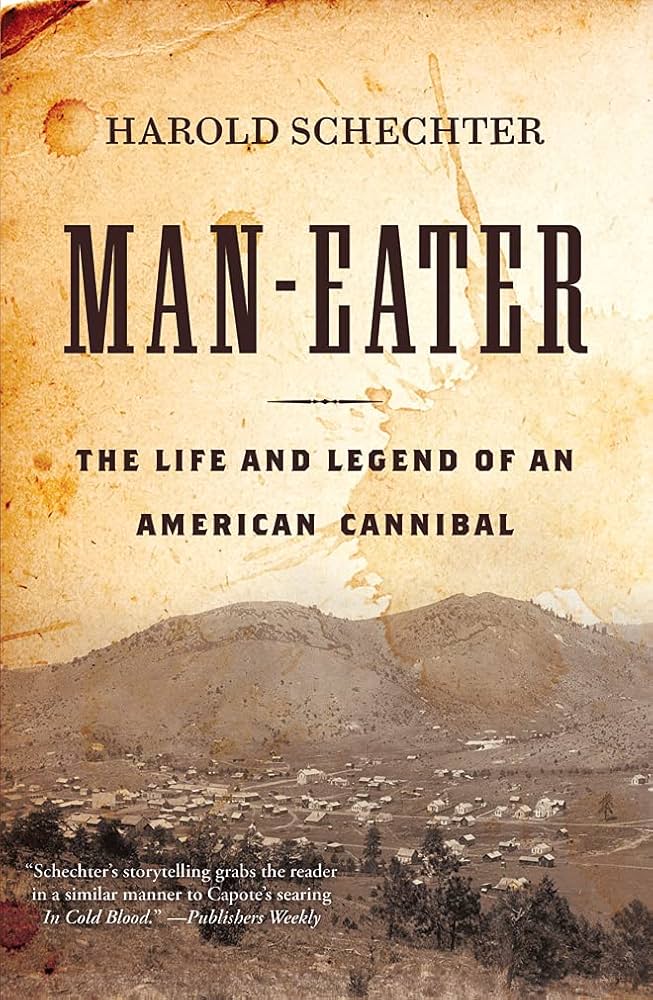
This is a review of Man-Eater: The Life and Legend of an American Cannibal, written by Harold Schechter. Ah, cannibals. If you want to get technical, use the term anthropophagy and watch people scratch their heads. We all know about the Donner Party, but there have been other cases of cannibalism, especially on the American frontier.
Consider the case of Alfred Packer, wilderness guide, Civil War veteran, and the sole survivor of a party of six prospectors intrepid or stupid enough to brave the Colorado wilderness. They set out in the winter of 1873-1874, got lost/stranded in the snow, and ran out of food. Mr. Packer claimed that a crazed butcher (the man’s real profession!) slaughtered the others while he was out searching for food, and then attacked him with an axe upon his return. Mr. Packer, who had a gun, killed the man and then hunkered down for the rest of the winter.
What can not be disputed is that Mr. Packer ate the remains of some of his fellow prospectors, because search parties found the evidence. Or to put it in the jargon of the newspaper reports of the time, HE FEASTED UPON THEIR CORPSES. Whether or not he committed a crime is a question, since he ate his fellow man to survive. History shows that he’s not alone in that, either.
Mr. Packer went to jail, but not for cannibalism. The charge that stuck was manslaughter. What was his motive? Well, theft. The prosecution pushed the robbery angle, although why anyone would subject themselves to starvation to commit a robbery makes no sense. Packer was brought to trial – several times – convicted, and sent to prison rather than being hanged. As time passed, the legend of the Colorado Cannibal grew.
The press took up his cause, including sob sister and gossip columnist Polly Pry. Back in those days, the press didn’t exactly have a savory reputation. Some things never change! One of the best scenes in this book is when a shyster lawyer shoots up a newspaper office, gets away with it, and is feted as a minor celebrity.
Packer was released, years later, and became a minor celebrity himself. He denied any wrongdoing until he died. He is portrayed as a tough, rather unsavory, man, with a striking appearance. People seemed to like or hate him. Did he kill his companions? I don’t know. Nobody does.
What do I think? Well, I doubt anyone considered murder until the food ran out. I also don’t believe that the party was taking a jaunt through the beautiful winter wilderness, making snow angels and catching snowflakes on their pink tongues, while all around them abundant game animals frolicked. The prosecution made this argument, btw. What happened is that they ran out of food and started eating their own boots, which is what you do when you are starving to death.
The other members of Mr. Packer’s group did not love him. He must have known that if it came to it, nobody would’ve bothered drawing lots; they would’ve eaten him first. He was convicted on circumstantial evidence, which means the prosecution had nothing but hearsay. Which doesn’t mean he’s innocent, it means the prosecutors managed to convince a jury he was guilty. Take that for what it’s worth.
If you like true crime, this is a great beach read. It’s entertaining as a slice of history, also, and reads like a potboiler. There are lots of great details from that time period, and the author has an engaging style. Recommended!
 Abandoned Places