
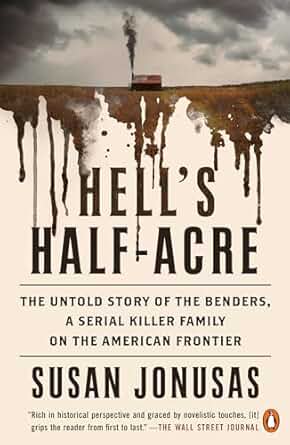
This is a review of Hell’s Half-Acre: The Untold Story of the Benders, a Serial Killer Family on the American Frontier, by Susan Jonusas. This review contains spoilers. I am not an expert on the Benders, and this book is my main (only) source of information. Gossip and conjecture aside, we do not know a lot about this family.
We do know that the Benders came to Kansas in 1870, when the new state was flooded with settlers. The family consisted of Ma and Pa Bender, a couple in their fifties who spoke mostly German. Kate Bender and John Gebhardt, in their early 20’s, might have been their children, or they might not have been even related. Eyewitnesses claim they saw ‘physical intimacy’ between them, so perhaps they were husband and wife. Or maybe those eyewitnesses were making things up after the fact.
The Benders lived in a one-room log cabin and sold groceries to travelers. Sometimes they killed those travelers by hitting them over the head with a hammer and slitting their throats. They buried their victims in the apple orchard and took their goods. After eleven murders – including a child, who was buried alive – the Benders fled Kansas and headed west, where they vanished into the frontier. They were never captured.
I do not think the term ‘serial killer’ describes the Benders. I’d call them opportunistic killers who murdered for financial gain. They didn’t have a ‘type,’ and neither I nor anyone else know if they derived psychological or sexual satisfaction from the murders. Yes, their modus operandi was brutal, but it was also efficient and minimized risk to the killers.
The killings spurred a press feeding frenzy, making it hard to separate fact from fantasy. In the aftermath of the murders, every person in Kansas seems to have encountered the Benders. To her credit, the author avoids speculation, although she does attribute thoughts and feelings to her characters, I’m assuming for dramatic effect.
The Benders were not criminal masterminds. They escaped justice by vanishing into the western frontier, which doesn’t exist anymore. Their pursuit was haphazard and disorganized, and that is putting it kindly. There wasn’t much in the way of law enforcement on the frontier, and people were all too willing to take the law into their own hands. One of the more vivid sequences of the book describes the lynching of a group of violent drunks and the attempted lynching of a neighbor of the Benders.
Hell’s Half-Acre is a good book that suffers from a paucity of content. Ms. Jonusas cannot interview eyewitnesses, so she relies on primary sources while avoiding speculation. This works for and against the author. The book reads as historically accurate but is sometimes limited in scope. The description of the discovery of the bodies at the Benders’ cabin is a visceral eye-opener. The same holds for the description of what passed for a manhunt.
After that, the Benders simply vanish and the book loses steam, shifting to the arrest, trial, and eventual acquittal of two women accused of being Ma and Kate Bender, years later. The trial scenes go on too long and belong in another book, but it isn’t the author’s fault that the ending is anticlimactic. Sometimes stories fade out instead of ending with a bang.
The Benders are fascinating in the same way as car crashes – people gawk with their mouths open, but stay safely in their cars. The fate of the central players of this drama remains unresolved, and not knowing adds a certain mystique to what is a sad and gruesome story. In the end, the Benders’ final fate is lost to history.
 Abandoned Places