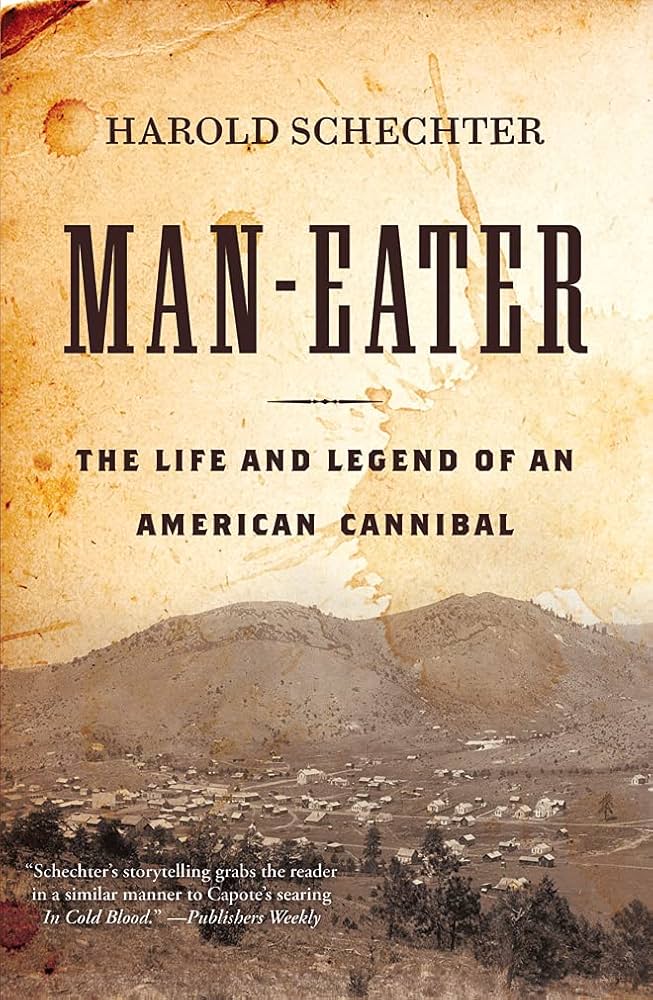
Man-Eater: The Life and Legend of an American Cannibal

This is a review of Man-Eater: The Life and Legend of an American Cannibal, written by Harold Schechter. Ah, cannibals. If you want to get technical, use the term anthropophagy and watch people scratch their heads. We all know about the Donner Party, but there have been other cases of cannibalism, especially on the American frontier.

Consider the case of Alfred Packer, wilderness guide, Civil War veteran, and the sole survivor of a party of six prospectors intrepid or stupid enough to brave the Colorado wilderness. They set out in the winter of 1873-1874, got lost/stranded in the snow, and ran out of food.  Mr. Packer claimed that a crazed butcher (the man’s real profession!) slaughtered the others while he was out searching for food, and then attacked him with an axe upon his return. Mr. Packer, who had a gun, killed the man and then hunkered down for the rest of the winter.

What can not be disputed is that Mr. Packer ate the remains of some of his fellow prospectors, because search parties found the evidence. Or to put it in the jargon of the newspaper reports of the time, HE FEASTED UPON THEIR CORPSES. Whether or not he committed a crime is a question, since he ate his fellow man to survive. History shows that he’s not alone in that, either.

Mr. Packer went to jail, but not for cannibalism. The charge that stuck was manslaughter. What was his motive? Well, theft. The prosecution pushed the robbery angle, although why anyone would subject themselves to starvation to commit a robbery makes no sense. Packer was brought to trial – several times – convicted, and sent to prison rather than being hanged. As time passed, the legend of the Colorado Cannibal grew.

The press took up his cause, including sob sister and gossip columnist Polly Pry. Back in those days, the press didn’t exactly have a savory reputation. Some things never change! One of the best scenes in this book is when a shyster lawyer shoots up a newspaper office, gets away with it, and is feted as a minor celebrity.

Packer was released, years later, and became a minor celebrity himself. He denied any wrongdoing until he died. He is portrayed as a tough, rather unsavory, man, with a striking appearance. People seemed to like or hate him. Did he kill his companions? I don’t know. Nobody does.

What do I think? Well, I doubt anyone considered murder until the food ran out. I also don’t believe that the party was taking a jaunt through the beautiful winter wilderness, making snow angels and catching snowflakes on their pink tongues, while all around them abundant game animals frolicked. The prosecution made this argument, btw. What happened is that they ran out of food and started eating their own boots, which is what you do when you are starving to death.

The other members of Mr. Packer’s group did not love him. He must have known that if it came to it, nobody would’ve bothered drawing lots; they would’ve eaten him first. He was convicted on circumstantial evidence, which means the prosecution had nothing but hearsay. Which doesn’t mean he’s innocent, it means the prosecutors managed to convince a jury he was guilty. Take that for what it’s worth.

If you like true crime, this is a great beach read. It’s entertaining as a slice of history, also, and reads like a potboiler. There are lots of great details from that time period, and the author has an engaging style. Recommended!
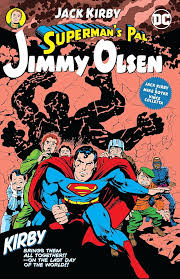
Superman’s Pal, Jimmy Olsen

This is a review of Superman’s Pal, Jimmy Olsen written and drawn by Jack Kirby. When people discuss Mr. Kirby’s DC work, they will usually talk about Kamandi or The Demon, reviewed here and here. I’ve never heard a word about this graphic novel, which is a shame. This book, which showcases Superman alongside an ensemble cast, is first-rate science fiction.

What about that ensemble cast, anyway? We have Clark Kent, the Newsboy Legion, the Golden Guardian, who is a clone – no, not of Captain America – as well as that freckled young cub reporter, Jimmy Olsen himself. The Newsboy Legion features five kids who have a vehicle called the Whiz Wagon, based on the Fantasti-Car, that can fly and is also amphibious. The kids are interchangeable, except for the one who dresses in scuba gear all the time, which won’t bode well after he hits puberty.

The plot revolves around The Hairies, a secret group of super-intelligent vat grown humans who live inside a mountain and drive around in a missile carrier disguised as a monster. They’re guarded by a biker gang and are doing top secret experiments on the human genome, backed by the U.S. government and Superman. In the 1970’s, that wasn’t considered unethical; today, there would be collective apoplexy.

Jimmy Olsen and the annoying – I mean youthful – members of the Newsboy Legion investigate. They tangle with the biker gang, and Jimmy automatically becomes head honcho when he punches out their leader. Jimmy Olsen, Biker, is only one of the many startling transformations in store for the reader. We also have Rampaging Jimmy Olsen, transformed by science into a mean green killing machine that doesn’t resemble the Incredible Hulk – NO, NOT AT ALL – and Neanderthal Jimmy Olsen.

Sound weird? Wait until the scene where everyone drops acid, including Superman, that Head Square Himself. Oh, Kirby gives us some nonsense about a solar phone, but this is his version of an acid trip. Anyway, Olsen and company discover that The Hairies are fiddling with human DNA, making all matters of chimera, including tiny Jimmy Olsens! At one point we look through a microscope to see the tiny Olsens, each wearing a pair of tighty whities.

Darkseid, rightfully deciding the world isn’t ready for that much Jimmy Olsen, sends the most incompetent cat’s paw in the DC Universe to destroy the Hairies. Media mogul Morgan Edge spends all his time trying to kill Jimmy Olsen and the Newsboy Legion. While they are annoying, he could just fire them instead, but I guess I’m missing something.

Other stories include a villain who lives in a volcano, a Scottish Lake Monster, and a miniature planet full of Count Dracula lookalikes that makes TOTAL SENSE when explained. We also have a story starring Don Rickles and his twin, which may have been funny when it was released, but somehow I doubt it.

Nobody in this graphic novel has anything resembling a personality, but that’s my only quibble. Mr. Kirby was a genius, and is allowed a misstep here and there. Highly recommended!

The Treasure of Abbot Thomas

This is a review of the short story The Treasure of Abbot Thomas, written by M.R. James and first published in the collection Ghost Stories of an Antiquary. Going forward, I will be reviewing one horror short story/novel per week in addition to my graphic novel reviews. If there is anything specific people would like to see (more graphic novel reviews, horror movie reviews, etc.) please let me know.

A scholar and man-of-means goes on a treasure hunt that starts out exciting, if you call translating Latin texts, examining stained glass windows, and deciphering code exciting. Since he’s a scholar, it is to him! Others may not find this section to be as thrilling. The adventurous academic toddles off with his manservant to the abbey where the treasure is hidden, where he meets something he doesn’t expect, and that’s when the story picks up steam.

The main character is a scholar who is over inquisitive. James’ protagonists are not men of action. They are steeped in academia, amateur historians, antiquaries, college professors. All are curious, overstep, and pay a price. After encountering the supernatural, his protagonists always come away marked. Many die.

By today’s standards, this story is overwritten with an awkward frame, and I don’t think anyone over the age of nine will find it scary. On the other hand, it is atmospheric and spooky in parts, mainly because of the description of the monster. Mr. James reveals his creation in interesting ways, using senses besides sight and sound. The toad-guardian is described by touch (leathery) and smell (mold).

Because of pacing issues, The Treasure of Abbot Thomas isn’t one of James’ stronger stories, but it is still worth a read, especially if you enjoy ghost stories. The BBC produced a TV adaptation in the 1970’s, which is now streaming on Shudder. Recommended!

Star Wars: Darth Vader

This is the first part of a review of Star Wars: Darth Vader by Kieron Gillen (writer) and Salvador Larroca (art). The events of this graphic novel take place after the Death Star’s destruction by a young Rebel pilot named Luke Skywalker, i.e. between A New Hope and The Empire Strikes Back.

Darth Vader uncovers a plot to usurp him orchestrated by…the Emperor? Turns out Palpatine isn’t happy with his disciple, and is searching for his replacement(s). Is Vader’s time with the Empire coming to an end? Anyone familiar with the first trilogy knows the answer, but it’s still fun to watch him spar with his doppelgangers in a series of fast-paced issues.

Darth Vader himself is cold, calculating, and methodical. It’s interesting, but in many ways he reminds me of Judge Dredd. In this volume, it’s revealed that he can also be subtle. He has no choice. When the one person more powerful than you is your boss, you need to be sneaky. Many of Vader’s victims get what’s coming to them, but an equal number have done nothing but be unlucky enough to get in his way. If there’s one thing this series drove home for me, it is that Darth Vader is not redeemable.

The first half of the graphic novel climaxes in a close encounter with our favorite band of rebels, Skywalker, Solo, and Leia. The creative team gifts us with grotesque parodies of our lovable heroes and heroines. Triple Zero and BeeTee-One are murder-Droids, Black Krrsantan is a homicidal Wookie, and Dr. Aphra is Han Solo. I read these issues knowing that nobody important would die, but still had a lot of fun.

If Vader is the bad-ass, his counterpart is Dr. Aphra, who throws in her lot with him early and becomes his cat’s paw, despite knowing that her lifespan is limited to her usefulness. Aphra is the most interesting character in this graphic novel. She reminds me of a Han Solo who shoots first and always makes the wrong choice. Despite having the glimmerings of a conscience, she is as bad as Darth Vader.

Interestingly, of the two I find Vader to be the more sympathetic character. If someone is going to kill me, I’d prefer they just get it over with and not mope about it. Accept what you are; maybe even lean into it a little! Final verdict: this is the best Star Wars comic I’ve ever read and as such is highly recommended.

Nosferatu the Vampyre (1979)

This is a review of Nosferatu The Vampyre (1979), directed by Werner Herzog and starring Klaus Kinski and Isabelle Adjani. I rewatched this movie to see how it compared to the newest version of Nosferatu, now in theaters, but that’s another post. The plot: Jonathan Harker leaves his wife Lucy, traveling from Wismar, Germany to Transylvania to consummate a real estate deal with an eccentric count. Beforehand, he stops at the local inn, where in time-honored fashion the locals beseech him not to go.                

Spoiler: Harker goes. He walks to Borgo Pass, where a buggy with black horses takes him to the castle, which is a ruin. He’s met by Count Dracula himself, played by noted thespian and homicidal maniac Klaus Kinksi. Mr. Kinski is grotesque. He can pass for human – barely. His features are rodentlike, including a pair of jutting incisors. It’s a wonderful makeup job. The good Count only appears at night, speaks in a low voice, and seems depressed. Who wouldn’t be depressed, living in a shitty old castle for hundreds of years?                

After signing the contract, Dracula leaves Harker behind and travels to Wismar by ship, bringing rats, stormy weather, and the plague. Harker manages to escape, but part of him dies on the journey home. When he exits Dracula’s castle he is still human, but he loses his humanity on the journey back. The man is gone, replaced by something else.                

Dracula arrives in Wismar. The plague hits. The action shifts from Harker to his wife, Lucy. Dracula wants Lucy, but gives her agency. By agency, I mean he doesn’t just take her when she rejects him. The choice is hers. This is one of the more interesting parts of the movie. Does Dracula leave her be because of an obscure vampire rule? He has taken hundreds of men, women, and children against their will. What makes Lucy different? I will be honest with you, reader. I have no idea.

The plague worsens. The Count’s coming brings death and mayhem, and he can’t even bring himself to care. He’s dead, after all. The living do care. There is a scene towards the end, when Lucy walks amongst the revelers celebrating their last supper after the plague has ravaged the city. You can tell what she’s thinking: this can’t go on. Will goodness triumph, or will darkness cover all? Since this is a Werner Herzog movie, who knows?

Nosferatu might not move quickly enough for people, especially horror fans. It’s slow and brooding. The scenery is wonderful, lots of forests, canals, mountains, and old, decrepit castles. This is a monster movie that seems real. It has focus, and part of that is because of the level of detail. People have argued that the scenes inside Dracula’s castle are dreamlike, but I disagree. When Harker awakens after his night with the count, he finds the breakfast table crowded with food, including an unplucked chicken.

The problem is that reality is awful. Nobody knows this more than the Count, who I would argue is looking for an excuse to die. By not taking Lucy, he gives her the means to end his existence – if she has the belly for it. Spoiler: she does.

Recommended!

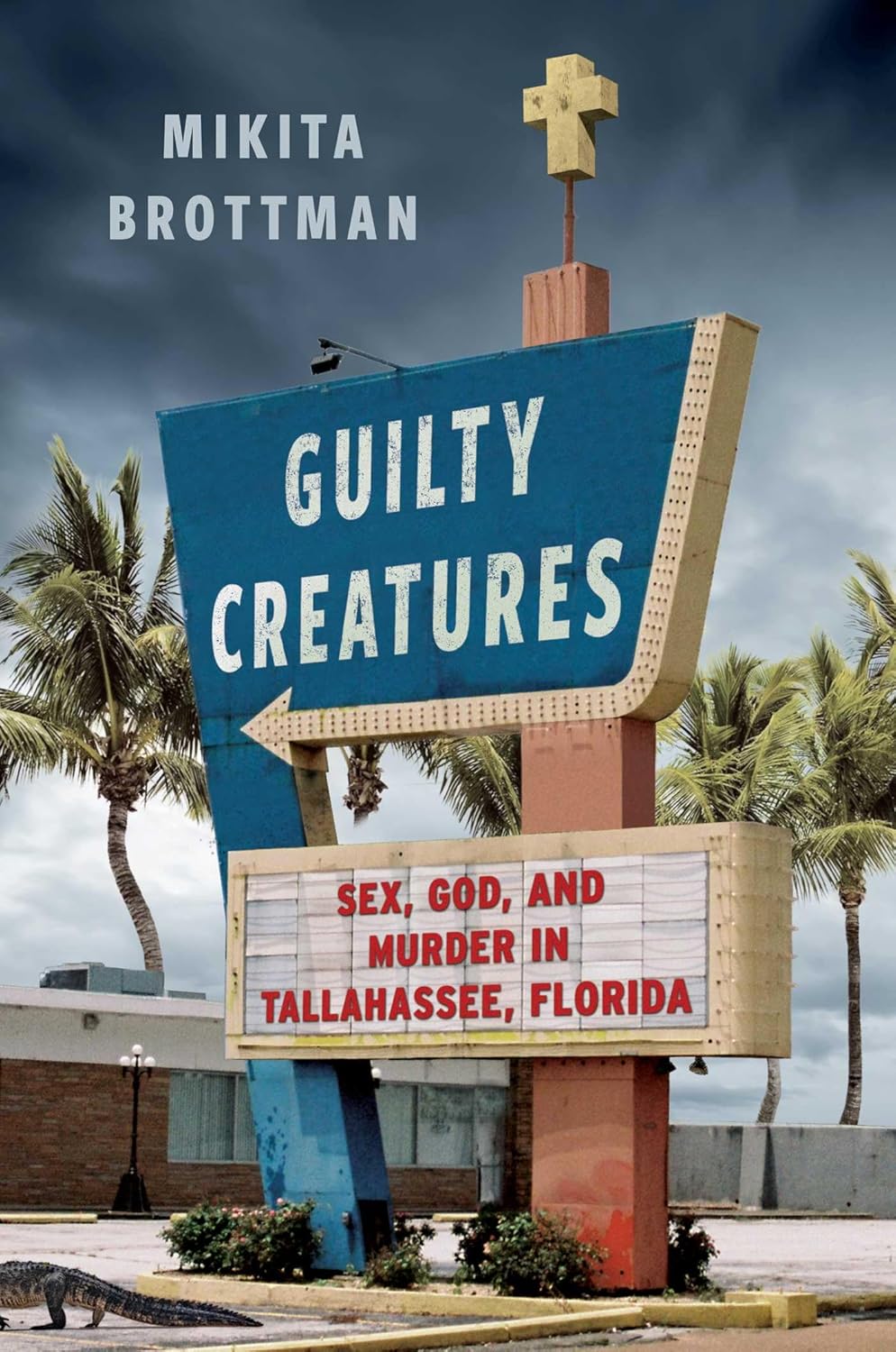
Guilty Creatures: Sex, God, and Murder in Tallahassee, Florida

This is a review of Guilty Creatures: Sex, God, and Murder in Tallahassee, Florida by Mikita Brottman. Please note that this review contains spoilers. The facts of this case are well-known, but the Devil – as they say – is in the details. If you don’t want to know, or don’t want to read about a fairly gruesome murder, read no further.

This book is about two couples who live in a religious community in the suburbs of Tallahassee. Mike – who did not grow up wealthy – spends most of his time working and neglects his wife (Denise), so she starts hanging out with his best friend Brian, who is having his own problems with his wife (Kathy). Brian and Denise start an affair. She doesn’t want to get divorced, so they start talking about devising a ‘test of God’s will.’

This ‘test’ involves Brian luring Mike out to a lake to go duck hunting and then pushing him off the boat. If he sinks, it’s God’s will. Since Brian and Denise believe that a person wearing duck waders will always sink, it’s not much of a test. Mike doesn’t sink, so he passes. Brian shoots him in the head anyway, drags his body into his truck, stuffs his corpse into a dog crate to control the bleeding, and then drives home. After which, he goes to Home Depot to purchase a shovel, tarp, & weights, and buries his best friend’s body in an unmarked grave.

The obvious question is, why didn’t Mike and Denise get divorced? People end relationships all the time and for all sorts of reasons, but mostly it boils down to money and compatibility, or lack thereof. People who aren’t God’s chosen are allowed to drift apart or even dislike each other. Sometime people discover they aren’t compatible, because reasons (insert your own). It’s when you deny those reasons because you are thinking about God’s will or God’s plan that you can run into problems.

Before Mike is murdered, he takes out two life insurance policies. Denise cashes in on both of them, and this is what catches the eyes of the authorities. Brian divorces his wife and marries Denise a few years later. The authorities suspect, people talk, and Mike’s mother won’t give up trying to find her boy. But none of that is the reason they are in prison today.

Brian and Denise get to a point where they can’t stand each other. Yes, there’s that compatibility thing again. When Denise divorces Brian, he kidnaps her at gunpoint and threatens to kill himself. This is a serious crime, especially in Florida. Denise asks the prosecutor for a life sentence, which is when Brian confesses. He gets a lenient sentence of twenty years behind bars. Denise, who was not involved in the actual execution of the murder, gets thirty years. Did she deserve thirty years? I do not know. This is a fairly recent case, which means that most of the people involved – families and friends – are still around, so it wouldn’t be right to speculate.

Ms. Brottman does a good job recounting the source material and getting the known facts of the case correct. She is a therapist, and will sometimes psychoanalyze her characters. Because ultimately that’s what they are, characters she invented. Please note that I am not saying Ms. Brottman made them up. We all have biases and prejudices, so our view of certain people is always going to be fictional to a degree.

For example, Brian is depicted as a jealous manchild with too much money. He doesn’t need to work, and fills the empty holes in his life with porn. There is less information about Denise, which makes her more of a tabula rasa. When a person seems like a blank slate, people will project. Some observers of the trial viewed Denise as an evil mastermind or puppet master. Maybe that’s true, or maybe she just wanted to block the whole thing out. She didn’t share Brian’s desire to confess, that’s for sure, and she’s not a big crier. So what?

I have no idea about ‘tests’ or ‘God’s will.’ To me, this book seems to be about obsession and human frailty. The author quotes the Bible and James M. Cain, the author of Double Indemnity and The Postman Always Rings Twice. Ultimately, this is a story about a pair of lost souls who are drawn to – and ultimately destroy – each other.

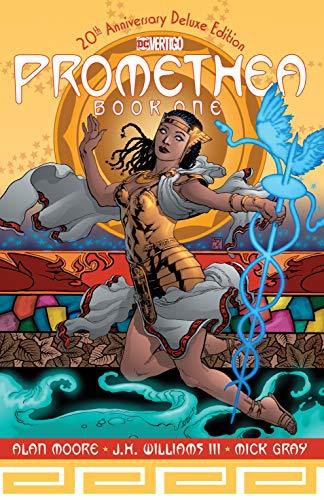
Promethea 20th Anniversary Deluxe Edition Volume One

This is a review of Promethea 20th Anniversary Deluxe Edition Volume One by Alan Moore (writer) and J.H. Williams III (art). Content warning: there is a consensual sex scene between two adults in this volume that people may find upsetting because of the gap in their ages. The setting is gritty near-future New York City, but this is fantasy and not science fiction – unless you consider magic to be science.

Promethea is a living story who flies and wields a glowing blue caduceus composed of a pair of talking snakes. Her alter ego, a college student named Sophie Bangs, is writing a term paper about Promethea and unwittingly becomes her new host after meeting Barbara Shelley (the old host). They encounter a Smee, which Promethea destroys, but this is just a warning shot. Sophie needs to learn magic, fast, before Hell’s legions come calling. Throughout the ages, there have been other Promethea hosts. Sophie travels to the Immateria to meet them, but still needs a teacher in the material world.

There is a lot of exposition about magic here, so be prepared. An entire issue is spent on the topic.  Unfortunately, after reading this I still do not understand magic, but I will say it seems very complex. Promethea spends most of her time flying around blasting people with her magic caduceus, and I’m unsure what is so complex about that, but I’m no wizard.

Sophie approaches Jack Faust, who is a wizard. He agrees to teach her magic on one condition. He wants sex…with Promethea. Keep in mind that we’ve seen the tragic fate of people who dare to love Promethea, and it’s not pretty. Neither is Jack Faust, who is portrayed as old, unattractive, and creepy, complete with a gross apartment. They have sex, which takes up an entire issue (20+ pages for non-comic readers).

I will be honest here. If I knew about the sex scene, I wouldn’t have reviewed this graphic novel. I am not defending or condemning, except to say that this scene has an ick factor through the roof and will upset people. I am sure Mr. Moore knew this. Since Jack Faust is a magician, Moore could have portrayed him as young and handsome (Faust even mentions using a glamour), but he makes the choice not to. Unfortunately, the sex scene is what most people will recall after reading this and will thus dominate the discussion, making it difficult to talk about the graphic novel’s other virtues and flaws.

Yes, what about those virtues and flaws? As I stated, there’s too much exposition about magic. The storytelling is great, because plotting has always been a strength of Mr. Moore’s. The art is phantasmagoric; too bad I can’t post visuals. I read this graphic novel virtually, but if it seems like something you might enjoy, I suggest that you buy the actual physical book.  

And that’s my review.

Hell’s Half-Acre: The Untold Story of the Benders, a Serial Killer Family on the American Frontier

This is a review of Hell’s Half-Acre: The Untold Story of the Benders, a Serial Killer Family on the American Frontier, by Susan Jonusas. This review contains spoilers. I am not an expert on the Benders, and this book is my main (only) source of information. Gossip and conjecture aside, we do not know a lot about this family.

We do know that the Benders came to Kansas in 1870, when the new state was flooded with settlers. The family consisted of Ma and Pa Bender, a couple in their fifties who spoke mostly German. Kate Bender and John Gebhardt, in their early 20’s, might have been their children, or they might not have been even related. Eyewitnesses claim they saw ‘physical intimacy’ between them, so perhaps they were husband and wife. Or maybe those eyewitnesses were making things up after the fact.

The Benders lived in a one-room log cabin and sold groceries to travelers. Sometimes they killed those travelers by hitting them over the head with a hammer and slitting their throats. They buried their victims in the apple orchard and took their goods. After eleven murders – including a child, who was buried alive – the Benders fled Kansas and headed west, where they vanished into the frontier. They were never captured.

I do not think the term ‘serial killer’ describes the Benders. I’d call them opportunistic killers who murdered for financial gain. They didn’t have a ‘type,’ and neither I nor anyone else know if they derived psychological or sexual satisfaction from the murders. Yes, their modus operandi was brutal, but it was also efficient and minimized risk to the killers.

The killings spurred a press feeding frenzy, making it hard to separate fact from fantasy. In the aftermath of the murders, every person in Kansas seems to have encountered the Benders. To her credit, the author avoids speculation, although she does attribute thoughts and feelings to her characters, I’m assuming for dramatic effect.

The Benders were not criminal masterminds. They escaped justice by vanishing into the western frontier, which doesn’t exist anymore. Their pursuit was haphazard and disorganized, and that is putting it kindly. There wasn’t much in the way of law enforcement on the frontier, and people were all too willing to take the law into their own hands. One of the more vivid sequences of the book describes the lynching of a group of violent drunks and the attempted lynching of a neighbor of the Benders.

Hell’s Half-Acre is a good book that suffers from a paucity of content. Ms. Jonusas cannot interview eyewitnesses, so she relies on primary sources while avoiding speculation. This works for and against the author. The book reads as historically accurate but is sometimes limited in scope. The description of the discovery of the bodies at the Benders’ cabin is a visceral eye-opener. The same holds for the description of what passed for a manhunt.

After that, the Benders simply vanish and the book loses steam, shifting to the arrest, trial, and eventual acquittal of two women accused of being Ma and Kate Bender, years later. The trial scenes go on too long and belong in another book, but it isn’t the author’s fault that the ending is anticlimactic. Sometimes stories fade out instead of ending with a bang.

The Benders are fascinating in the same way as car crashes – people gawk with their mouths open, but stay safely in their cars. The fate of the central players of this drama remains unresolved, and not knowing adds a certain mystique to what is a sad and gruesome story. In the end, the Benders’ final fate is lost to history.

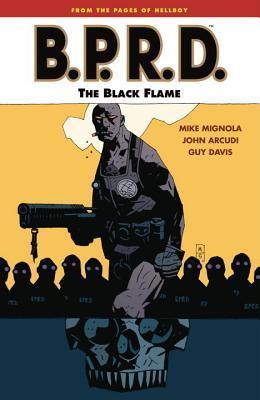
B.P.R.D.: The Black Flame

This is a review of B.P.R.D.: The Black Flame, the fifth volume of this series. Read my reviews of the first, second, third, and fourth volumes to catch up. B.P.R.D. stands for Bureau of Paranormal Research and Defense, and its members consist of Liz (firestarter), Roger (golem incubated in horse manure), Johann (friendly ghost), Abe (fishman), and Ben (dead man walking).

In this volume, the war on frogs continues. By frogs, I mean enormous frogmen. Roger the golem has become a tough guy, just like his idol Captain Ben Daimio. Both have heads hard as rocks, so they have a lot in common. Liz meets a mysterious figure in her dreams who stuffs cryptic warning notes down her throat, which she spits out upon awakening. Abe Sapien mopes about his undead wife, and then rejoins the team. Not a lot happens with Johann in this volume, but his time is coming. Oh, and a team member dies.

However, the star of this volume has to be Landis Pope, a corporate CEO who dons a cape and tights – a fantasy of corporate CEOs everywhere, although it’s unclear if they’d be superheroes or villains – and starts referring to himself as The Black Flame. He trains a pair of captured frogmen to talk and releases them into the frogs’ lair in the hopes that they will worship him.

Or something like that. Mr. Pope is out of his mind, so it’s tough to tell what he wants. Why would any sane human being want to wipe out humanity and rule over a bunch of frogmen? The Black Flame’s plan works, sort of. The frogs tell their frog friends, who use him to summon a creature that looks like it’s out of Pink Floyd’s The Wall movie (art courtesy of the great Guy Davis). Afterwards, the Frog Men keep the Black Flame alive as their prisoner, just in case the monster he’s just summoned wants lunch.

I suppose there’s a lesson to be learned from this, but I’m unsure what it is. Frogmen are smarter than you think, maybe? Anyway, another great entry in a great series, and as such highly recommended.