
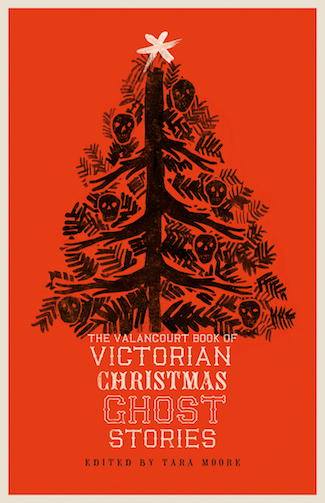
I am reviewing tales from The Valancourt Book of Victorian Christmas Ghost Stories for the month of December in honor of the holidays. Read my review of The Tapestried Chamber, here. This is a review of Horror: A True Tale, published anonymously. Contrary to what I said in my first review, this story is set during Christmas.
A well-to-do young woman celebrates the Yuletide holidays with her loving family. Her house is so crowded with love (and people) she has to sleep in a disused part of the house. Unfortunately, an escaped lunatic bursts into the bedroom and collapses on the bed. He grasps her sleeve so that she can’t get away. In the morning, she does gets away, but she’s aged decades from the shocking incident and her facial features are disfigured, although the lunatic didn’t touch her face. Her fiancée leaves her and she is now shunned by polite society, although it’s not clear if society shuns her, or if she does the shunning herself.
Unlike The Tapestried Chamber, this is a scary story. People still tell variations of this tale today, mostly in urban legends – the man with a hook for a hand, the babysitter and the maniac, etc. We have a deep-rooted fear of being alone or isolated…and then realizing we aren’t really alone.
This story has yet another layer. The narrator’s life is ruined by this event. I think it’s likely that the lunatic – who is depicted as being all-too real – did more than just grab her sleeve. The narrator seems to be stained from the experience. Is her disfigurement of the body or the mind? Did her features change that much, or did her supposed friends and family believe her to be tainted?
Anyway, this seems like a very modern story to me. It reads like an amalgam of morality tale and psychological horror, but what makes it stand out is the psychological horror. True, the language is archaic, but a sense of doom hangs over the tale. The author does a good job of foreshadowing (the butchered ewes!), and I also liked the addition of the nasty old great-aunt who might know more than she’s telling. The narrator herself is decidedly unreliable.
I doubt the Victorians viewed sexual assault as a topic for a ghost story. However, they as a society were obsessed with purity. Elements of this story seem to bear the mark of a morality tale – others try to turn the narrator from her chosen path (her sisters want her to spend the night with them!), but she ignores them and pays the price. What was her sin? Pride? Not being able to foretell the future?
Wait, I know: she slept in a bed not her own! I am being serious, here. The symbolism fits, but from a literal/logical point-of-view it makes no sense. However, horror is not about logic. Horror is all about how the world isn’t safe, how things don’t make sense, how bad things can randomly happen. Yes, it’s true: sometimes your life can be ruined by doing something as simple as sleeping in the wrong bed.
Recommended!
 Abandoned Places