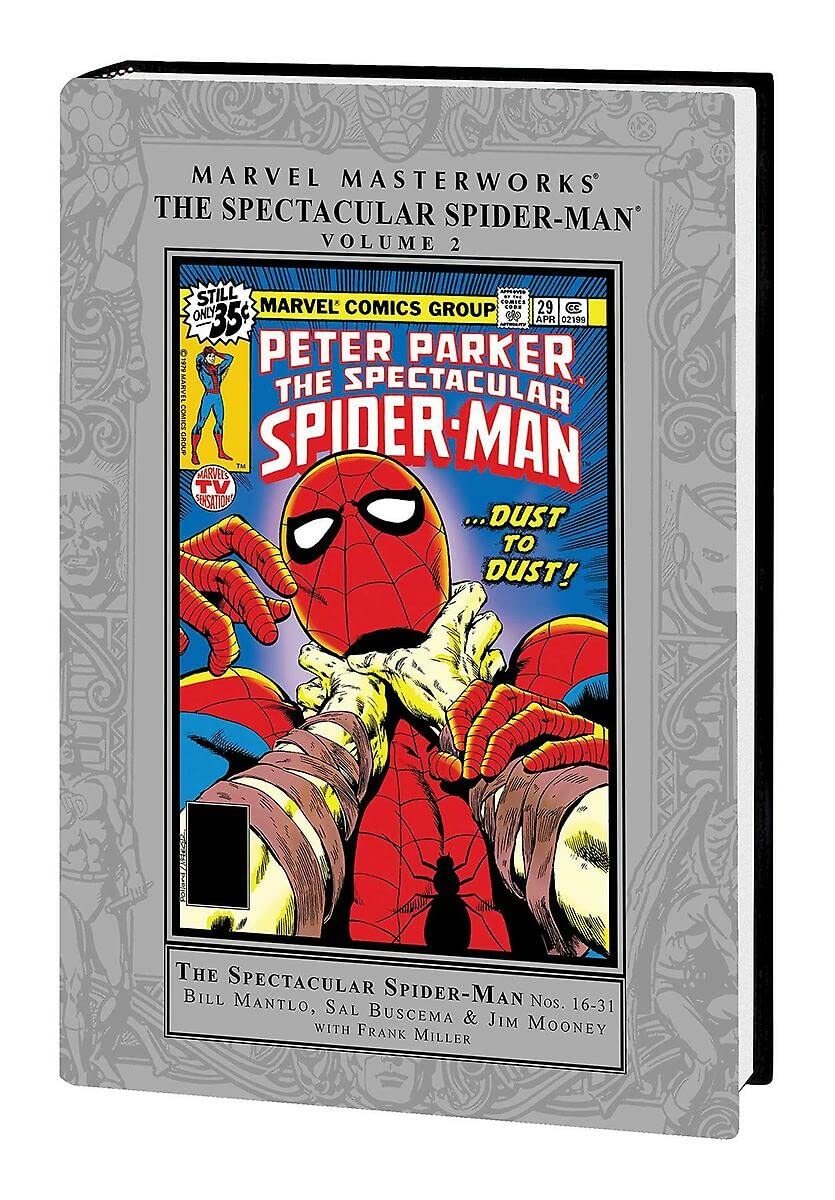
Marvel Masterworks Peter Parker The Spectacular Spider-Man Volume Two

This is a review of Marvel Masterworks Peter Parker The Spectacular Spider-Man Volume Two. I read the first volume a few years back, but didn’t review it. This Spider-Man title features the art & writing team of Sal Buscema and Bill Mantlo, although Mr. Buscema didn’t draw everything in this volume. The issues are quick reads, as are so many Marvel titles of that time period (late 1970’s).

Mr. Mantlo wrote a lot of comics, many of which I’ve read. He also created lots of characters. In two volumes of Spectacular Spider-Man, he created Razorback, The White Tiger, Carrion, Spider Amoeba, and the Hypno-Hustler. Sure, there’s a few misses (read: Hypno-Hustler), but Mr. Mantlo also created characters such as Rocket Raccoon, who went on to star in the Guardians of the Galaxy movies.

This is a normal Spider-Man title for that time period. We have shorter story arcs, and an overarching storyline involving the Maggia that percolates for most of the volume. Peter goes to California, fights a brainwashed Iceman, and then battles the Masked Marauder and his dumb android. Coincidentally, I first read about The Masked Marauder and his dumb android earlier this month in Daredevil, reviewed here, but this time the character is handled a whole lot better, because Mr. Mantlo is not pulling plot points out of his ass. We have an appearance by Daredevil and Moon Knight, and last but certainly not least – the debut of the Spider Amoeba, which to my knowledge doesn’t survive more than a single issue. This is a real shame.

Frank Miller did some of the artwork, here, which is exciting. We also have a sneaky reference to Peter Parker having sex. Since the comic creators of that time couldn’t show the characters actually having sex, they used hints and tasteful cutaway scenes, and – well – at twelve years old I wasn’t a very astute reader. I spent my first thirty-plus years reading superhero comics convinced that none of them ever had sex. My attitude can be summed up by a scene in Brian Bendis’ New Avengers run, when Wolverine refers to his son and Spider-Man says – ‘wait a minute. You’ve had sex?!’ That was my reaction, sort of, when I finally read between the lines.

This graphic novel won’t set the world on fire, but it’s a fast, fun read from an underrated writer.

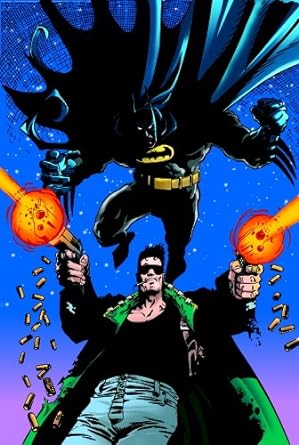
Tales of the Batman: Steve Englehart

This is a review of Tales of the Batman: Steve Englehart. I bought a bunch of Batman graphic novels over the holiday season. I’ve read and liked parts of Mr. Englehart’s West Coast Avengers and Green Lantern runs in the 1980’s, so I took a chance.

Reader, I was not disappointed. Mr. Englehart wrote the Joker Fish storyline, which apparently is famous even though I’ve never heard of it. Before this point, I’d never even heard of Silver St. Cloud. I don’t quite get why this run is so obscure, because Mr. Englehart has a unique take on the character. It might be because his original run on Batman is blink-and-you’ll-miss-it short, running eight issues in the 1970’s – but he makes those issues count. Mr. Englehart introduces a new villain, Dr. Phosphorous, and brings back two older villains (Dr. Hugo Strange and Deadshot) in an interesting way.

He also writes an awesome Joker. The Joker Fish storyline starts with the Clown Prince dumping toxic chemicals into the bay, which produces smiling fish. The Joker decides to cash in by copyrighting his Joker Fish, which means anyone eating a fish sandwich will owe him $$$. He then commences killing any bureaucrat that refuses to grant him the copyright.

And then there’s Silver St. Cloud, the love interest I’d never heard of. That might be because Mr. Englehart goes where few Batman writers have dared. Silver & Bruce start to date, and when it gets serious she figures out his secret identity. She leaves him, for a variety of reasons, and doesn’t return for 30 or so years (real time, not comic time), when the storyline is resolved – sort of.

As I’ve said, portraying Batman as an adult human being with certain, uh, needs, seems to be taboo amongst Batman writers. This is sad, because if you read more than two issues of Batman it becomes obvious that he really needs to get laid. So why doesn’t he? The simple explanation is the one Mr. Englehart went with. Batman declared war on crime as a boy, on a boy’s terms, which leaves no room for love. The simpler explanation, which is the one I go with, is that Batman is mentally ill.

I mean, whatever. Mr. Englehart pulls off the feat of having Batman be in a serious relationship with a woman that feels real, and it is additive rather than reductive to his character. The culmination of their affair occurs when Batman says something stupid, because he has no idea how to talk to women. This makes senses, as anyone who spends their nights dressed up as a bat will almost certainly lack basic social skills. The storyline as written in this volume feels unfinished, and I’m almost afraid to Google Silver St. Cloud’s name, as the easiest solution is to fridge her.

An underrated run that spans over three decades.

Hitman: A Rage in Arkham

This is a review of Hitman: A Rage in Arkham. Garth Ennis, the writer of Hitman, is notorious. In this volume, you get PG-13 Garth because this is a superhuman comic. Superhuman, not superhero. Tommy Monaghan has X-ray vision and he can read minds. He is also a hitman who does hits on superhumans. Deep down, Tommy is portrayed as a decent guy with a sense of honor, even though he’s not. You can take this as sly meta-commentary, or just treat it like good stupid fun. Since many 90’s comics can be described as just stupid, this was and continues to be a standout title.

Tommy is hired to kill the Joker in Arkham Asylum. This leads to an encounter with Batman and a ten-armed hellfiend called The Mawzer. The best part of this volume is when Monaghan does a bunch of side-jobs in Arkham for beer and pizza money. Tommy also goes on a date, and reads her mind to discover what kind of food she likes. Hey, it beats cyber-stalking. Oh, and he throws up on Batman’s shoes.

This title works best when it is the equivalent of an action movie. From my recollection, the earlier part of this series is a lot of fun but goes downhill in later volumes, but we will see. Monaghan’s sense of honor amounts to only killing what he considers to be the bad guys. He’s written as a decent guy with a tough, blue-collar job. Like most of us, he worries about money, but he wouldn’t dream of using his newly found mind-reading powers to sell Batman’s secret identity to the highest bidder.

The trick to writing Hitman – and any other title featuring The Punisher, The Vigilante, or any other character whose main occupation is murder – is to portray the character as street smart rather than a homicidal maniac/serial killer, and have the villains be so scummy they always deserve what they get. This is also the formula for the billion or so buddy cop movies I watched in the 80’s.

Recommended!

Marvel Masterworks Daredevil Volume Three

This is a review of Marvel Masterworks Daredevil Volume Three. You can read my reviews of the first two volumes here and here. Thus far, this series has been uneven. I can sum up this particular volume in four words: great art, awful writing. Matt Murdock takes his identity hijinks to the next level when he starts pretending that he has an identical twin brother named Mike Murdock.

Matt tells Foggy Nelson and Karen Page, his law partner/friend and secretary/potential lover, that Mike is Daredevil and not him. Apparently they believe him, even though Matt and Foggy roomed together in college and Matt never mentioned having a twin brother. Oh, and Matt and Mike are never in the same room. Writer Brian Michael Bendis adapted some of this material as fodder for his own Daredevil series, where DD’s secret identity is treated as an open secret and he’s portrayed as an out-and-out narcissist.

In this volume, Matt’s antics are portrayed as funny – I guess? To me, it seems a little weird to be lying to friends, coworkers, and potential lovers. This seems like the type of storyline a kid might find funny. The Cobra/Mr. Hyde storyline starts out dopey, with Daredevil swinging around Manhattan dressed as Thor, but becomes interesting when Mr. Hyde manages to deaden DD’s other senses. Unfortunately, the climax of this storyline strains credulity.

On the plus side, we have the debut of the Leap Frog, another great weirdo Daredevil villain. The Leap Frog dresses up in a green frog costume and hops around as he robs banks. He joins the Stilt Man, The Owl, The Gladiator, and The Purple Man in the pantheon of Daredevil’s rogue gallery. Verdict: you can see the holes in the writing a mile away, as the writer is so obviously phoning it in, and the art can only take this series so far.

For Daredevil completionists only.