The House That Dripped Blood

House That Dripped Blood

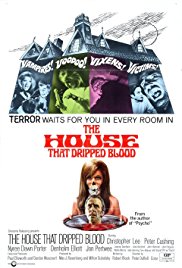
The House That Dripped Blood is one of those movies that sits around on your watch-list forever. You keep meaning to watch it, but never do. Well, I finally watched it yesterday! This 70’s British horror anthology comes from Amicus, not Hammer, but stars a number of Hammer stalwarts such as Peter Cushing, Christopher Lee and Ingrid Pitt. Written by Robert Bloch, The House That Dripped Blood’s frame story is about an inspector investigating the latest in a series of bizarre happenings at a house.

There are four tales. In the first, a horror writer and his wife rent a house in the countryside. He’s writing a potboiler about a strangler terrifying the countryside and needs inspiration; pretty soon he has all the inspiration he can handle. The second story is about a retired bachelor (Peter Cushing) who wanders into a Wax Museum of Horrors, where he sees a waxwork figure who is the spitting image of his dead lover.

The third yarn concerns a widower (Christopher Lee), his young daughter and the woman he hires as a nanny. Mr. Lee displays a strange aversion towards his own child, even throwing her doll into the fire, an act he later lives to regret. The fourth story is my favorite. An over-the-hill horror actor (played by a scenery-chewing Jon Pertwee) is on the prowl for a decent cape. He finds the perfect cape, which – unfortunately for him – belonged to a real vampire.

I’m sure The House That Dripped Blood didn’t cost a lot of money. I liked it, though! The stories are decent and all contain Twilight Zone twists, but believe me when I say you’ve seen it before. I do like the fact that Mr. Bloch doesn’t try to convey any sort of moral message. Be warned that some of the outfits the stars wear might give you sun glare.


The Living Dead Girl

Living Dead Girl

Living Dead Girl is a return to form for director Jean Rollin. After viewing the disappointing Iron Rose months ago, I worried that the master was losing his touch. I needn’t have fretted; Living Dead Girl is vintage Eurotrash, chockful of sex, violence, gore and nudity.

Three movers haul barrels of toxic waste into a chateau’s crypt. They are in the process of robbing the dead people in said crypt when an earthquake smashes the barrels, releasing toxic fumes into the air. Catherine, who has been dead for two years but still looks great, revives and manages to kill the movers in the bloodiest way possible (poking out eyes, fingers through the throat) without staining her white dress.

Cut to a pair of American tourists. We know they’re Americans because they’re loud assholes who speak English. What else could they be? They’re in a field arguing when the wife snaps a picture of Catherine, who is staggering around in a daze. At this point I was wondering what the hell the plot was going to be, but I needn’t have worried. Many of Mr. Rollin’s movies begin with the characters running/staggering about.

Catherine ends up back in her chateau. She’s wearing white and the walls are deep red, so the symbolism isn’t exactly subtle. The next victims are the chateau’s realtor and her boyfriend, who decide to spend a dirty weekend at the chateau. They get naked in record time, but their lovely moment is interrupted by a ravenous Catherine, who kills and eats them.

A side note: I’m not sure if Catherine is a vampire, a zombie or the Toxic Avenger’s little sister. I’d say a zombie except we see a bat during one of her kill sequences, which makes me think vampire. Anyway, Catherine snaps out of her funk when she hears the voice of Helene – her friend/lover – on the phone. Mr. Rollin is uncharacteristically coy about the particulars of their relationship, but it must have been intense, because Helene is the engine that drives the plot.

Helene rushes to the chateau. Instead of taking Catherine to a hospital or calling the police, she lovingly washes the blood off her friend’s naked body and then hides the bodies of her victims in the crypt. When Catherine gets hungry Helene goes in search of food. Unfortunately, Catherine eats people.

Living Dead Girl is one of the better Jean Rollin movies I’ve seen this year; it ranks up there with Fascination and The Grapes of Death. The sets and scenery are lovely, interspersed with short bursts of over-the-top gore that would make a giallo director proud. Yes, Living Dead Girl is skimpy on plot, but that’s okay. If you like Eurotrash, it doesn’t get much better than this.


The Mothman of Point Pleasant

Point Pleasant, West Virginia. From November 1966 to December 1967 hundreds of people saw a flying creature with a pair of red glowing eyes and a wingspan of over ten feet. The Mothman of Point Pleasant does not tell us who dubbed this creature the Mothman. I am assuming it was an enterprising reporter or perhaps John Keel, who wrote a book called The Mothman Prophecies.

The sightings quickly escalated, with the Mothman chasing teens in their cars, the Mothman hanging out at the abandoned TNT factory, the Mothman peering through windows. The filmmakers give us footage of a number of credulous-sounding locals describing their close encounters with the Mothman. One man saw the Mothman by the side of his bed, and when he thought of the blood of Christ the Mothman went away.

The sightings went on for months, evolving from Mothmen to UFO sightings, Grinning Man encounters and culminating in the city of Point Pleasant being invaded by the Men in Black. The sightings ended after the Silver Bridge collapsed ten days before Christmas 1967, resulting in the deaths of 46 people. Unfortunately, some have tried to link the Mothman to this horrible tragedy; fortunately, the filmmakers do not make this connection.

If – like me – you don’t know much about the Mothman, The Mothman of Point Pleasant is informative and entertaining. It’s obvious the filmmakers are true believers, so keep that in mind. They speculate about mutant birds and the Indian chief who was murdered by the white settlers and supposedly cursed Point Pleasant, and gloss over the fact that there were hundreds of eyewitness sightings and nobody ever managed to snap a picture. Many eyewitnesses state that the Mothman looked like a big bird, with a few insisting that it was a barn owl. I tend to think that’s the most likely explanation, but realize that people are going to believe what they want to believe.

What was the Mothman? A barn owl? An extraterrestrial? A demon from Hell? A case of mass hysteria? We will never know. But there is now a Mothman Museum and a Mothman Festival, which takes place every year on the third weekend of September. So the Mothman lives on…


Varan the Unbelievable

VARAN

Varan the Unbelievable is a Japanese rubber-suit monster movie made in 1958. The version I saw was the chopped-up American remake (1962), ala Raymond Burr’s Godzilla. Interestingly the monster’s name seems to be Obaki, not Varan the Unbelievable, but whatever.

Commander James Bradley sets up base at an isolated Japanese island. He wants to do experiments on the isle’s saltwater lake, using a chemical to convert saline to fresh water. Even though everyone in the movie thinks this is a bad idea the tests still go on. At his wife’s urging, the Commander decides not to evacuate the villagers who, you know, live there. The American version portrays the Commander sympathetically; apparently the Commander doesn’t even appear in the Japanese version, which seems to have a different plot.

The villagers believe a monster lives in the lake. In a plot twist everyone sees coming, said monster lurches out of the lake when the chemical sinks in. Varan has spikes running down his back and looks like a cross between Godzilla and Anguirus. Sometimes the Unbelievable One walks on four legs, sometimes on two. He destroys the village and then heads for a larger city – in the American version it’s Oneida – to demolish, because that’s what monsters do.

The Commander and his wife get stuck in a Jeep, and spend the final act of the movie trying to radio the city and tell them about the magic chemical that can kill Varan. Varan attacks the city, but flees when the magic chemical is detonated in his face. The Commander and his wife leave for Southern California, leaving the villagers to rebuild their shattered lives.

The best part of Varan the Unbelievable is Varan, who is freaky-looking. There’s a sequence in the 1958 version where the Unbelievable One flies or glides through the air like an enormous squirrel. That was cut in the American version (even though it appears in the trailer), which is only 67 minutes. Some of the movie’s other cuts don’t make sense (who was the guy driving the truck?), but this version of the movie is a cheapo so it doesn’t really matter.

Bottom-line: I enjoyed Varan the Unbelievable, but it’s for connoisseurs of Japanese monster movies only.